Most museum visitors know the rule “look, but don’t touch,” but where does that leave people who are blind or have low vision? As museums work toward increasing accessibility, many are exploring the incorporation of tactile images, or three-dimensional objects designed to be interpreted through touch. While audio tours — such as those available on Bloomberg Connects — offer biographical information on artists and interesting insights behind specific artworks, tactile images communicate visual details through a modified hands-on experience.
Art education students from the University of Georgia recently explored the impact of tactile images at the museum. At the end of the spring semester, students were challenged with generating “intervention projects,” or arts-based responses that visually engage with the social issues raised by the course.
Mallory Lind, the museum’s associate curator of community engagement and outreach, gave the class a presentation on museum accessibility and representation to introduce them to tactile works. Lind has created several tactile replicas of artworks from the museum’s collection. Classmates Charlotte Ransom, Carrigan Haney and Braylon Pritchett decided to investigate the impact of tactile works more deeply through their intervention project. They found that tactile works resonated with themes discussed in class, especially professor emeritus of art education at the University of Illinois Paul Duncum’s concept of multimodality.
“[Duncum’s work] challenged the idea that art can only be experienced visually and emphasized that meaning can also be communicated through touch, texture and physical interaction,” said Ransom.
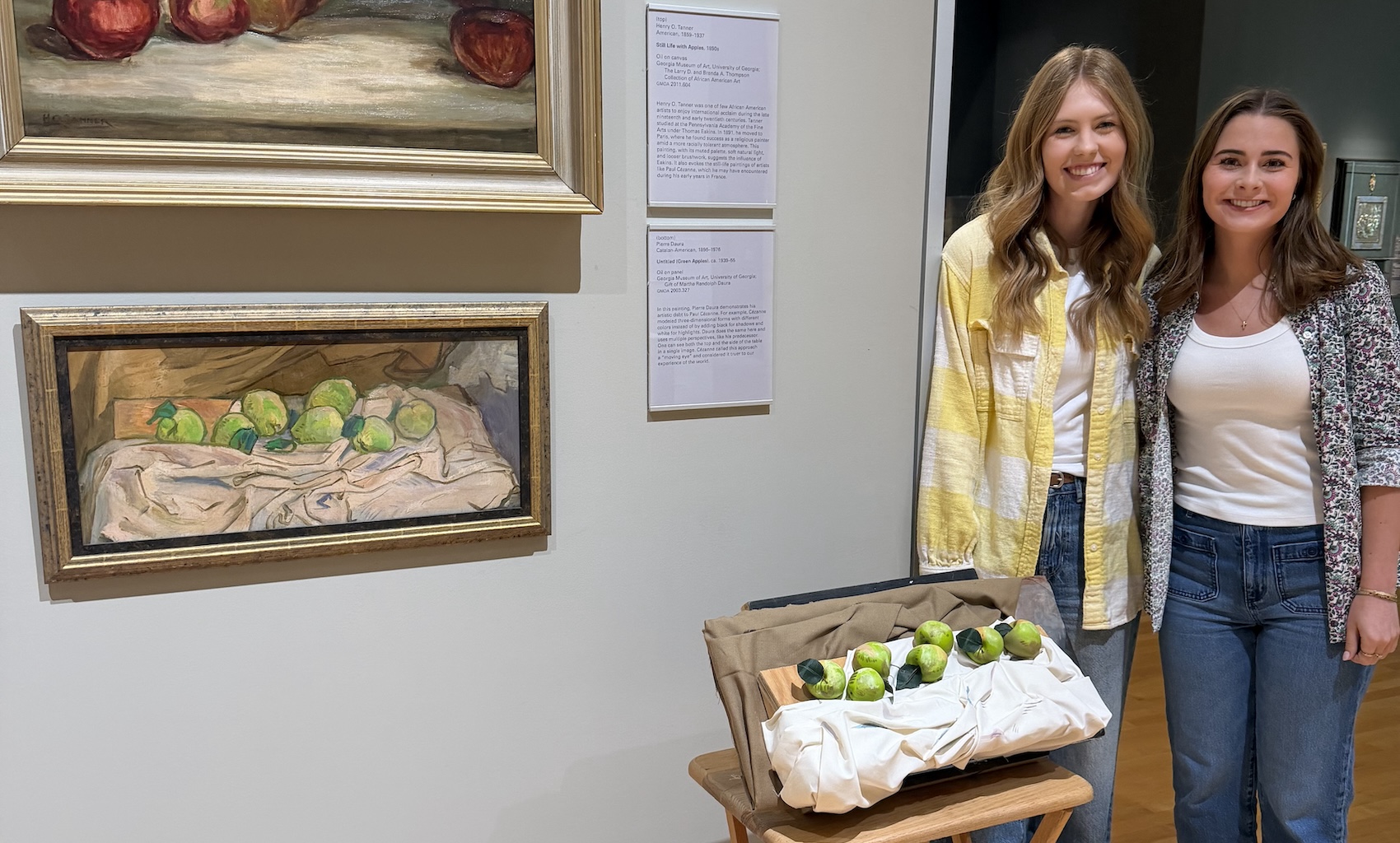
Haney, Pritchett and Ransom selected Pierre Daura’s oil painting “Green Apples,” on display in the museum’s permanent collection galleries, as inspiration for their three-dimensional model. The still life depicts seven bright green apples strewn across a small wooden table covered with a cream-colored tablecloth. The students not only paid close attention to the placement of the apples and folds of the fabric but to the weight and textures of their craft materials so that the model would be as life-like as possible.
“Our goal was not only to create a tactile representation of the painting, but also to maintain its visual integrity,” said Ransom. “Since visual impairment exists on a spectrum and is rarely completely total, it was important that the piece could be appreciated both visually and through touch.”
The students displayed their three-dimensional model next to Daura’s original painting in the gallery during Sunday Slowdown, a day-long program that included guided meditation, tai chi, a sound bath, a mandala workshop and restorative yoga. Visitors were encouraged to scan a QR code to provide feedback about their experiences interacting with the tactile work.
While tactile images are traditionally designed to engage visitors who are blind or have low vision, they also create multi-sensory, hands-on learning experiences that a broad audience can enjoy. Survey results noted both their ability to increase accessibility and their potential to foster more meaningful connections for all museum visitors. The museum’s learning and engagement department also uses tactile replicas as instructional tools for young children to deepen engagement and aid cognitive understanding of art.
“Through this project, my group members and I learned that accessibility extends far beyond simply being able to physically enter a space,” said Ransom. “Forms of accessibility such as tactile engagement are often overlooked, even though they can significantly impact how people experience art and public spaces. This project encouraged us to think more empathetically and become more aware of the diverse needs of museum visitors.”
Authored by:
Jessica Smith