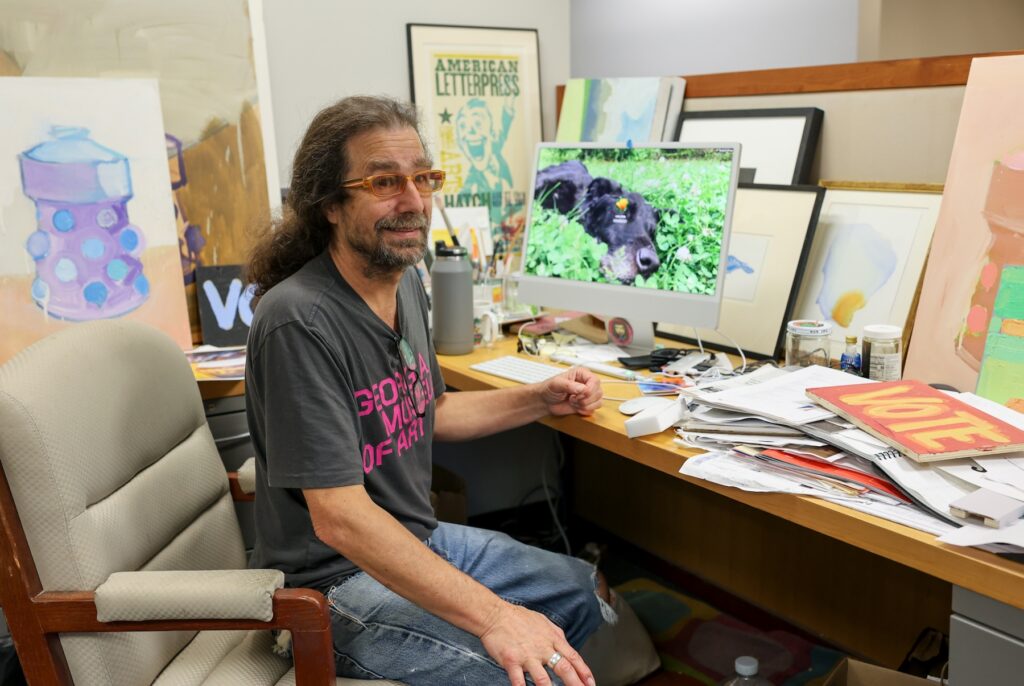
Recently, the Georgia Museum of Art, under the guidance of its curator of American art Jeffrey Richmond-Moll, reinstalled its Nancy Cooper Turner Gallery. The project was part of the museum’s ongoing reinstallation of its permanent collection galleries, which it is undertaking one at a time over a couple of years. With each gallery reinstalled, the museum hopes to bring new perspectives and new critical approaches to its collections.
Richmond-Moll explained that his goal was to “bring out and highlight the longstanding strength of the collections and new acquisitions, and to show works that have not been on display for quite some time.”
The reinstallation of Turner allowed certain artists, like John Rogers, a chance to shine. “The Favored Scholar,” a sculpture(opens in new tab) by Rogers, is now on display in the gallery after undergoing conservation. Rogers mass-produced his pieces, painting them to mimic the surface of terracotta to make them appear handmade despite being produced in a factory-like workshop. He sold paint alongside his sculptures, encouraging people to touch up their personal collections. Part of the purpose of reinstalling the galleries is to integrate various perspectives and types of media into the story of art history, including work by 19th-century African American artists in this case. Cabinetry by Thomas Day and storage jars made in the workshop of Thomas Chandler illuminate this perspective. Chandler’s workshop enslaved women, who would apply glazes to his pottery and contributed to the whimsical and floral motifs on the vessels.
Besides highlighting never-displayed art and various perspectives, the reinstallation of the Turner Gallery also opened the door for a new way to display works of art. The museum has employed a salon wall, on which work is packed from floor to ceiling, allowing it to be displayed in a new context. This style of displaying art originated in France and became a model for public exhibitions. Through a salon wall, the museum is able to mimic a method of displaying art traditional to the period in which the pieces were made, while putting the works from Europe in conversation with American art. The salon wall also changes the way most modern museum visitors experience art. Rather than in a linear progression with each piece isolated, the works are presented to the viewer all at once.
Works removed from the Turner Gallery are receiving much-needed attention from conservators. Not only are these pieces being stabilized, but they are also being studied. One exciting discovery during this process is the history of William Partridge’s bust of a woman, which is, in fact, a sculpture of the Madonna that Patridge used as a study for his sculpture of Mary and Christ in St. Patrick’s Cathedral in New York City. George F. Peabody owned this bust and was a major donor to the University of Georgia.
There are often different philosophies on the function of permanent collections, specifically, whether they should be static or living installations. Richmond-Moll subscribes to the latter philosophy, as he believes a flexible and open permanent installation is important. “The challenge of a permanent collection,” Richmond-Moll said, “is that you don’t know how it will change over time, so you have to allow for displaying new acquisitions.” Richmond-Moll said he is committed to having pieces in communication with one another, rather than segregated within certain sections, and it is his goal to keep improving the ways the museum looks at art across all its collections.
Authored by:
Emma Emery