This summer, the Georgia Museum of Art has been hosting a series of workshops anchored by Julie Green’s “The Last Supper,” an installation on view in the Phoebe and Ed Forio Gallery through August 16. Through these workshops, which are supported by a learning and engagement grant from Art Bridges, the museum has provided a space for conversation around justice, ritual and empathy.
“We are deeply grateful to Art Bridges for their generous support of our learning and engagement programming around Julie Green’s ‘The Last Supper,'” said David Odo, the museum’s director and chief curator. “This grant has allowed us to bring meaningful conversations about justice, empathy and shared humanity to a wide range of participants — from university students to individuals in carceral institutions — and to extend the reach and impact of this powerful work well beyond the gallery walls.”
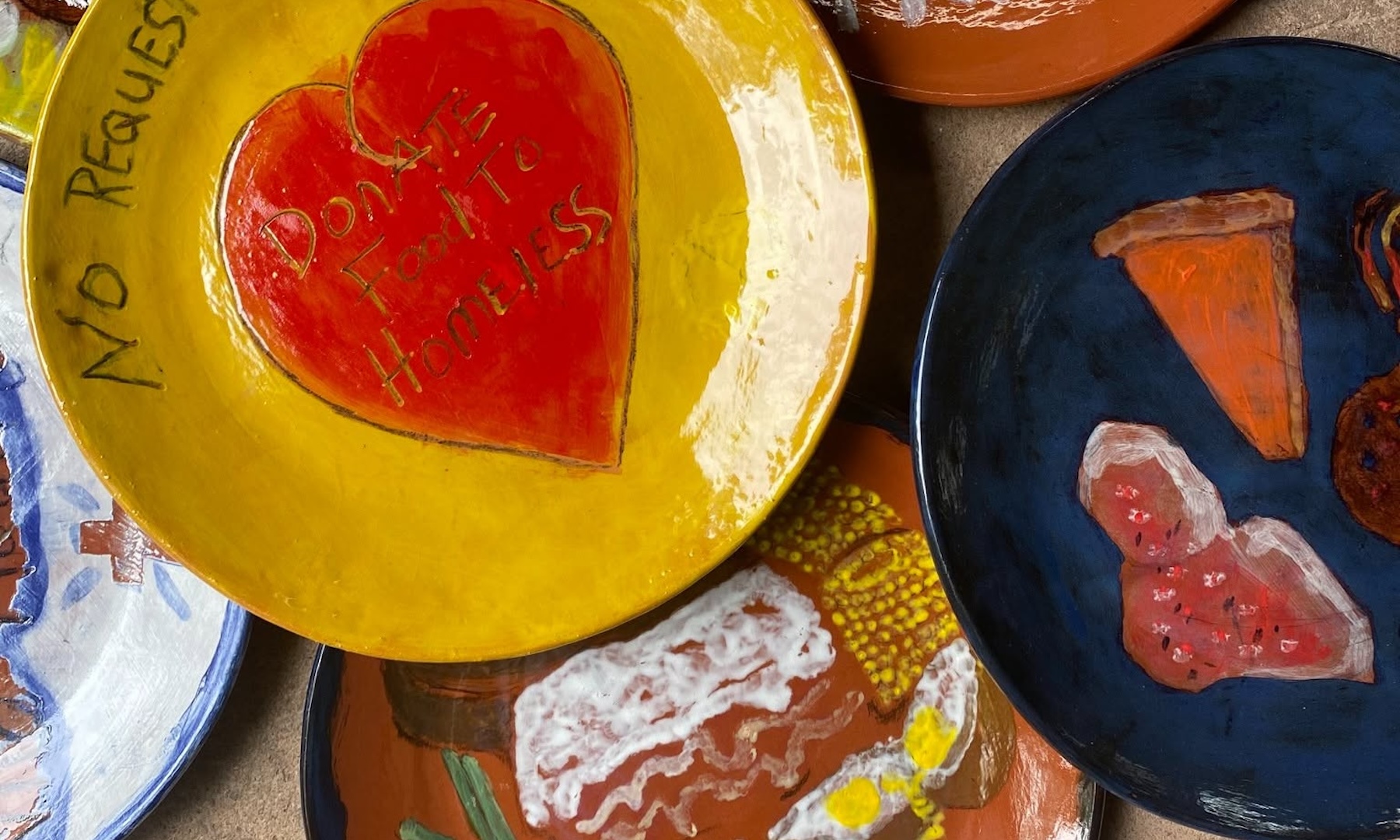
“The Last Supper” is a collection of secondhand ceramic plates, each painted with the last meal of an incarcerated person on death row. Green, who died in 2021, began the plates in 2000, inspired by a death row order from Oklahoma: six tacos, six glazed donuts and a cherry Coke. This meal puzzled Green due to its specificity and the irrationality of the tradition of last meals. They said, “Food is sustenance, food is community, food is sharing ideas with friends and family, it’s a celebration, it’s joy, and even if it’s eaten alone, it’s still a ritual. I have much gratitude for the good food in my life, and this death row meal just stood in such contrast to that.”
Green added 50 plates per year, with the goal to stop at 1,000 painted plates, or until the U.S. abolishes capital punishment, whichever came first. The 1,000th plate was completed in September 2021, one month before their death.
To extend the impact of the installation, the museum has been hosting workshops led by Callan Steinmann, the museum’s director of learning and engagement, and teaching artist Kristen Bach. These workshops begin with careful viewing of the exhibition, which includes 377 plates representing the Southeast region, and discussion of its themes. Then each participant paints a ceramic plate to explore their views on justice, rituals and connection. The museum then transports the painted plates to R. Wood Studio, in Athens, for firing, before returning them either to the artists or to their families. The museum has completed about 10 workshops so far, with several University of Georgia classes and two carceral institutions participating.
Georgia has a particularly interesting relationship with incarceration and capital punishment, as a state with one of the highest incarceration and execution rates in the country. Though the museum was unable to physically bring the ceramic plates from the gallery to inmates, Steinmann says the conversations at participating carceral institutions have “been really powerful.” Whether with students or incarcerated individuals, the goal of the discussions stays the same, she said: “to invite participants to learn about Green’s work, share their perspectives with others in the group, discover their own meaning and find connection to the art and one another. Green’s series acts as a catalyst, giving us an opportunity to engage in deep thinking and conversation about some difficult topics.”
The workshops leave participants with a deeper understanding of how both artmaking and museums can help navigate complex topics. Through thoughtful conversations and deep engagement with the work, participants develop an expanded understanding of art’s capacity to communicate sensitive social and political issues. One participant said, “Our conversations around the artwork prompted reflections on brandings of people, and how those labels enmesh people within dispassionate, dehumanizing systems. For me, it highlighted the humanizing potential of art, and affirmed the use of dialogic methods and visual arts.”
The workshops have created a unique space to interact and engage with the themes of Green’s work, and explore the intersection of art and activism. Steinmann said, “I’ve been struck by the openness, thoughtfulness and care that participants bring to both the gallery conversations and the art-making.” Navigating their own interpretations of the work, participants have been able to consider these issues from a different perspective and have those conversations. Steinmann said, “For me, Green’s work is fundamentally about empathy and helping us tap into our shared humanity, and so getting to experience firsthand the depth of responses from visitors from all walks of life has been very meaningful.”
The museum will also host a discussion of “The Last Supper” on August 13 at 5:30 p.m. with Jessica Haywood, clinical associate professor at UGA’s School of Law, and museum director David Odo.
Authored by:
Paige Carter