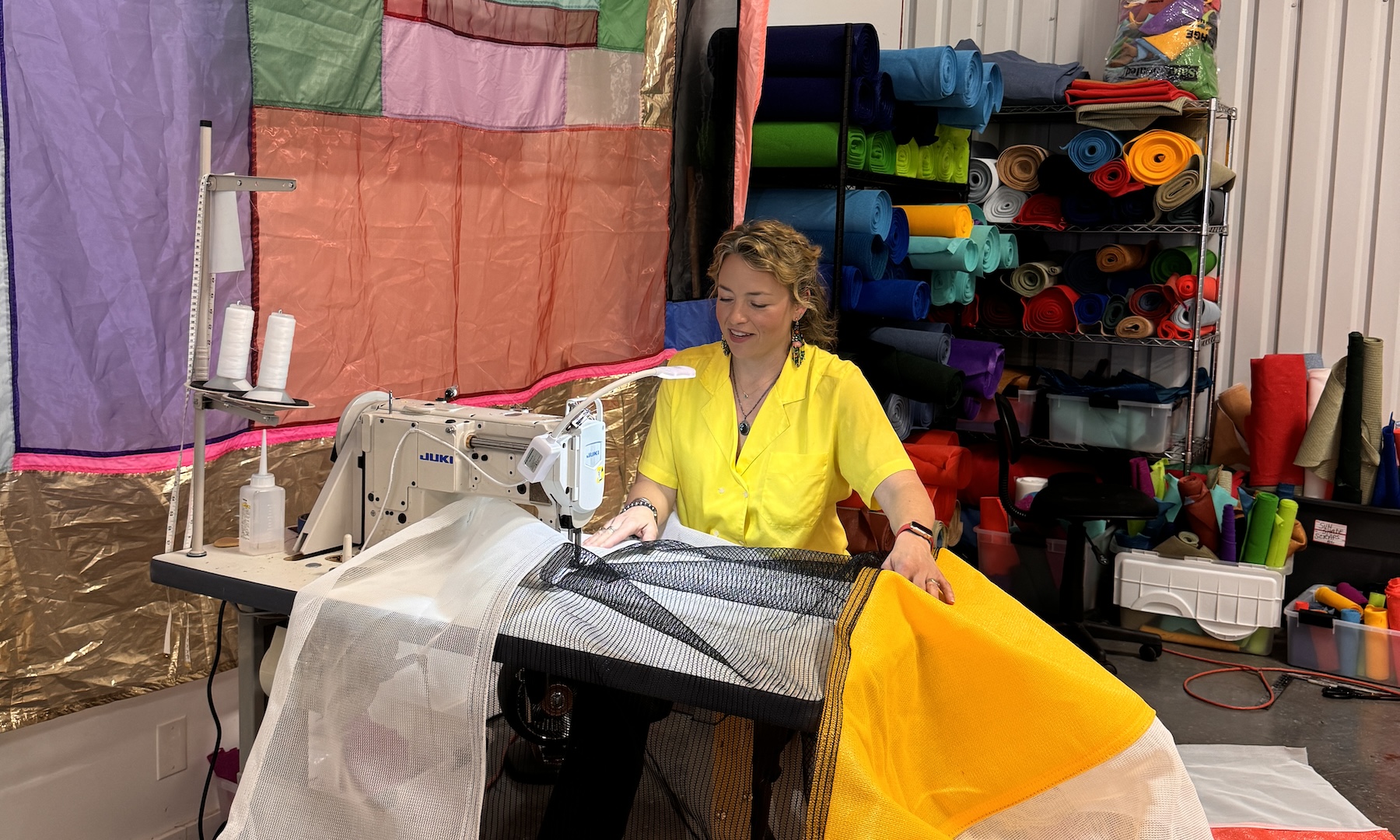
Commissioned for the Georgia Museum of Art’s Jane and Harry Willson Sculpture Garden, the color-field canopies in “Looking Through a Sewn Sky” balance craft and contemporary landscape-based art. In the following Q&A with public relations intern Nabiha Rahman, Rachel Hayes shares insight into her creative process and sources of inspiration.
Georgia Museum of Art: How do principles of abstract painting — such as color, composition and movement — influence your design process? How do they show up in your work?
Rachel Hayes: For this particular installation the museum wanted me to reference some of the pieces in the collection, and they are all abstract. I can go through them and kind of explain what I’m drawn to in each of these pieces and how I’m referencing them. How about that?
Sounds good.
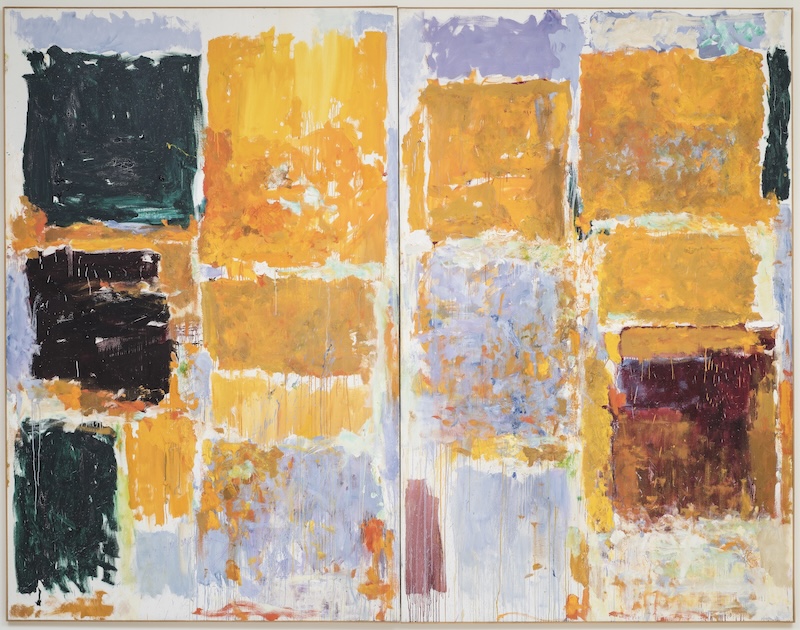
All right. So, this is a Joan Mitchell painting — it’s called “Close.” I love this color combo, the yellow next to purple next to a dark green or turquoise. Sometimes when you put colors together, it’s really pleasing to the eye. And then sometimes when you throw in an “off color” it makes you kind of curious, like, why did I do that? Why did they do that? But in the end, it actually makes something a little bit more interesting to look at. I’m not saying that this is what’s happening in her painting, but when I’m putting it through my filter and my colors that I use, it kind of feels like, okay, now it’s time to try to fit that turquoise in. And I don’t know if it wants to be here, but I’m going to make it work and kind of intuitively know that it’s going to make something more interesting if it’s a little uncomfortable.
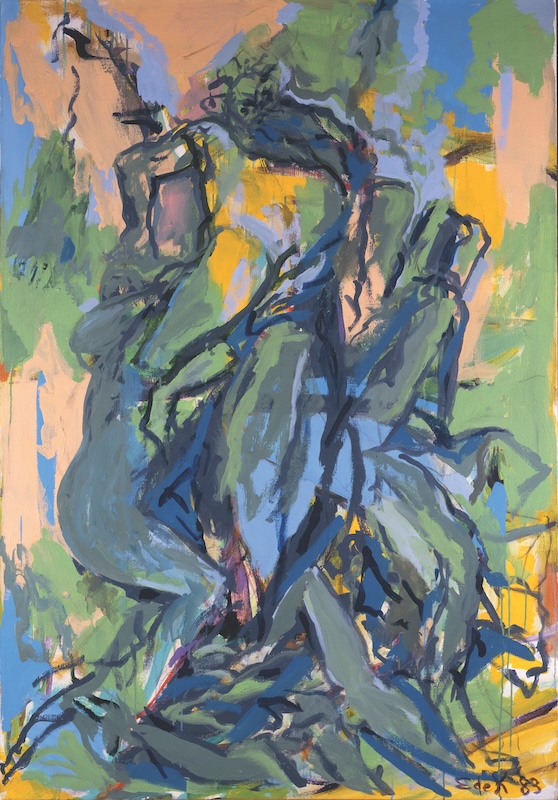
And similarly, there’s this Elaine de Kooning painting that I put in, and it also has some greens and turquoise. It’s called “Bacchus.” I was just — oh, now I’m really glad I printed these out (photos of paintings).
Yeah, they’re coming in really handy!
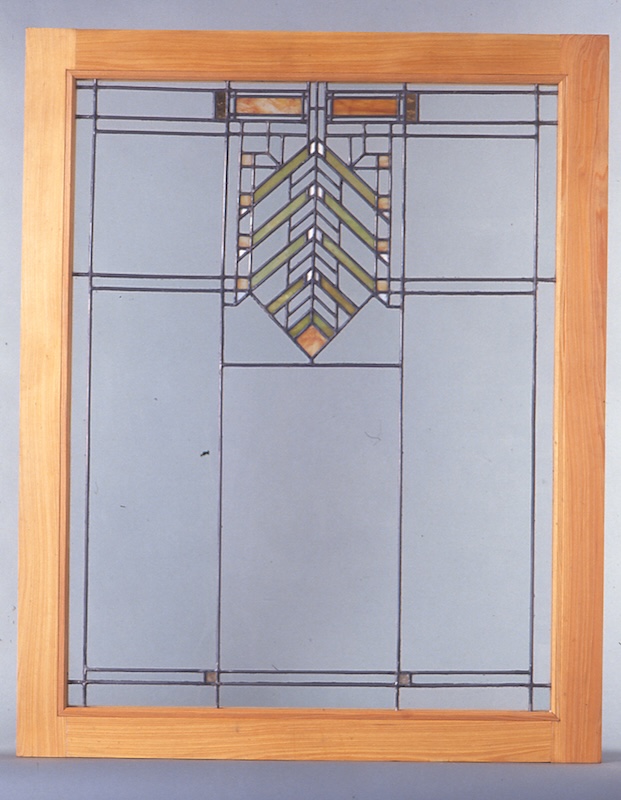
And then here are the Frank Lloyd Wright windows that are part of the collection.
Yes.
Okay. So, that is an important thing that I like to reference in the way that I sew. When I sew two colors together, there’s always a seam, and that seam makes a line. And when there’s sun shining and you’re underneath it, or you’re seeing it with light through it, it kind of creates a new color, or it makes the line more prominent. That’s something that I would throw in — a black line or a thin dark color — to kind of reference the stained glass and the way that it’s built.
Also, it has all of these angles. There’ll be a bunch of small little lines and then a larger shape. I definitely thought about that too. In one of my pieces, I have a lot of thin little stripes and then a larger breathing space, like a larger pane of glass. And I guess I would say the same about these two pieces also that are in the collection. This is Sophie Taeuber-Arp and Albert Gallatin. So, so far, we’ve got color and then these bold moves. A lot of dark and light and then pops of color.
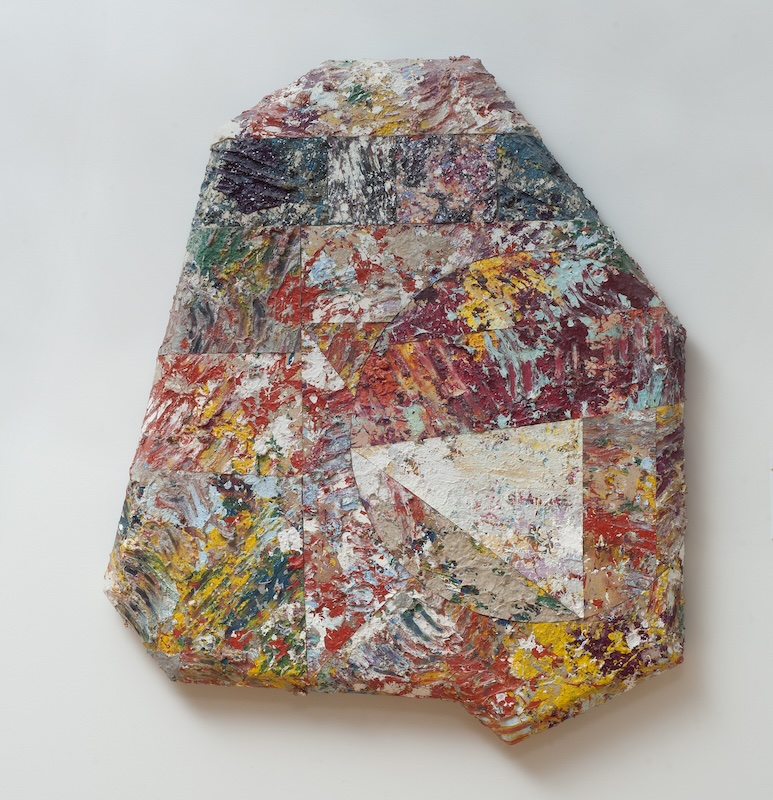
Then there’s this Sam Gilliam painting. It’s a painting that’s actually patchworked together, which means a lot to me for my work to be seen in that way. Here’s a direct example of someone who is patchworking, picking pieces of his painting to create a shaped painting. You can see there’s a triangle on the inside, and several of the pieces that I made are based on a triangular pattern. So, I was thinking about that. And he, too, has a lot of white and dark. There’s a lot of light and dark play.
So, in synopsis, to reference the abstraction, I love to be thinking about light and dark, translucency and opacity and how an off-tone color can provide a breathing space for the piece as a whole. And so, that’s the direct reference, I guess, to the abstract painting.
In a blog post on She Explores, you said that in the beginning of your career, you wanted to challenge the dialogue that often surrounded your work in relation to craft and sewing by creating larger and bolder work, as if to deem it more masculine. How do you think the feminization of textile arts affects how viewers engage with your art?
I will say that I feel like there’s an inherent sincerity to textile work where people can imagine how things are made by hand. And, most often, historically, a lot of those makers were women. It was a way to express themselves. And then, the piece that I’m making outside — I have my scale model here — it’s definitely taking up space on an architectural scale. To me, that’s showing how powerful these kinds of materials are that can be overlooked because they are so familiar to us, like in craft, fashion and even textiles that we have in our home, like curtains and bedding. Things that you surround yourself with and really, literally envelop and touch.
There’s a sensitivity we all have to those materials. Like, what we choose to put on our body, and how different textures have a pleasing or displeasing roughness or softness. And can I also talk about different things? There’s all kinds of things you can bring into what textiles reference. Like, lingerie is sheer, therefore sexy. Versus something very opaque and solid, like workwear or leather bondage. I mean, you name it. You know? It has the ability to talk about all of those things, and those aren’t necessarily what I’m talking about, but it’s there because it’s textiles. So therefore, people can bring something to it. It’s not pure abstraction in a way because there are all these inherent meanings that people can bring to textiles.
And I love that, because although I view my work as abstract and color play and this formal thing, the flip side of the coin is that there’s a lot to talk about. If you want to look for things to talk about, you could talk about patchwork and quilts, or you could talk about architecture and shade and function, or you could look at it as a whole, as an interactive, environmental installation that someone can partake in and walk around with.
I guess I’ve never really thought about textile art in that way.
Well, I think that’s what I was trying to say in a nutshell in that blog post a long time ago. So, there’s a lot there. I like to have the work be open so that people can bring whatever it is that they’re interested in to the work. Like, let’s say you’re a mathematical engineer type of person. You might really be more interested in how these things are built and made. For the math and engineering that comes with working this way and thinking about the elements and the actual practical things. The sturdiness, the weights. And then if you’re just into color and that makes you feel really good to be in a space and surprised by a large gesture of color, that is a completely different experience. I like that it can work in a lot of different ways. In some ways, it’s kind of like a hybrid of all the things that I’m interested in.
I think that’s why I find your work so interesting, because there’s so many forms of artistic reasoning that are interacting to create your sculptures.
Well, thank you. I think it evolves from just kind of being influenced, and I find so many things interesting to look at and think about. And it used to really stress me out to really hone in on this one idea. Like, what am I all about? What is it that I want to say? And I could never really figure that out. And then, through time and working through a lot of ideas, to just be like, okay. It’s not about one thing. It’s about a lot of things. And now I’m happy that I worked that way because I feel like I have a lot of different audiences that I can speak to.
That kind of leads into my next question, which is, what are some things that you have learned throughout your career? And if you could tell your younger self one thing, what would it be?
I would say to not worry about categories so much. What would I tell my younger self? I would tell them a lot. Always be observant and listen to what people say or how they react, and particularly what I like and what I’m attracted to. And if I want to see it in the world, then I will make it because no one else is going to. So, that’s what I would encourage in my younger self instead of holding back, which maybe I did a little bit in the beginning.
Are there any materials that you particularly enjoy working with? Why?
Well, I’ve had to become kind of like a textile engineer because I have to figure out how to make these pieces last for two years outside, and at the same time, be thinking about the indoor component to this installation. Those materials are almost the complete opposite. They’re very fragile and lightweight. And so, I love that I get to use all kinds of different materials and explore and try to bring out the best in each material. Like, what does it really want to do? What is it good at? I try not to force any material to do what it doesn’t want to do.
And something that I’ve been exploring on the side for a long time that is getting more attention in my studio and I’m excited about is working more with glass. A lot of my materials have that ability to cast shadow and be seen through in the same way as stained glass. So first, I learned how to do stained glass and dabbled in that for a while… Let’s say 10 years, but never really figured out how to make it fit in my work. I guess I was still trying to figure it out, and then I got the opportunity to work with glass blowers. In that, I found more of a relationship where it’s like you’re taking something solid and through the process of melting it, the gravity creates the volume and the shape.
I also like that I can cut the glass and arrange it in a similar way to how I arrange a textile pattern. And so, all that practice, like cutting glass for stained glass, has been helpful. I can cut these glass pieces and then work with the glass blowers to give it that volume in the form of a cylinder.
In a way, the liquid glass becoming something hard again captures a moment in time in the same way that a lot of my outdoor photography can capture this moment in time. So, I think that’s an interesting thing to think about.
I can definitely see how there would be an overlap between your fabric art and your glass blowing, and I’m excited to see how that influences your future work.
I also love that there’s two sides when looking through a cylinder, so I can layer it and play with layers of color in the same way that I can play with the textiles. And you know, there’s so much going on in the textile and glass, and that kind of brings me back to Frank Lloyd Wright being part of my inspiration.
Back to this specific installation, there are these outdoor pieces that are in the garden behind the museum that someone will be able to walk around and explore. And then there are three pieces that are on the facade of the building. There’s a piece down here. This is, like, if you’re in the sculpture garden looking at the museum. This is on the glass outside, and this is on the glass outside. And then this over here is inside after you come into the museum. There’s a whole wall of windows, so you’ll probably see one of the pieces on the windows first, and then you’ll realize there’s more outside. And then once you get upstairs, there’s an interior piece. So. depending on how you’re coming through the museum, it’s either leading you out or leading you in. It kind of reminds me of the abstract painting principles question because it’s like the movement kind of draws your eyes in a certain direction depending on where you’re coming from.
When you enter a new environment, what does your process of designing a sculpture that engages with that space look like?
Well, I walked around it and kind of followed the pathway, the natural pathway. I guess I like to not think practically at first, because then you can always pull back from that. I kind of just go with my gut and then get the idea out, get the drawing out, and then work back from there. After that, I like to know what is not possible, and then once you find out all the constraints of the space, then you can play and find out what is possible. That’s probably one of the main things that I like to think about first, and what’s great about that way of working is that I’m never working with a blank canvas. I always have something to respond to. It feels like a natural call and response to a space where I’m not coming in and splashing everything around with no care for the space. My goal is for it to feel seamless. Like, it was always there, and it should be there and it’s part of it.
What are a few things that inspire you to create?
I guess the inherent need to make something. And then, learning about yourself, learning through studying, being culturally aware and always looking are constant sources of inspiration. Whether it was looking at fashion magazines when I was a kid or going to places with my parents. I mean, I don’t really know how far back I need to talk about anything, but I’d say my materials are definitely my muse. What can I do? How can I see this anew? And then the working site specifically is always invigorating too. So, I’ve got the materials that I work with, and then I’ve got a site that I’m working with.
And before I was getting asked to do things at a museum, I was doing it in my backyard. Like, oh, there’s this beautiful sunset. I want to hang something up in front of it and see what it looks like. Or I have got my hands on a ton of this material — I’m going to lay it out in the yard. And then you start to think about, like, oh, wow. That kind of looks like a picture that I saw a long time ago of people laying out their textiles to dry on these big stairs by the river in India. Or this looks like some quilts that I saw hanging in a picture in my book about the quilters of Gee’s Bend.
I guess I’m inspired by the art that I was exposed to in college. And before then, the art that my parents had in their house. So obviously, art is an inspiration, and I like being part of that dialogue. But I also very much like seeing myself as just being part of this world and that everything is potential inspiration, whether it’s this chair that I’m sitting in or a pretty sunset, or a beautiful vintage dress that I find at a thrift store. You know, inspiration is everywhere.
What kind of sensory or emotional experiences do you hope to evoke from viewers with your art?
I mean, I feel like I’m a director of a movie. I’ve got all these things in place, and I have an idea of how I would like someone to walk around and notice different things. There’s a romanticism that I feel when I’m thinking about things, and I want someone else to bear witness to how beautiful something can be, or the impact that it can have visually. When you’re asking someone to walk through a garden, it becomes physical too. All these colors are going to be over your head, or through a window. And the sky will look different every time you come. So, how does that affect the piece? How does the sky affect the colors? It’ll feel different every time, and I love that. It will never be the same.
In some ways, the work is alive, and it’s present and ever-changing. And those are ideas that I’m attracted to. There’s this idea of capturing a moment here at the museum. Maybe catching someone in one mood, and having an effect on that. Not to cheer people up, but maybe just to have a time of reflection.
At the same time, you could look at my work and see it purely as form and function, you know? I don’t know if it evokes any of those ideas. Those are just things that I’m thinking about.
I guess it is subjective to everyone based on their preconceptions.
Mm-hmm. And where they are on that day.
Where is your favorite place that you’ve ever created an installation, and why?
Well, I have three places that I’ve been going to for 23 years, I’d say. One is in New Mexico. There’s a couple of spots in New Mexico. I love to go to White Sands ‘cause it’s literally this beautiful gypsum, white-sanded area. So, the color really pops, and like I was saying, the sky always looks different. I love going there because no matter how big I think I’m working, everything looks so small. It just really messes with your perspective and your sense of scale and your place in this world. I guess I like those big feelings.
And then I love going to my husband’s family farm in South Dakota. It’s also a different kind of grand vista of rolling prairie lands. And it’s far enough north that the sun doesn’t set in the summertime ‘til almost 11 at night. So, you get a big long day, and there’s just all kinds of old barns and old farm equipment and beautiful grasses and gravel roads, and that has been an endless inspiration to just kind of be out there and play in the summertime with no one watching except myself, and then when I bring someone in who’ll help me.
My parents are actually from opposite coasts, but I grew up in Missouri. So, I grew up visiting both of their homes, California and New York, my whole life, with these long road trips. [Missouri is] very foresty, like more deciduous and green with all the trees. I could hang the same piece up in their yard with all this greenery around and it looks so different. Like, the colors look different. It looks so dense. Surrounded by green. I would think, “Well, should I put red in there?” ‘cause that’s a complementary color, and then think about “Why does red look good with green?” Or, maybe more oranges or something. Hot orange. And then in the fall, when all the trees are brown and orange and yellow, everything looks very different then as well. I guess those are my three favorite places to go to. All very different experiences.
What’s next for you in terms of your career?
I don’t know. This is a highlight because it’s a long-term project with the museum and that really means the world to me as an artist to get this opportunity. And also being around students and seeing what the young kids are doing. That’s inspiring to me too.
Authored by:
Nabiha Rahman