As you walk down Baldwin Street on the University of Georgia campus, you may spot the striking facade of the Fine Arts Building. Above the building’s three sets of front doors are frescos that show personifications of music, theater and the visual arts. Renowned muralist Jean Charlot (1898 – 1979) painted them during his three-year residency at UGA in the 1940s, but they weren’t his only work on the campus. Just around the corner, less known but no less striking, are his murals inside Brooks Hall on Herty Drive. Thanks to a newly completed restoration project involving people from all over campus, the preserved murals are back to their original vibrancy and will be enjoyed for decades to come.
Creating the Murals
Charlot’s multinational heritage was an obvious influence on his works. He was born in 1898 in Paris, France. His father was a Russian exile, and his mother was born in Mexico of French and Indigenous American descent. This ancestry gave Charlot a life-long interest in pre-Columbian American history. After moving to Mexico City, he became a significant contributor to the Mexican Muralist movement, both through his own works and as an assistant to artist Diego Rivera.
Charlot moved to New York City in 1928 to begin a teaching career. Among his students was a young Lamar Dodd. A decade later, Dodd became head of the UGA art department, and in 1941 he invited Charlot to visit Athens. For the next three years, Charlot gave informal lectures and talks while working on his murals with assistance from UGA art students.
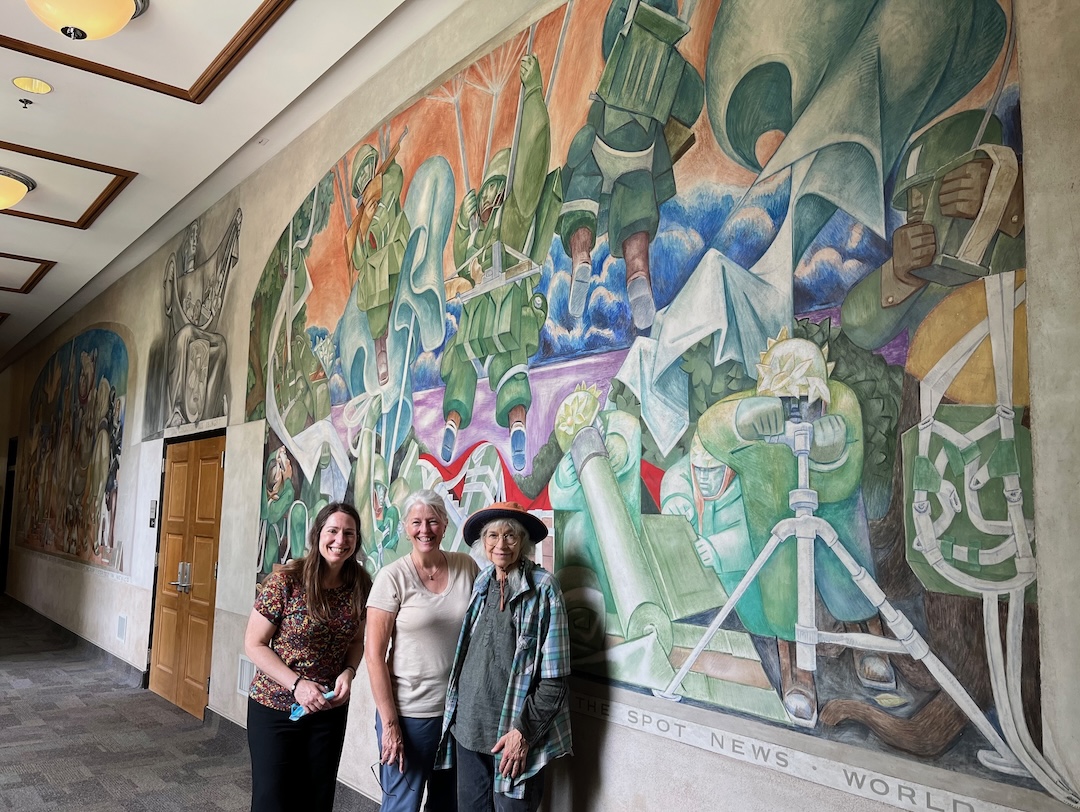
At the time, Brooks Hall housed the journalism school. Charlot consulted with its dean, John Drewry, on potential subject matter for murals at the building. Given a 68-foot-long hallway bisected by a door, he created two murals. Charlot chose to pay homage to and highlight the role of journalists and documentarians. In the left mural, the Indigenous Aztecs meeting Hernán Cortez’s conquistadors include artists rendering the invaders to inform their emperor. The mural is captioned in headline jargon: “ANNO DMI. 1519. EMPEROR MONTEZUMA’S SCOUTS COVER AMERICA’S FIRST SCOOP. CORTEZ IN MEXICO.” For the right mural, Charlot observed military paratrooper drills in Alabama for reference and created a dynamic depiction of the soldiers in the moments before they land. Accompanying them are war reporters, their cameras and notepads out while their parachutes trail from their shoulders. The caption reads “ANNO DMI. 1944. PRESS AND CAMERAMEN FLASH ON THE SPOT NEWS. WORLD WAR II.”
Above the center door, Charlot included a poignant personification of Time as a Hellenic statue with an open bag filled with symbols of history. “All things that happen in time are cast together in Time’s poke,” he wrote in 1945. “The good with the bad: kings, emperors, poets, klu klux klans [sic], scholars, painters, richmen, poormen, soldiers, a lamb beside a lion. The dove of peace perches outside, waiting for its turn to get in.” Below her is written “TIME DISCLOSETH ALL THINGS,” a timely reminder of truth in the historical record.
Charlot’s murals aren’t the only ones in the building. Lorraine Harris created “The History of Bookmaking” (1945), a painting in true fresco in the entryway on the left. On the right is “The Freedom of the Press” (1947), an oil painting on plaster by John Chalmers Vinson. The two earliest paintings are in the stairway. On the right is Dorothy Douglas Greene’s “Contemporary Journalism” (1942), for which she sketched the offices at the Athens Banner-Herald. On the opposite wall are the remaining fragments of Edith Hodgson’s “Communication of the News” (1943). Both Greene and Hodgson created their murals as thesis projects toward the completion of the master of fine arts degree in painting.
Restoring the Murals
Annelies Mondi, who retired from the Georgia Museum of Art in 2023 after a long career in various roles, has always had a soft spot for the Brooks Hall murals and has been involved with their preservation over decades. While leading a tour for staff at UGA’s Office Institutional Research, whose offices are located in that building, she noticed a section of paint peeling in Hodgson’s mural. Her sharp eyes and the collaboration of many people and units across campus mean that the murals are now back to their original luster. The newly completed project is a testament to the UGA community’s dedication to preserving campus history. If you have a chance to visit Brooks Hall to view the murals, you won’t be disappointed, said Mondi.
Libby Hatmaker, a painting conservator for the Georgia Museum of Art and Lamar Dodd School of Art lecturer, was at the helm of the restoration of these works. She previously helped restore them after a fire at Brooks Hall in 1995 caused significant damage.
“I would like to thank Libby Hatmaker for her thorough and professional conservation treatment of the murals, said Mondi. “As always, she went above and beyond in her job and repaired numerous losses not originally identified in the initial proposal. I will always be thankful for the time and care she has devoted to these murals and am grateful for her patience and expertise.”
The project was funded in part by the Georgia Museum of Art and the estate of Pat Dietz. Many museum staff, including Noelle Shuck, Hillary Brown, Lisa Conley and Ryan Woods, also deserve thanks for their efforts to help with this project, said Mondi.
Mondi said that she believed the murals needed signage to explain them to help in their preservation, and credits Lamar Dodd School of Art director Joe Peragine with funding its fabrication and installation. “It is my hope that by understanding the murals a little more, viewers will also help protect them,” said Mondi.
Jeff Benjamin, associate vice president of Facilities Management, and his staff were integral to the project. “They were always willing to share their knowledge and experience to find a solution to any challenge,” Mondi said. They inspected the roof, repaired the window in the stairwell, repainted the non-mural areas of the stairwell, installed a new chair rail in the foyer and holdbacks for the stairwell door. They also made sure Hatmaker had access to the site and were eager to provide advice and help with signage installation. In particular, Mondi thanked facilities staff members Lynn Hix, Carol Van Sant, Richard Piotrowski and Joshua Kuyrkendall for their help.
While Mondi was initially the project coordinator, Christy Sinksen, the museum’s associate registrar, stepped in after Mondi retired. “I was confident that Christy would adeptly handle the various moving parts to this project with tact and thoroughness and she did so with great success,” said Mondi.
“The [work] by Jean Charlot and the accompanying murals done under his advisement are an integral part of the university’s history,” she said. “Their message about the importance of communication is just as pertinent now as it was 80 years ago when the paintings were created. These murals were created through collaboration and live on because of the good work of many.”
Authored by:
Kelsey Schoenbaum