De Scott Evans (1847 — 1898), born David Scott Evans, was a 19th century artist. He was known during his lifetime for his genre paintings as well as portraits. He favored realist painting, while other artists at this time had embraced impressionism. Evans taught art on the college level for many years. In the 1870s, he traveled to Paris to study with William Adolphe Bouguereau to further his traditional academic method in painting.
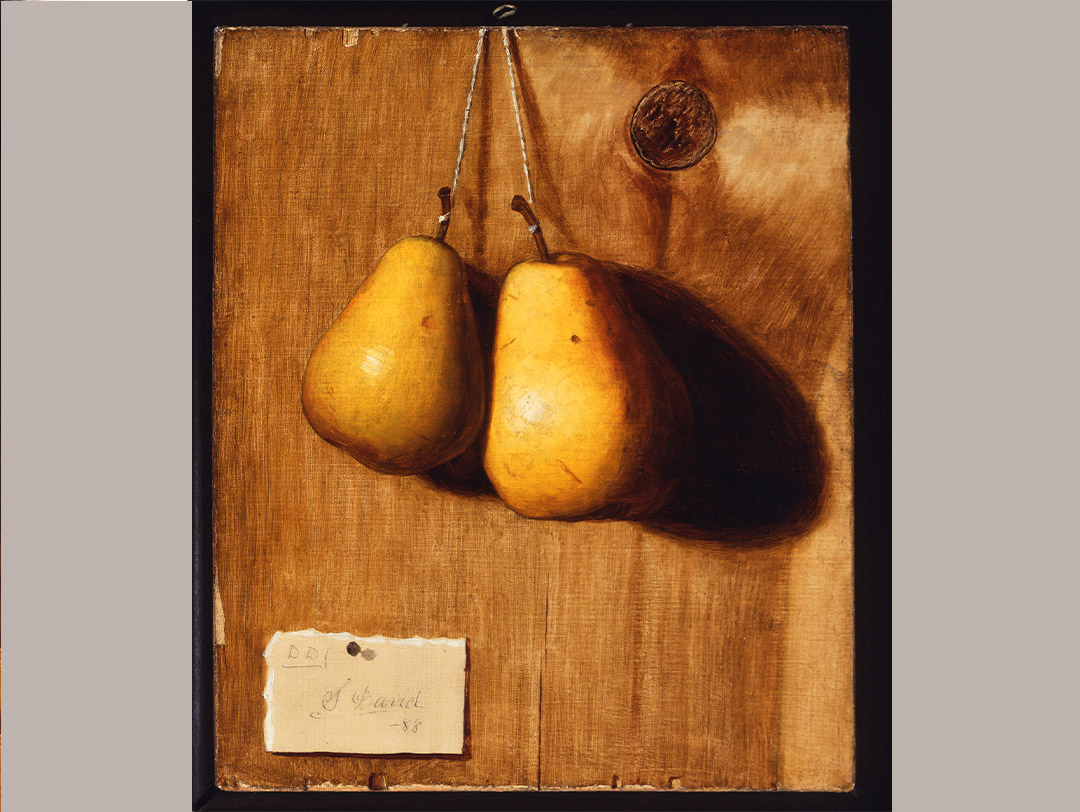
Evan’s realism was so remarkable, that he painted a series of trompe l’oeil works which have interested collectors and museums. The Georgia Museum of Art has a wonderful example of Evans’ trompe l’oeil style, “Still Life with Pears.” Trompe l’oeil is an art term meaning “to fool the eye.” When one walks into the museum’s Turner Gallery, one’s eyes move straight to the painting of the pears.
This style gives a three dimensional view with Evans’ use of brush strokes, color and shading. He takes the effect a step further by painting a string from the pears that travels up to a nail, which is also painted into the frame. He tops it off by painting a little note with his signature, S. David. This name is also one David Scott Evans would use on occasion. Beyond this painting, Evans painted other trompe l’oeil pieces that are just as fascinating. I found several examples online by searching for images of De Scott Evans’ work. I urge you to do the same.
Evans spent much of his life here in the United States painting and teaching art. He would travel to France on occasion. Sadly, he and his three daughters died in a ship wreck on a journey back to Europe in 1898. His trompe l’oeil works garnered acclaim posthumously. It is likely what De Scott Evans is best known for today.
Authored by:
Phillip Bond