Over the past few years, the Georgia Museum of Art has steadily worked its way through its permanent collection wing, finding creative ways to highlight fresh perspectives and new works. As part of this reinstallation initiative, the Byrnece Purcell Knox Swanson Gallery, which exhibits modern art, and the Barbara and Sanford Orkin Gallery, previously dedicated to contemporary art, reopened September 20 after undergoing a major overhaul.
“We’re keeping some favorites, but we are adding a lot of exciting things that haven’t been on view, or haven’t been on view in a long time,” says Kathryn Hill, associate curator of modern and contemporary art.
Stepping into the Swanson Gallery, visitors were previously greeted by a survey of self-taught artists, but works by these artists are now part of larger thematic presentations. “They’re more dispersed throughout,” says Hill. “And that’s kind of the intention: to no longer silo individual movements or approaches and to really integrate them into the galleries more effectively.”
Thornton Dial Sr.’s “Spirit of Grand Central Station — The Man That Helped the Handicapped,” an unusual large-scale portrait painted on braided rope carpet and industrial sealing compound, was moved to a prominent location at the top of the stairs on the second-floor landing. Howard Finster’s “Howard Goes from Jackass Speed to the Speed of a Jet with Peter Paul” galloped back into storage, but a different self-portrait by the Paradise Garden visionary is now part of a new selection of portraits, alongside images by Alice Neel, Beauford Delaney, Paul Cadmus and others. In another corner themed around “play and care,” one of Nellie Mae Rowe’s hand-sewn dolls joins a drawing by Rowe entitled “I Am Own My Way I Jest Stop To Rest A Little While.”
“With the re-envisioning of this space, something I’m really looking forward to is moving away from a classical, chronological display into intimate groupings with thematic conversations between works,” says Hill.
One such conversation is how various mid-century artists responded to the trauma of war and engaged with different political and social environments. Ralston Crawford’s painting “Test Able,” for example, takes its title from the first detonations of nuclear devices that followed the atomic bombing of Nagasaki. Woody Crumbo, a Potawatomi artist, dancer and flutist, used his artwork to promote and preserve Native American history and culture. These wide perspectives contextualize what artists were trying to contend with through their work.
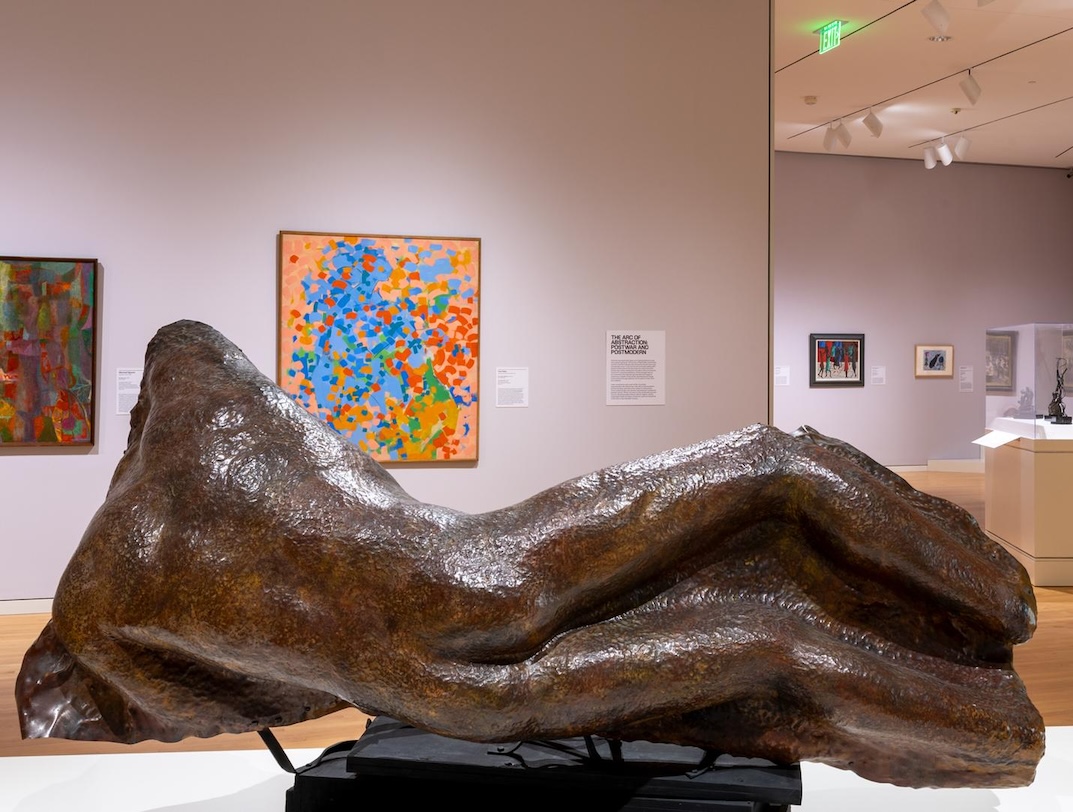
Another major theme is the body, presented in varying degrees of abstraction. Elaine de Kooning’s popular “Bacchus #81” will remain on view, but it is now joined by a rotating cast of studies she completed in watercolor on paper. Coming out of storage, Saul Baizerman’s sculpture “Day” is a large reclining nude figure, inspired by Michelangelo’s allegorical figure of Day, made from hammered copper. Viewers are able to see the sculpture up close and from all angles, revealing its textured, dimpled surface and hollow reverse side.
“When you see them in conversation together, you really see how artists are simplifying the form of the body, transforming it into lines or shapes and then reconfiguring it,” says Hill.
One wall explores the theme of dance and music through visual art. Joining abstract expressionist Alice Baber’s oil painting “Sound of the Red Dance” are two other oil paintings: Pierre Daura’s “Dancers” and Stephen Greene’s “Fermata #4.” A bronze sculpture of a woman by John Rhoden invites viewers to consider how the paintings nearby echo abstracted figure’s gestures. To engage the artwork in a different way, Hill worked with Peter Van Zandt Lane, associate professor of composition at the University of Georgia Hugh Hodgson School of Music, to create a playlist of songs inspired by the works on view. A fermata is a musical symbol indicating that a performer can hold a note, chord or rest as long as they want for emphasis. The playlist encourages viewers to pause and take a moment to reflect on the artwork.
“The hope with moving toward thematic grouping is that you really focus on the conversations that these artists are having in response to their surroundings and what is happening in the world around them,” says Hill.
A new seating area in Swanson allows space for lounging, reading or drawing. The gallery’s partition wall was extended to create a designated area for photography that will change throughout the year. The first rotation kicks off with two large photographs by Berenice Abbott, best known for her “Changing New York” series that captured the architecture and shifting landscape of the city during the Great Depression.
Preparators added a new object wall in Swanson that displays three-dimensional decorative objects on floating shelves hung salon-style. Varying in style and media, these objects range from a glazed earthenware owl figurine by Pablo Picasso to a doomsday calendar Zebedee B. Armstrong painted on a VW hubcap.
A staple piece in the Orkin gallery, Joan Mitchell’s large abstract painting “Close” was recently restored by conservator Larry Shutts in an open-access conservation lab viewable to museum visitors. “Close” will return to Orkin after November 2, and works by Josef Albers, Carl Holty and Kyohei Inukai are on view in the meantime.
Orkin also includes a new display spotlighting op art, demonstrating different ways artists have used optical illusions and principles of perception to create the impression of movement, vibration, depth or color. In addition to a rotating series of prints by color field artist Jules Olitski, this section features a wall-bound sculpture by Lila Katzen that emits light and color and a sculpture by Yvaral that creates the illusion of a four-sided pyramid as the viewer’s body moves from side to side.
As the museum’s collection grows, curators are adapting and exploring new approaches for getting more works on view. One of the most significant changes to come out of the reinstallation is that the Orkin Gallery, previously designated for contemporary art, will now feature late modern and post-war works. Contemporary art will instead be shown in the museum’s Virginia and Alfred Kennedy Gallery — with high ceilings ideal for large pieces — when it’s not occupied by temporary exhibitions. With changes to the Swanson and Orkin galleries now complete, a new selection of contemporary artwork is expected to go on view in the Kennedy Gallery this spring.
Authored by:
Jessica Smith