Edmund de Waal used a potter’s wheel for the first time when he was only five years old.
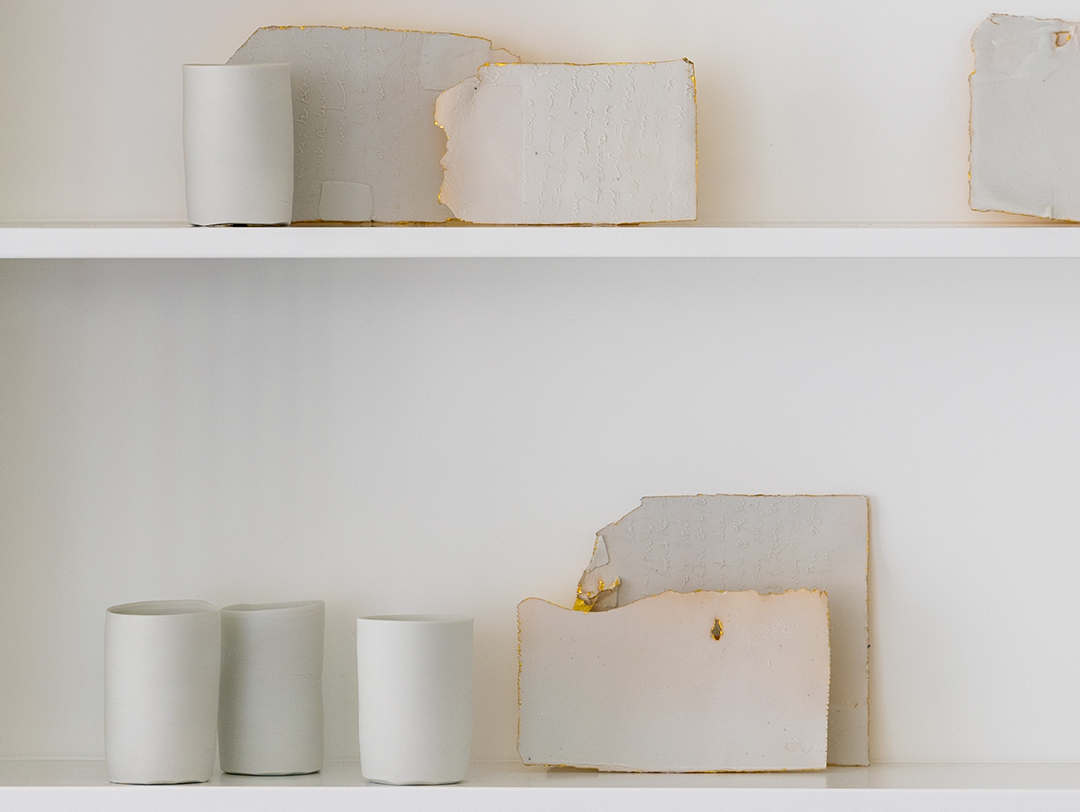
Over more than five decades since, De Waal has honed his craft in a meditative, thoughtful way, investigating subtle shades of black and white. The Georgia Museum of Art recently became the first museum in the United States to acquire his work. De Waal’s “Letters to Amherst II,” is now on display just outside the exhibition “Mind the Gap: Selections from the Permanent Collection.”
De Waal is at least as well known for his writing as for his ceramics. His 2010 memoir, “The Hare with Amber Eyes: A Hidden Inheritance,” became an unexpected best seller. The book tells the story of the Ephrussi, a wealthy European Jewish banking dynasty who lost their fortune during World War II when the Nazis confiscated their property. Inspired by and tracing the story of their collection of Japanese miniatures carved from wood or ivory, known as netsuke, it incorporates art history and literary references in equal parts. One could say the same of De Waal’s artwork, which he files under the category “making” on his website.
“Letters to Amherst, II” is part of a group of six sculptures, each of which consists of a white-glazed rectangular aluminum box divided in half horizontally by a shelf. In each of the two sections sit small, delicate white porcelain vessels and thin sheets of white porcelain inscribed with lines of poetry. Similar to Giorgio Morandi’s still-life paintings, the result feels repetitive at first and possibly too simple, but contemplation yields an appreciation of subtleties in construction, in glazing and in spacing. De Waal has said, of white, that it “is not a stripping back to reveal, but a starting place. . . . A page, a wall, a handful of white clay, porcelain, a block of stone. It is the pull and push between the object and its shadow.”
The “Letters to Amherst” series derives its title from poet Emily Dickinson, who spent her life in Amherst, Massachusetts. Dickinson was notoriously reclusive but corresponded at length with friends. Her poetry uses slant or imperfect rhymes, as well as frequent dashes, to break up words and lines. De Waal refers to her as “the poet of fracture.” She makes “spaces and connections between often very disparate feelings and emotions and images,” notes De Waal. In a similar way, his works use vessels and the spaces between them to make a sort of visual poem. The beauty of his objects, which often glow with gold and silver leaf, can seem removed from the world, but he says, “It’s possible to make things that are beautiful that also have guts to them.”

Authored by:
Hillary Brown