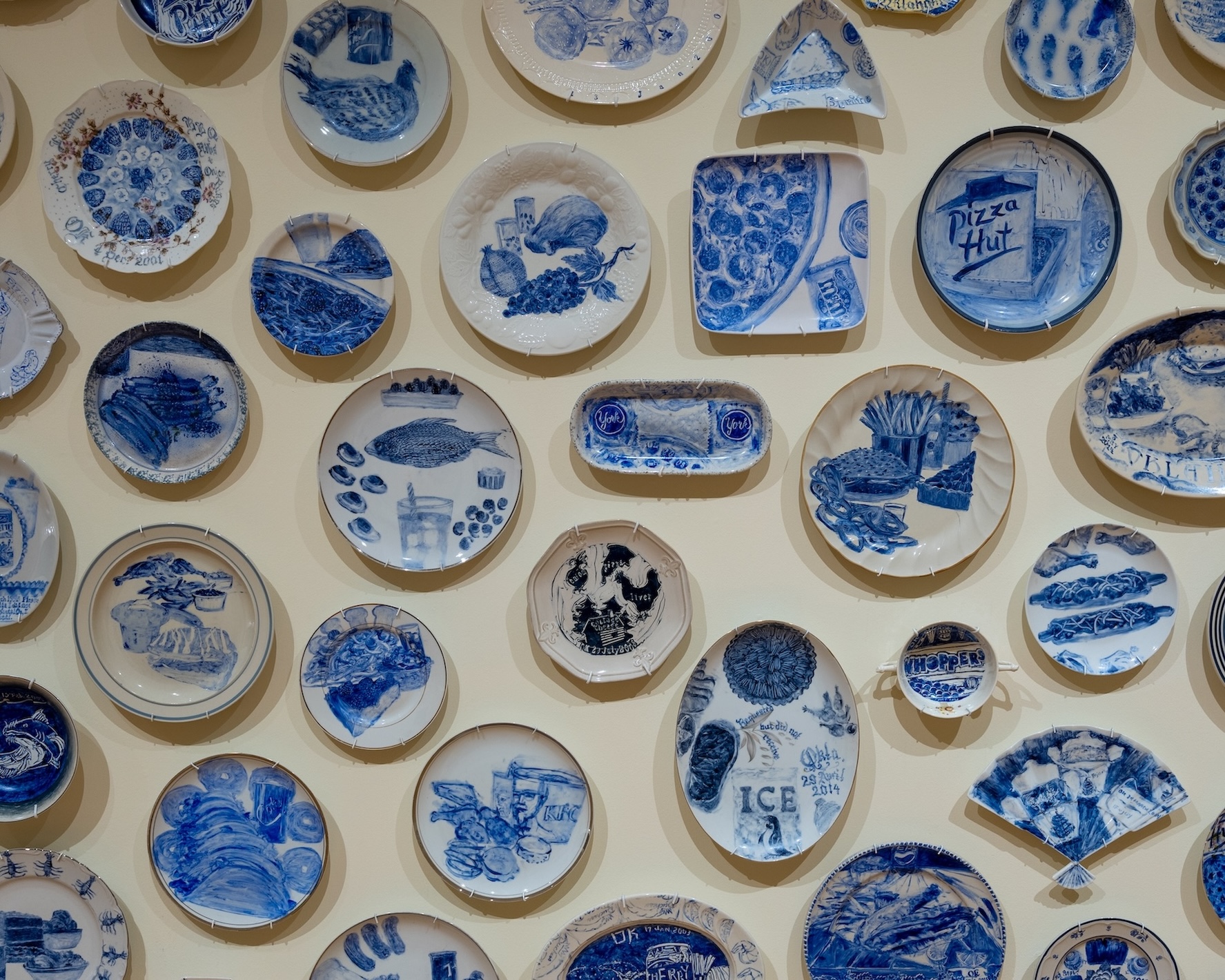
The Georgia Museum of Art is displaying plates from Julie Green’s “The Last Supper” series in its Phoebe and Ed Forio Gallery February 21 – August 16, 2026. Each second-hand ceramic plate is hand-painted with cobalt blue mineral paint to illustrate death row inmates’ final meal requests, the state and the date of execution. Green planned to create 50 plates every year until they reached 1,000 plates or until capital punishment was abolished — whichever came first. This selection from “The Last Supper” is generously lent by Crystal Bridges Museum of American Art as part of Art Bridges’ Partner Loan Network.
Julie Green was born in Yokosuka, Japan, in 1961. Following their parents’ separation, Green grew up with their mother in Des Moines, Iowa. They earned a bachelor of arts in graphic design in 1983 and a master of fine arts in 1996 from the University of Kansas in Lawrence. Between their degrees, they lived in New York City and worked as a server and a designer.
“Growing up in Iowa, I admired family quilts and ukiyo-e prints at home and the neighbor’s yard with larger-than-life historical figures and a 20-foot American flag made with ears of colored corn. An appreciation for the homemade and handmade led me to paint blue food,” Green wrote in their artist statement.
A 1999 Oklahoma newspaper clipping that described a man’s final moments before execution inspired Green to begin “The Last Supper” series. “He asked for a final meal of three fried chicken thighs, 10 or 15 shrimp, tater tots with ketchup, two slices of pecan pie, strawberry ice cream, honey and biscuits and a Coke,” they read aloud in a short documentary about the series. Despite the crimes that the man had committed, the comforting quality of his food selections reminded Green of dinners with their family and humanized him in their eyes. Green began calling newspapers and prisons to investigate why they published information about death row inmates’ final meals, to which they simply replied, “The public wants to know.”
The centrality of food in “The Last Supper” humanizes death row inmates to a largely indifferent public and encourages viewers to consider their relationship to the U.S. prison system. “Food carries powerful associations with care, ritual, culture and comfort. In ‘The Last Supper,’ these meanings sit in tension with the realities of incarceration and execution. The meals depicted are often ordinary — even banal — which heightens the unsettling contrast between everyday human needs and the finality of state-sanctioned capital punishment,” shared David Odo, the museum’s director and the curator of the display. “By centering food as the primary visual subject, the work encourages viewers to reflect on how the prison system manages bodies and lives, even in moments framed as gestures of compassion or dignity.”
Green painted their 1,000th plate in September 2021, one month before they died of ovarian cancer. Of the 1,000 completed plates, the Georgia Museum of Art is displaying 377 plates that focus on the Southeast and neighboring states, encouraging local viewers to consider how their region has been impacted by capital punishment. “The goal was to create an immersive experience that communicates both the repetition and gravity of the practice itself,” Odo said. “Even in a reduced number, the accumulation of plates conveys the scale of the work and the persistence of the system it documents.”
“The Last Supper” makes abstract ideas about the ethics of capital punishment concrete by drawing attention away from the spectacle of crime and toward the universal, life-sustaining act of eating, thereby humanizing death row inmates who are frequently written off as monsters or statistics.
“Instead of advancing a single viewpoint, museums can frame conversations in ways that invite critical engagement, reflection and dialogue,” Odo said. “In the case of ‘The Last Supper,’ contextual information can help audiences understand the systemic dimensions of the work without closing off individual emotional or moral responses.”
Art Bridges Foundation stems from philanthropist Alice Walton’s vision to expand access to American art in all regions across the United States — a mission she began with the opening of Crystal Bridges Museum of American Art in 2011. It partners with a growing network of over 300 museums and cultural organizations to provide financial, strategic and logistical support for exhibitions, collection loans and programming designed to educate, inspire and deepen engagement with local communities.
Authored by:
Nabiha Rahman