Since opening in 2011, the Jane and Harry Willson Sculpture Garden at the Georgia Museum of Art has been dedicated to showcasing sculptures by women artists. In a field historically dominated by men, this important distinction helps close the gender gap by raising the profiles of underrepresented contemporary artists. After a two-month renovation, the sculpture garden is officially open again, with fresh landscaping and a new approach to programming.
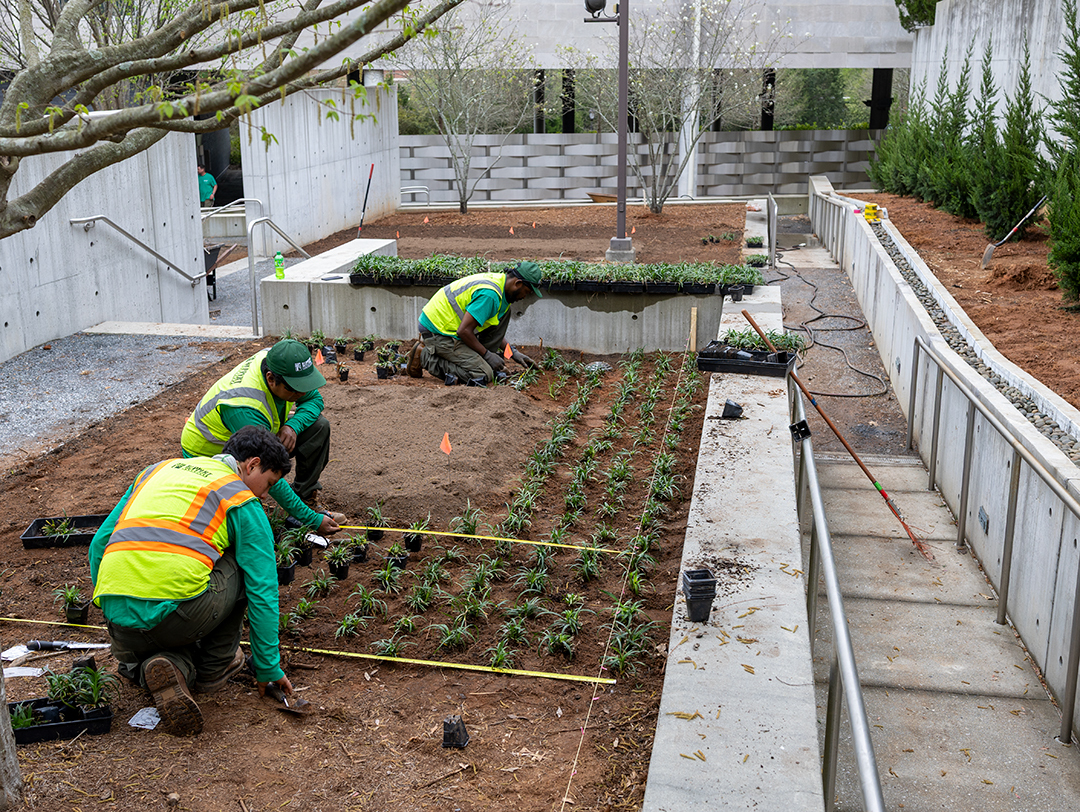
Under the guidance of Ruppert Landscape, the sculpture garden received several improvements in both beautification and functionality. Ruppert removed the thick bamboo growing along the garden’s back wall and replaced it with a row of green columnar juniper trees that will add softness to the concrete backdrop while eliminating the previous issue of fallen leaves clogging the garden’s fountain feature. They replaced an invasive species of liriope, a grasslike ground cover, with a native variety and added a patch of flowering catmint for a pop of color. They gave all the garden’s trees a trim to make them shapelier and added a growth inhibitor to the tall brick wall so that the lush vines climbing on it are encouraged to reach up but not out. Ruppert also repaired the garden’s irrigation system, added a fresh layer of slate chips to pathways and replaced the pine straw in the garden beds with mulch, a more durable material that’s less susceptible to move with the wind.
“When we opened the new wing in 2011, the garden was intended for rotating exhibition space,” says Todd Rivers, the museum’s director of exhibitions, who supervised the project. “We would have an exhibition and acquire one of the pieces, and it would stay in its location. Then we would have another exhibition, and we would acquire a piece from it.” Eventually, as the museum acquired more and more sculptures, the collection began to compete for space originally intended for temporary installations.
Most recently, the sculpture garden featured three distinct works purchased over the years. “Terra Verte #1,” by Scottish environmental artist Patricia Leighton, is a stainless-steel “growing cube” that encases delicate, living sedum plants as it combines geometric structures and organic forms. “Tide,” by Icelandic sculptor Steinunn Thorarinsdottir, is an androgynous, life-sized cast-iron human figure with a glass band inlay across its left arm. “Andreas,” by American sculptor Jane Manus, is a tall, abstract work of welded aluminum painted bright blue. The three sculptures have been deinstalled and moved into storage until the museum can find new locations for their installation.
In the meantime, Athens-based objects and sculpture conservator Amy Jones Abbe will return to the museum in May for an annual assessment of outdoor artworks. Abbe was recently highlighted in the New York Times for her extensive restoration of the famed “Iron Horse,” a 2-ton abstract modern sculpture by Abbott Pattison that’s been returned to its former glory after enduring exposure and multiple incidents of vandalism over the last 70 years. In addition to the three sculptures recently removed from the garden, Abbe will clean and assess the museum’s other outdoor works, such as Andrew T. Crawford’s massive screw “Split” on East Campus Road and Beverly Pepper’s gravity-defying “Ascension” on the Performing and Visual Arts Complex quad.
“The idea was that we wanted this garden to get back to its roots of being a rotating space,” says Rivers. “The best way to do that is to identify spaces where sculptures can go.”
Part of the renovation process involved finding a balance that supports the garden’s multiple roles, reserving the first level for special events such as weddings and allocating the second and third levels for sculpture. Ruppert removed four large concrete pads originally poured to support the installation of various sculptures. In their absence, Rivers and his team have identified the three best zones for future works. When these zones are not occupied by sculpture, they will feature colorful seasonal flowers.
The museum also purchased tables and chairs to encourage visitors to study, eat lunch or gather with friends. “We would love to have this be a place where people come and hang out,” says Rivers. “We’re trying to reimagine it to align with Director David Odo’s goals of increasing our student engagement and student involvement in all areas of the museum, and this area is one of them.”
In August, the sculpture garden will debut new works by Rachel Hayes, a textile artist based in Tulsa, Oklahoma, whose vibrant, large-scale installations aim to insert color and form into both built and natural environments. Informed by traditional fiber art processes and approaches to abstract painting, her body of work blurs the boundaries among craft, sculpture, architecture and land art. Subtly interacting with their surrounding landscapes, her installations rustle in the breeze and cast colorful, shifting shadows onto the ground.
Authored by:
Jessica Smith