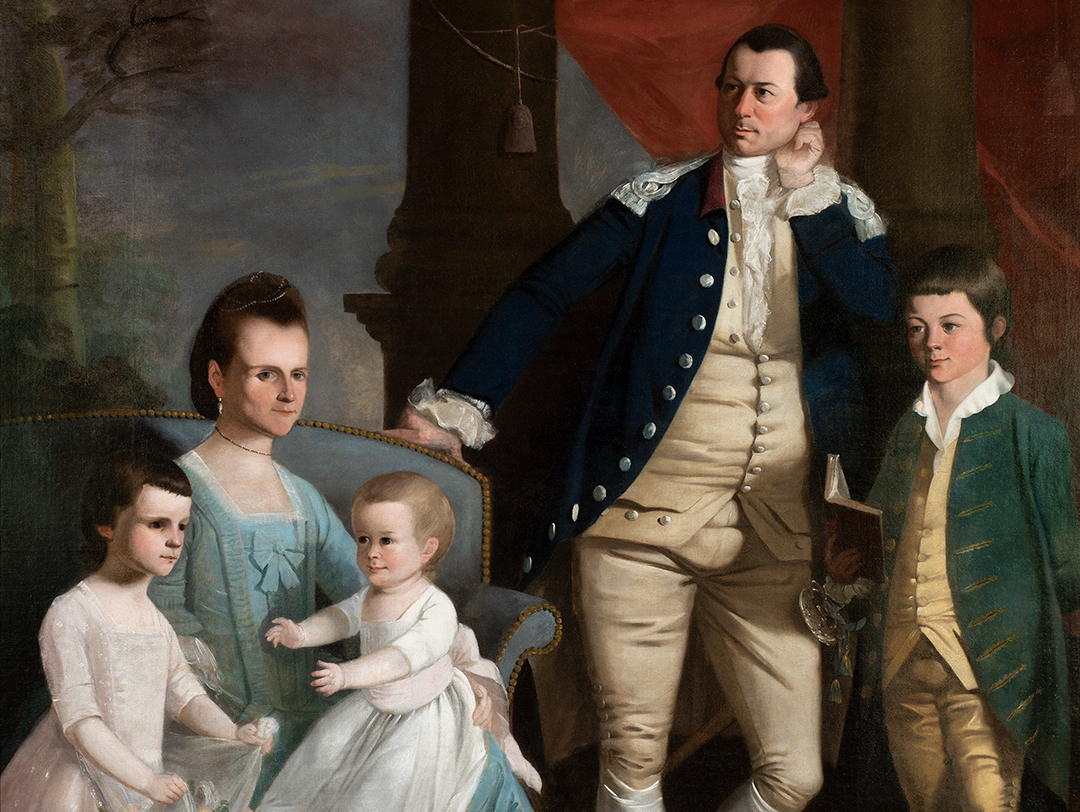
At a towering 89 inches tall, “The Archibald Bulloch Family” stands tall in the gallery of the Georgia Museum of Art. Painted by renowned portraitist Henry Benbridge ca. 1775, the portrait is unique to the museum for another reason: it is the first Benbridge painting in the museum, and it both raises and clarifies questions about the South’s elite planter class, the primary subject of Benbridge’s portraits.
During the 10th Henry D. Green Symposium of the Decorative Arts, Jeffrey Richmond-Moll, the museum’s curator of American art, presented a talk about the painting and its importance. One reason for the work’s significance is its subject, Archibald Bulloch, a prominent figure in Georgia history, notably for his roles as leader of the Liberty Party and eventual election as governor.
Richmond-Moll’s Green Symposium talk also addressed an unusual connection between this painting and another Benbridge work located at the Telfair Museum in Savannah. “Mary Bryan Morel and Her Children” depicts another family, yet both the woman in this portrait and the woman in “The Archibald Bulloch Family” are wearing the same blue dress, and the children’s outfits are quite similar as well. While during this era it was typical for sitters of portraits to pick their desired body types and props from prints, Richmond-Moll’s research deduced that this is not the case for these two portraits and that these two women are wearing the same dress.
“There’s something about these two portraits that I think there’s more to do,” said Richmond-Moll. “That’s I think why it’s great that we have it, because we are at a research institution and we can bring things in that still have questions around them…we have students and faculty, and even we as curators can pursue those research questions even after works enter the collection.”
Beyond Bulloch and his family, however, Benbridge’s significance as a painter in the South is a noteworthy aspect of the acquisition. Benbridge was one of the most sought after portrait painters in the South, along with his predecessor Jeremiah Theus. In fact, Theus’ “Portrait of John Habersham” complements “Benbridge’s The Archibald Bulloch Family.”
“With the John Habersham portrait by Theus, we have this kind of wonderful lineage or multigenerational story that we can tell of portrait-painting in the South with these portraits together,” Richmond-Moll said.
For Richmond-Moll, the Benbridge acquisition has opened up a conversation between fine arts and decorative arts in the South. Traditionally, these two fields have worked independently of one another.
“That’s one of the great things about presenting this at the Green Symposium, because in some ways a lot of the really interesting work on the American south is happening in the history of the decorative arts and not so much the history of painting,” Richmond-Moll said. “I think there needs to be more conversation, collaboration, cross-pollination between people who study the fine arts and the decorative arts.”
By Anika Chaturvedi