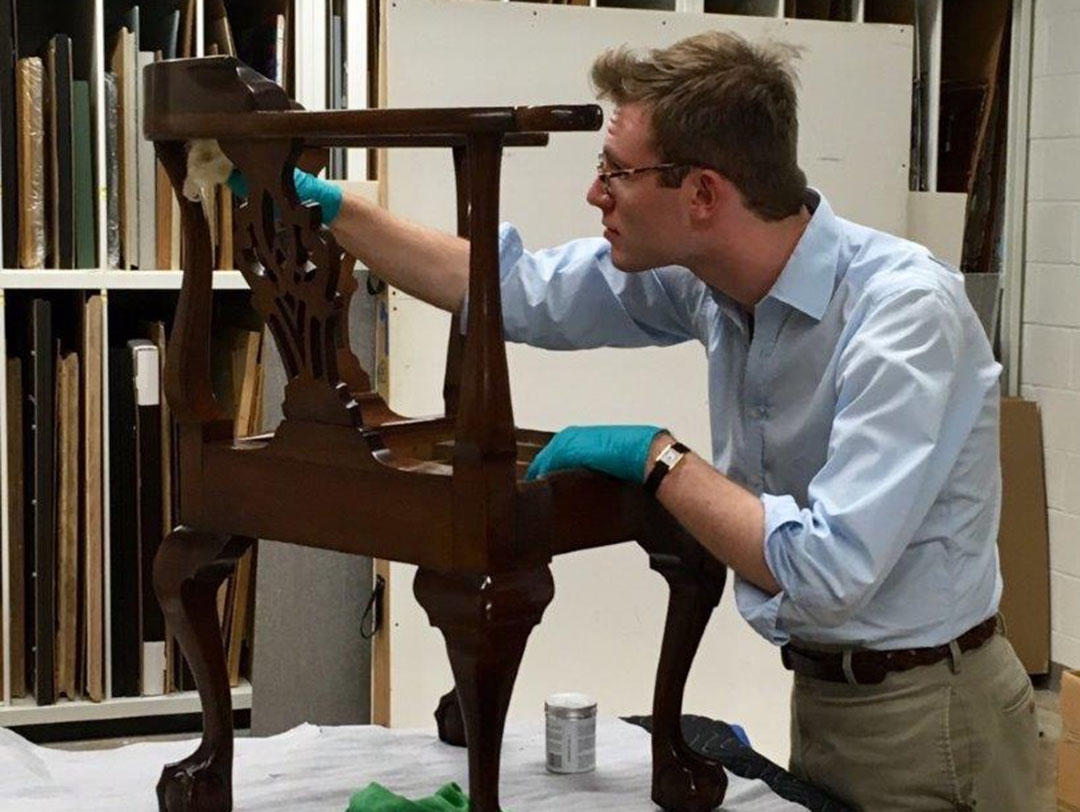
Since his tenure at the Georgia Museum of Art began, in 2010, Dale Couch has supervised, mentored and learned from a series of student interns for the Henry D. Green Center for the Study of the Decorative Arts, most of whom have been UGA students, both graduate and undergraduate. This program, which has alums now occupying a wide variety of fields — both in the art world and beyond — has been “an unqualified success,” according to Couch.
The truth in this statement is apparent as Couch enthusiastically launches into stories about each student upon hearing their names. Without any notes or reminders, he lauds Lauren Word’s (AB 2013, MSW 2016) presentation on a rebellious, anti-monarchial Staffordshire mug, the curiosity of Courtney Magill (AB, 2011) that led to her discovery of two 1838 silver equestrian trophies, and the hundreds of sideboards that Laura Conte scanned and studied, which led to her presenting at the Colonial Williamsburg Antiques Forum. Couch is proud of each of his past and current interns, calling them “our eyes and ears…connoisseurs in the field [of decorative arts].”
Many of these former interns were eager to reflect on their time at the museum and to share how the internship and Couch influenced what they have gone on to do. Magill now works in the historic preservation department with the University of Pennsylvania, where she serves as an architectural conservator and laboratory manager. Magill had not explored the decorative arts before her 2011–12 internship but said that the position “opened up a new avenue of thought for me into how a person’s choices in the types of objects that they keep…can lend great insight into both past and modern material culture.”
“I do not have an intern in whom I have been disappointed,” Couch said without hesitation. The pride that emanates from him is mirrored by his former students’ own glowing praise of their mentor and the internship program as a whole.
Joseph Litts, whose internship ended last winter, has shifted his studies from the decorative arts to 18th- and 19th-century American art, but said that “the variety of opportunities to engage with a broad, nonacademic audience” was one of the most valuable aspects of his time at the museum. Now enrolled in the Winterthur Program in American Material Culture at the University of Delaware, Litts’ thesis has been heavily influenced by his former work with the museum’s Cherokee basketry holdings, and he is contributing an essay on the same to the museum’s forthcoming exhibition catalogue for “Material Georgia 1733–1900: Two Decades of Scholarship.”
Laura Conte’s internship ended almost five years ago, but she points to her experience here as confirming that museum work was the right path for her. Currently employed at the Taubman Museum of Art in Roanoke, Virginia, she said, “the professional relationships I developed while I was [at the museum] have continued to be a valuable part of my career.”
James Rooks’ internship ended very recently, but he is already willing to bet that his work with the decorative arts will continue. Even though his focus will likely be of a different nature than Couch’s, Rooks (a master of historic preservation student at UGA) credits Couch as taking him on as an inexperienced candidate who was passionate about diving into the world of decorative arts.
Conte expressed awe of Couch’s “incredible encyclopedic knowledge of the field”; Magill was glad to “explore the Green Center resources and become part of a larger community in both Georgia and the greater South”; Litts cited “the range of projects I got to work on…in fields ranging from donor relations to curatorial work to education.” But perhaps the most telling measurement of success is that 100 percent of former interns recommended the program to future students. “Bring your passion with you,” said Rooks, “Don’t leave it at the door.”
Authored by:
Taylor Lear