Mingqi, or “spirit goods,” are funerary objects that were placed in ancient Chinese tombs to provide the dead with necessities and comforts in the afterlife. Often reflecting the individual’s social status or wealth, mingqi might include utensils, vessels, furniture, miniature buildings, and figurines of animals, guardians, soldiers, servants, dancers or musicians. They rose in popularity during the Han dynasty (206 BCE – 220 CE), and new glazing techniques were introduced during the Tang dynasty (618 – 907 CE).
Collectively, mingqi reveal insights into the belief systems, architecture, craftsmanship and daily life of people at the time. Debuted on May 9, the museum’s new display “Buried Treasure: Funerary Ceramics from the Han and Tang Dynasties” explores the symbolism of various animals and patterns while highlighting their well-preserved glazing and paint.
When the museum received a large gift of Chinese ceramics from D. Jack Sawyer Jr. and William E. Torres a few years ago, it solicited assistance from UGA alum Kendal Parker (AB ’98; MA ’01), an expert in Asian art, to assess the extensive collection. Parker had previously interned in the museum’s registrars’ department in 1997. She returned as a curatorial intern while pursuing her master’s degree in art history at the Lamar Dodd School of Art, and she organized the exhibition “Art for the Afterlife: Chinese Funerary Art of the Han Dynasty” in 2000.
She went on to gain professional experience at Sotheby’s, Ackland Art Museum at the University of North Carolina-Chapel Hill, the Metropolitan Museum of Art, Japanese Art Society of America and Leland Little Auctions, and even spent several years living in Hong Kong and Singapore to deepen her knowledge of Asian art. In 2020, she founded her own company, Kendal Parker Art Advisory, that offers evaluating, cataloguing and curatorial services to museums, galleries and large private collection owners.
Parker carefully examined each new object from the Sawyer-Torres collection, providing descriptions, condition reports and other notes of interest. Before wrapping up her time in the vaults, she suggested multiple case installations for the museum, the first of which went on view the summer of 2023.
Alexis Gorby, associate curator of academic and campus engagement, joined the museum’s staff last year and took an immediate interest in building on Parker’s work. Gorby is a doctoral candidate in classical archaeology at Oxford University in England and specializes in late antique sarcophagi from the Mediterranean. While Parker’s initial plans laid out a framework of two subsequent installations of funerary ceramics — one of animals, one of vessels — that relied entirely on the gift from Sawyer and Torres, Gorby saw an opportunity not only to combine the two themes for a larger, more impactful presentation, but to incorporate other objects from the museum’s collection.
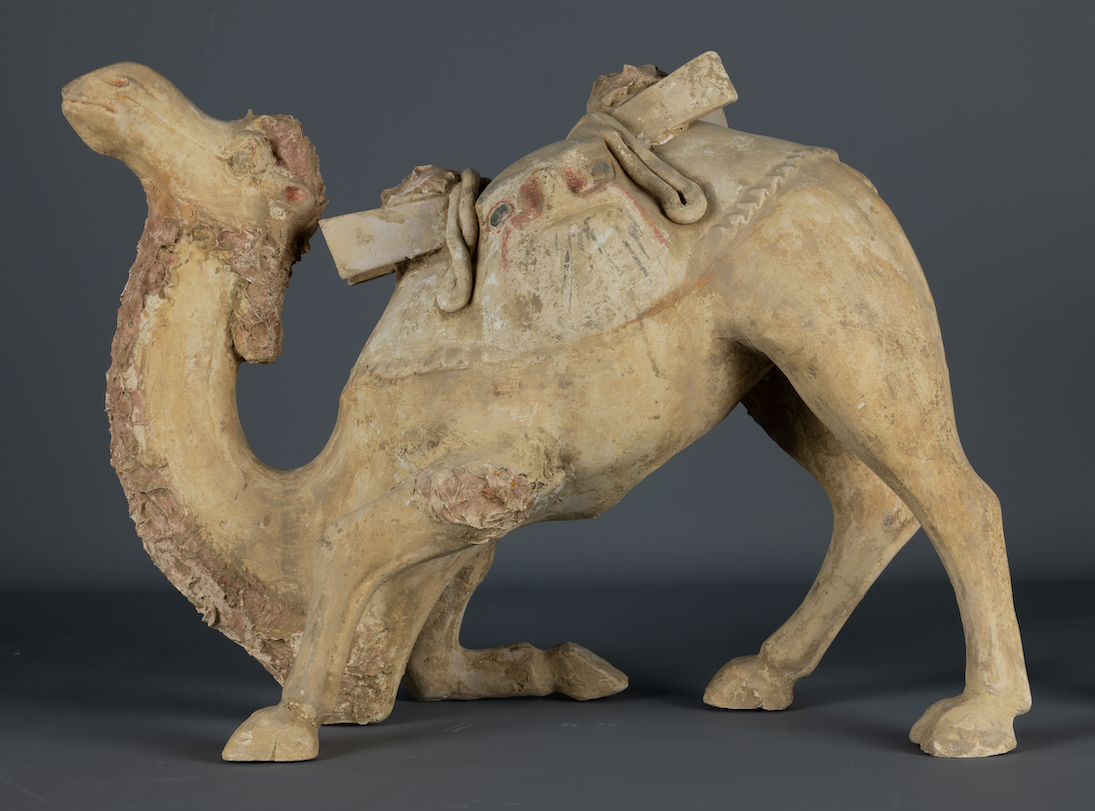
Animals were an important category of mingqi, and each one on view in “Buried Treasure” carries a symbolic meaning or role. Funerary sculptures of dogs guarded the deceased as they had the living and provided companionship in the afterlife. Horses symbolized wealth and power. Two-hump Bactrian camels, once crucial to trade on the Silk Road, were useful for carrying goods in high altitudes and required little water. To supplement Parker’s selections, Gorby chose a pair of owls, believed to shepherd souls from one world to the next, and a chimera (a mythical hybrid creature), thought to protect the dead from evil spirits.
“Buried Treasure” also demonstrates a range of techniques for achieving color. One camel uses bold sancai glaze — a three-color combination of white, amber and green glazes — while the other camel employs polychromy, a practice of painting ceramics in a variety of mineral-based pigments.
The display also features several interesting examples of vessels, such as a ram-shaped ewer and a vessel with a handle shaped like a goose’s neck. Often, the patterns and images on these special vessels related to beliefs from Taoism and Confucianism. A small green jar, for example, is decorated with both real and mythical animals associated with longevity, while the lid is adorned with rolling hills to represent paradise.
“Buried Treasure: Funerary Ceramics from the Han and Tang Dynasties” is currently on view in the Frances Y. Green and Harry & Caroline Gilham cases, which can be found on the main hallway in the museum’s permanent collection wing. The old proverb “You can’t take it with you when you die” might come to mind, but these mingqi beg to differ. What items would you want to pack for the afterlife?
Authored by:
Jessica Smith