As we celebrate the 75th anniversary of our museum, it’s an opportune time to look back at our history. From now until the end of the year, we’ll be featuring a post once a month about the history of the museum through the decades. This month, following the kick-off to our year-long celebration of our history as a source of free inspiration, we take a look at our humble beginnings in the 1940s.
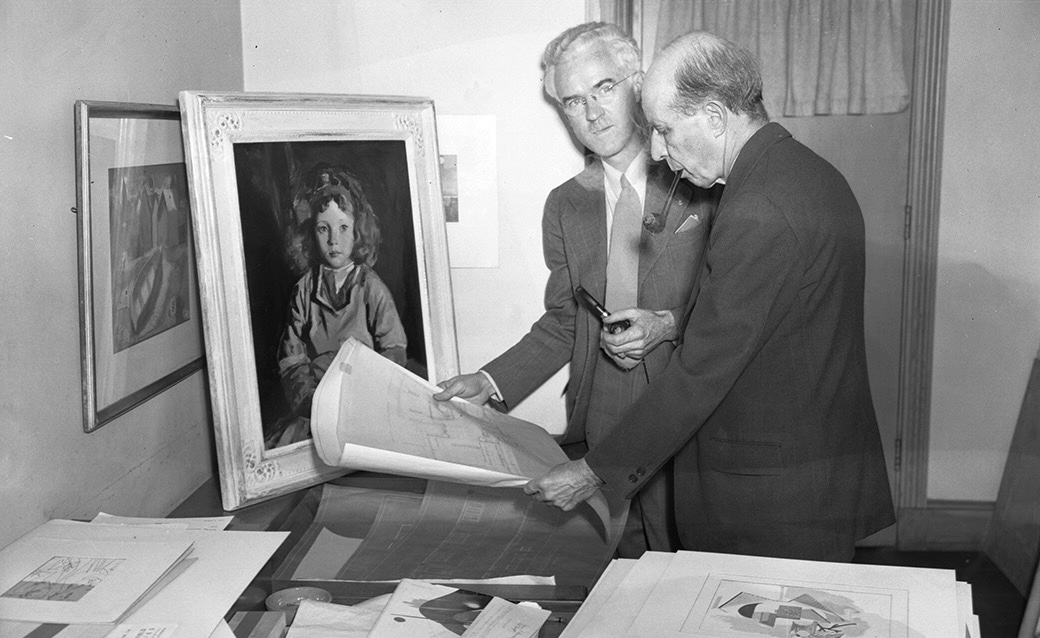
The Georgia Museum of Art opened its doors officially on November 8, 1948, thanks to the dedication and passion for art of the museum’s first director, Alfred Heber Holbrook. There are varying narratives about Holbrook and the how and why of his dedication to opening a museum, but all accounts and primary sources have one common thread: Holbrook had an unwavering love of art.
The 1940s was a time of great growth and expansion for the American arts scene, thanks in large part to President Franklin Roosevelt’s Works Progress Administration (WPA), a program that served as an employment and infrastructure booster following the Great Depression. While the WPA put nearly 8.5 million Americans to work building schools, hospitals and roads, the agency also sponsored projects in the arts aplenty. According to several accounts, the WPA had a big impact on Holbrook’s eventual founding of a museum at the University of Georgia and his donation of 100 works of art from his own collection. According to one narrative (https://tfaoi.org/aa/5aa/5aa109.htm):
“Holbrook was a lawyer in Manhattan when he and his wife, Eva Underhill Holbrook, discovered a passion for art. Following his wife’s death in May 1940, Holbrook pledged to open an art museum in her memory. In an effort to begin his collection, Holbrook would leave his law practice early everyday to meet with dealers to buy works of art on his undersized budget. Holbrook’s main focus of interest was American Impressionism and Realism.
At the age of 65, he retired from the practice of law to establish the art museum he had so beautifully pictured in his mind. At that time, Holbrook’s collection numbered 100 pieces and spanned approximately a century of American image making.
Holbrook required several provisions for his ideal museum. First, the museum had to be in the South, a region underserved by art museums. Second, Holbrook wanted the museum to be part of a university. He felt that the museum, above anything else, should be a learning experience and a university setting was the best locale. Last, the university had to have a reputable and esteemed art program that focused not only on drawings and paintings but also on sculpture, ceramics and other art forms.
Luckily, one afternoon Holbrook met Holger Cahill, federal art director under Franklin Roosevelt. Holbrook asked Cahill for advice on universities that would meet his three requirements for the museum. Cahill recommended the University of Georgia, based on the reputation of Lamar Dodd, the school’s art director.
In October 1944, at the age of 70, Holbrook visited Athens, Georgia. Pleased with what he saw, he moved to Athens, enrolled in art courses, and became an active part of the University of Georgia’s art community. In May 1945, Holbrook donated his entire collection of paintings to the university and became the first director of the new Georgia Museum of Art.
On November 8, 1948, Eva U. Holbrook’s birthday, the first two galleries of the museum opened in the basement of the old library on the university’s historic north campus.
According to some accounts, Holbrook met the national director of the Federal Art Project and soon after visiting Athens he moved here to fulfill his goal of creating a museum with his own collection initially:
(From Museum Minute) https://www.wuga.org/show/museum-minute/2022-08-01/museum-minute-who-founded-the-georgia-museum-of-art
At a fateful dinner in 1944, he met Holger Cahill, who had served as national director of the Federal Art Project under President Franklin Roosevelt. Cahill suggested that the University of Georgia, which did not have a campus museum, might be a good fit for Holbrook’s collection. Holbrook visited Athens that October and met Lamar Dodd, then head of UGA’s art department. He fell in love with the town and after his move the same year began attending art classes with Dodd, clad in a pink smock.
His gift of 100 American paintings to the university in 1945 founded the museum, although it did not open to the public until November 1948, in the basement of what was then the university library. Holbrook would serve as its first director and did so until past his 90th birthday. Legend holds that he would load paintings into the trunk of his car and drive them around the state to show them to others. He maintained an office at the museum until just a few weeks before his death in 1974. His vision continues to shape his beloved institution.
Current Georgia Museum of Art director, William U. Eiland, wrote in his 1996 book on Dodd that:
If Alfred Heber Holbrook was the “founding father” of the new museum, Lamar Dodd was surely its godfather, if not, better still, its midwife. Holbrook, from New York City, retired from the practice of law and looked for a place in the South where he could enjoy a temperate climate and study the history of art at his leisure. The forward-looking Holbrook and his wife, Eva Underhill Holbrook, had already put together a fine collection of paintings, including significant works of art by Theodore Robinson, Childe Hassam, Georgia O’Keeffe, Marsden Hartley, John Twachtman, William Merritt Chase, John Kensett, and other, by-then, American masters of impressionism and modernism. They also had an important group of Hudson River paintings in their collection. Holbrook wanted a home for their pictures, but he also wanted the chance to study art. He had heard of the program Dodd had built in Athens, and he was charmed by the artist’s hospitable and gracious reception when the two finally met at an arranged interview in August 1944. Dodd persuaded Holbrook to enroll at the University of Georgia, and at seventy-plus years of age, Holbrook moved himself and his pictures to Athens. For his part, Dodd had plans with which even a craft ex-attorney could not argue.
Dodd next helped persuade Holbrook to donate his collection to the people of the state of Georgia through the good offices of its flagship university.By 1946 Holbrook’s wife had died, and he believed that a museum in honor of the collection he named after her would be an appropriate memorial. With the blessing and help of the president of the university, Holbrook took Dodd’s advice, and the Georgia Museum of Art opened in 1948 as a teaching resource for the students and faculty at the university, as a repository for an ever growing collection, and as a place of enjoyment and learning for the community. Holbrook became its first director and remained in this post almost until his death many years later. Until his retirement, he took the message of his museum’s mission all across Georgia by loading valuable paintings into the back of his car and carrying them into schools, libraries, retirement centers, even prisons, from Rome to Valdosta, from Savannah to Columbus. On June 20, 1974, only five months shy of his 100th birthday, Holbrook died after a brief illness. Just one month earlier he had been busy at the museum, even making a purchase of one final gift, a drawing by Thomas Moran.
Holbrook’s dream of an art museum that was accessible and truly promoted a broader educational understanding of art and culture remains intact today. In the coming months, we’ll further detail the history of his lasting legacy on the progress of art for the state of Georgia, our community in Athens and the University of Georgia. We are so proud of this legacy and its continuation for 75 years.
Authored by:
Jessica Luton