On October 4, 2022, the Athens Convention & Visitors Bureau(opens in new tab) (CVB) held its first annual meeting since 2019 to share the release of new tourism economic impact figures for Athens-Clarke County, present the annual Athens Hospitality Awards and unveil its new tourism strategic plan.
According to the Travel Economic Impact on Georgia State, Counties and Regions study prepared for the Georgia Department of Economic Development by Tourism Economics, visitors spent $338.3 million in direct, tourism spending in Athens-Clarke County in 2021. This spending put 3,977 people to work in Athens-Clarke County this past year and in turn, their jobs generated a $97.7 million payroll, as well as $27.3 million in state tax and local tax.
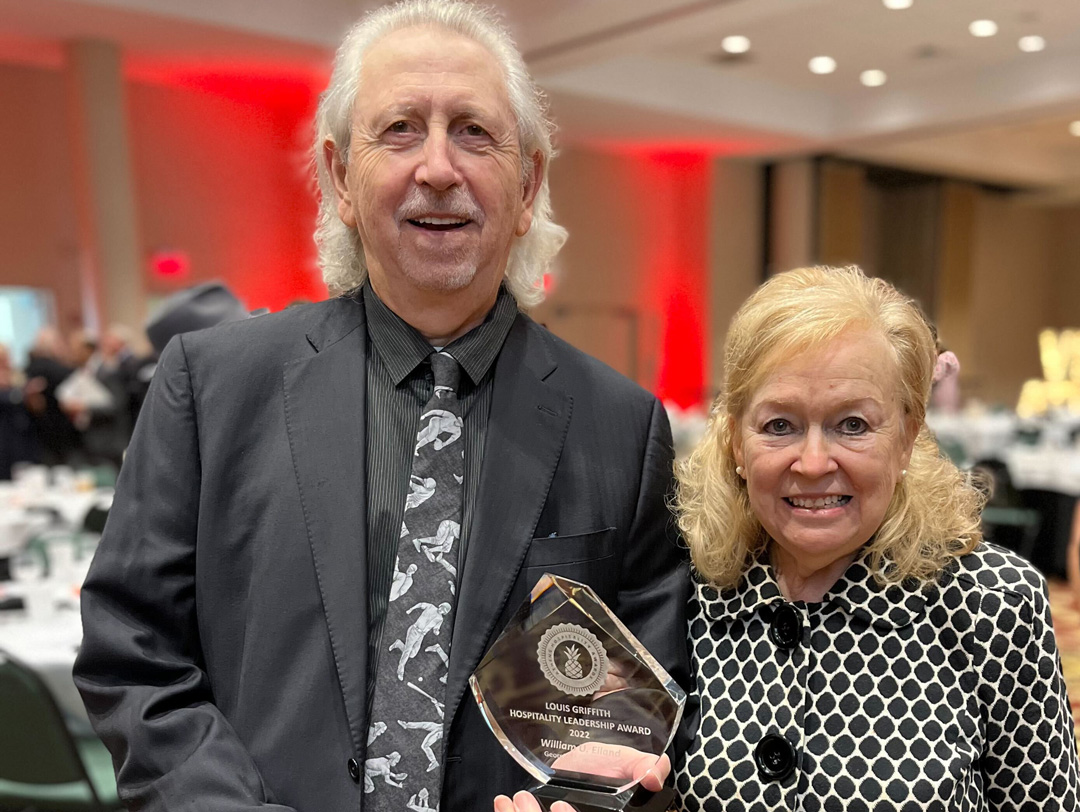
The CVB presented the Louis Griffith Hospitality Leadership Award, honoring an outstanding individual who displays foresight and exceptional leadership skills to impact the Athens-Clarke County hospitality industry, to William “Bill” Eiland, our director. Bill has been the museum’s director since 1992 and under his leadership, it has grown into the major tourist attraction it is today. “As Bill approaches retirement in March 2023, it seems right to honor his contributions to leadership in the hospitality industry with this award,” said Hillary Brown, museum communications director. “From the time he was hired, he has focused on making our museum the best it can be, by developing several crowd-drawing exhibitions, prioritizing our tourism and economic development through his active participation in the Historic Heartland Tourism Association, and more.”
Bill didn’t know he would receive the award when he agreed to come to the meeting. He thought that the CVB had asked him to say a few words about Louis Griffith, its namesake and a mentor to him in his earliest days at the museum. We present the brief talk he wrote but didn’t get to deliver here:
Louis Turner Griffith(opens in new tab) was chair of the Board of Advisors of the Georgia Museum of Art from 1989 to 1999. He was a beloved fixture at the museum, always ready with sage and pertinent advice to me and my staff.His obituary is one of the longest and most accomplished of any I have ever read. But it is not only the museum or even the university that valued and benefitted from Louis’ service to the people of the state, but also the region, and, indeed the nation. To this day I miss his wise counsel, his great good cheer and his love for the city of Athens, its museum and the flagship university that resides here.In fact, people all over the state knew Louis Griffith. For but one example, because he established a center at the museum, all teachers in public and private schools in Georgia have access to our in-service teaching materials and catalogues. In addition, our library at the museum(opens in new tab) proudly carries Louis’ name.Moreover, early in my career here I was struck by the reach of Louis’ friendship and care for all Georgians. In 1990 or thereabout, I accepted an invitation to speak to a class at Reidsville’s prison. I foolishly chose as a subject colonial portraiture, to which one member of the class remarked after my slideshow, “you people were ugly.” He was not wrong. After I finished he and I chatted for a minute, and, upon finding out that I was from Athens, he asked, “Do you know Mr. Griffith?” Indeed, I did, and indeed happy am I that I did.So should we all Georgians, certainly all Athenians. Louis proselytized travel in the state — forays into its past and its future as well as its present — and most of all to his beloved homes of east central Georgia, of Eatonton and, of course, of his beloved Athens. We follow in his footsteps, and every time I give a talk across Georgia, many in my audiences express how lucky I am to live in Athens.I wish I were more like Louis Griffith, who was an advocate and champion, but an even better description may be that he was an apostle of our good life here.
Authored by:
Museum Staff