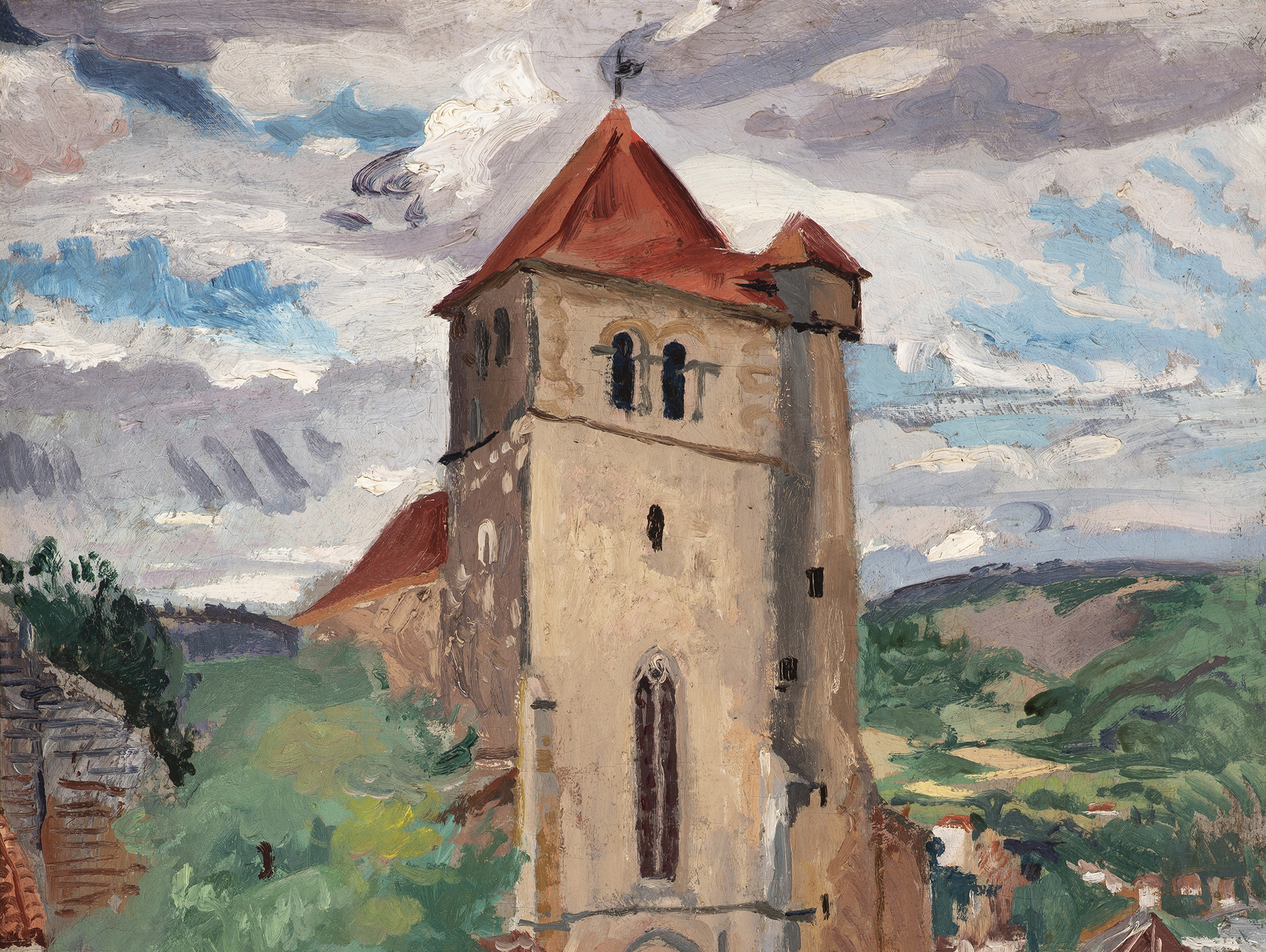
Pierre Daura (American, b. Spain, 1896 – 1976), detail from “Saint-Cirq-Lapopie (Lot). L’église vue du cimetière” (Saint-Cirq-Lapopie. The church seen from the cemetery), 1930 – 39. Oil on canvas, 31 1/4 × 20 1/2 inches. Georgia Museum of Art, University of Georgia; Museum purchase with funds provided by the Pierre Daura Foundation. GMOA 2019.81.
“Repetition is not repetition, … The same action makes you feel something completely different at the end,” Pina Bausch, a German dancer and choreographer, told the New York Times in 1985. The exhibition “Look, Paint, Repeat: Variations in the Art of Pierre Daura,” on display at the Georgia Museum of Art, highlights artist Pierre Daura’s renditions of the same landscapes, each with a different style and feel than the last. The show, which opened on February 4, will be on view until May 23.
The exhibition is a continuation of the museum’s “In Dialogue” series, in which curators create focused, innovative conversations around a single work of art from the permanent collection. The series brings these familiar works to life by placing them in dialogue with works of art by influential peers, related sketches and studies or even objects from later periods.
Born out of an acquisition of Daura’s work “View of Saint-Cirq-Lapopie,” “Look, Paint, Repeat” examines Daura’s affection for the small French town Saint-Cirq-Lapopie. The exhibition, organized by Nelda Damiano, Pierre Daura Curator of European Art, focuses on Daura as a landscape artist. At the center of it all are Daura’s paintings of the church in Saint-Cirq, a subject he painted over 100 times.
“The focal point is definitely this imposing architecture that dominates the village,” Damiano said. Saint-Cirq is a small, medieval village about 400 miles south of Paris with a population of around 200 people. Life there revolves around the church, making it a natural subject. “I wanted to present the viewer with different points of view – almost as if Daura planted his easel in different spots and you almost get a 360-degree view of the church,” Damiano said.
Another subject Daura painted frequently was the home of his friend writer André Breton. The exhibition includes watercolors of Breton’s home, all from the same perspective, but created using different techniques, each more abstract than the last.
There were some factors Damiano had to consider when putting the show together. The limited real estate (it occupies a single wall) required her to be very selective of the works she chose to display. After combing through the images of the museum’s Daura collection, she selected nine works to showcase. This decision was also influenced by the lighting choices she’d have to make. “It’s a bit complicated to have, on the same wall, drawings and paintings because they don’t require the same lighting levels,” Damiano said. Additionally, the availability of works played a role in what ultimately made it onto the wall.
Damiano hopes the exhibition encourages observation and contemplation. She wants visitors to take their time looking and observing the art in the same way that Daura took time observing his own surroundings.
Organizing the exhibition was a meticulous process, but Damiano still allowed herself to have a bit of fun while doing it. “One thing that was fun for me is to see where he signed his paintings. He’s always signing his paintings, but never in the same spot, so I thought, ‘Let’s play where’s the signature,’” she said, laughing.