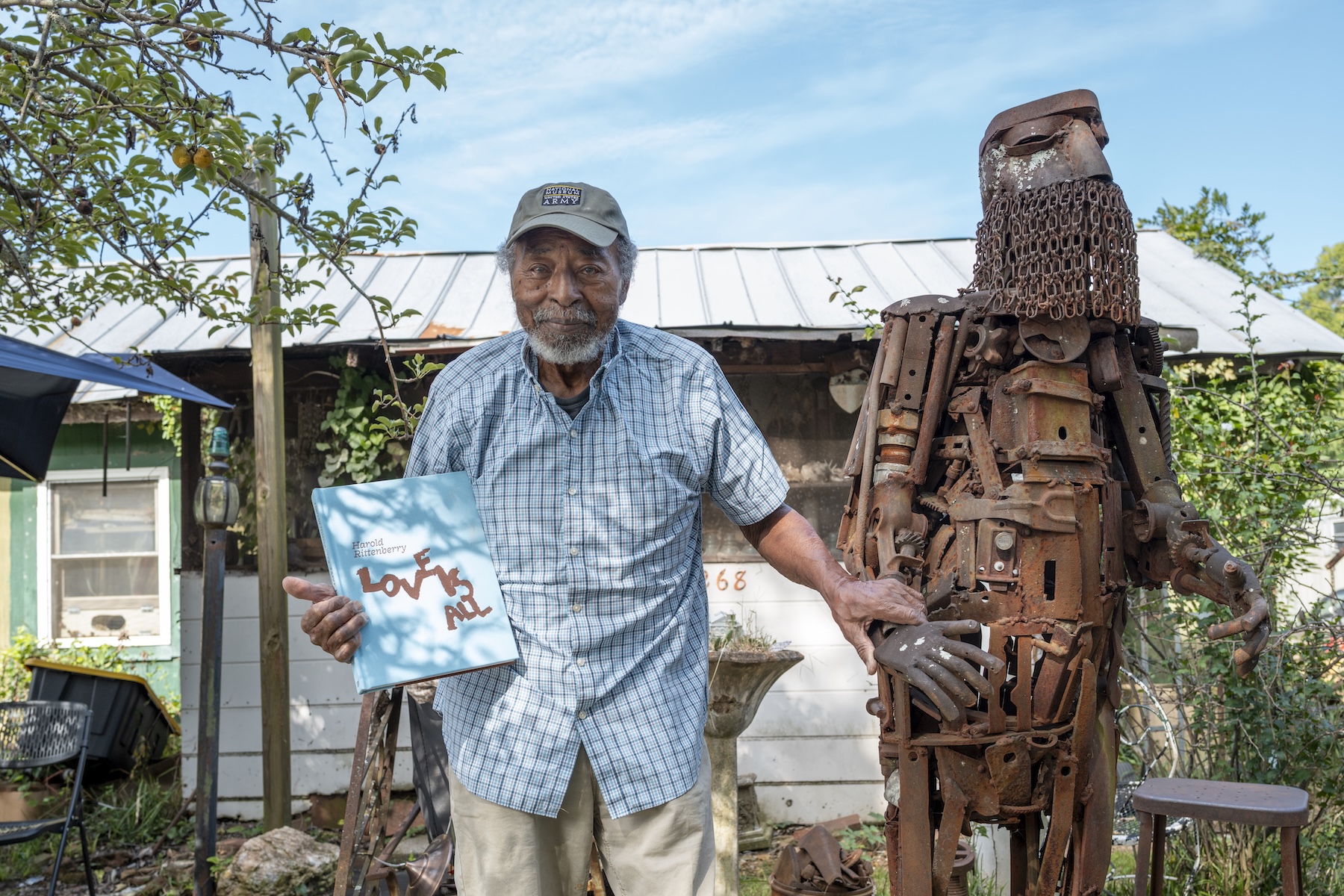
Throughout Athens are birds, snakes, mermaids and unicorns shaped and welded from scrap metal. Sculptures in the form of benches, towers and gates are sprinkled all over, at libraries, shopping centers, cemeteries, neighborhoods and parks. You may have encountered a few, some beckoning you with the simple message: “Come Rest Ye.” These are the creations of Harold Rittenberry, a local sculptor and self-taught artist whose metalwork has reached the Athens community, supporters in Atlanta and admirers across the globe.
Now, a new Georgia Museum of Art publication, “Harold Rittenberry: Love is All,” offers the first monograph on the life and works of the prolific sculptor. Six years in the making, the book brings together essays from Dan T. Coenen, University of Georgia professor emeritus of law; Robert Clements, UGA professor emeritus of art; and William Underwood Eiland, former director of the Georgia Museum. Coenen and Eiland also conducted an extensive interview with Rittenberry, alongside Shawnya Harris, the museum’s Larry D. and Brenda A. Thompson Curator of African American and African Diasporic Art.
As a child, Rittenberry would go on adventures with his friends in the woods and creeks of Athens, digging up anything he could find and, in turn, creating a lasting connection to nature. Those early visions of animals, bugs and landscapes stayed with him through the years and, along with his religious upbringing, came to define the major motifs running through his work. Rittenberry creates art that is symbolic and representative of his view of the world. The pieces tell stories, real or imagined, and advice driven by his philosophies.
“Love is all” is a simple phrase, yet it captures the overarching message that Rittenberry puts out into the world. He was enthralled with large metal machinery from a young age, particularly drawn to a truck his father bought to haul materials used for masonry work. That fascination ultimately led to the U.S. Army, with the goal to operate big military vehicles. In 1956, not yet old enough to enlist on his own, Rittenberry found himself forging his parents’ signatures and on the way to Germany to serve.
There, Rittenberry grew in ways he never expected, learning to work in hard weather conditions and strengthening his reading and writing. While abroad, he made sketches in his downtime. Eventually, officers took notice and began requesting drawings for themselves.
Three years later, he returned to Athens. He worked an array of different jobs until his mother began to develop Alzheimer’s in the early 1980s, and he began taking care of her with his sisters. Due to the intense stress of being a caregiver, he searched for an outlet to stay sane. This led him to purchase a welding torch, a tool with which he had no experience. After several failed attempts, he started small, making abstract “tabletop pieces,” and displayed them on his lawn. It didn’t take long for others to notice. An antiques buyer passed through his neighborhood and offered him $2,000 for six of the sculptures. Though he doubted that this sale was even real, Rittenberry agreed immediately. That buyer kept coming for more sculptures and eventually arranged for Rittenberry to submit his work to an Atlanta folk art festival, where it was once again popular. Rittenberry continued to create, and visitors began to come. His “Spirit Yard” amassed numerous sculptures and gained the attention of collectors well beyond Athens. In 1996, he was commissioned to create work for Atlanta’s Folk Art Park ahead of the Olympic Games.
Despite great interest in his work domestically and abroad, much of Rittenberry’s work has gone to people he made handshake deals with in his yard or that he donated to community organizations. Shawnya Harris describes Rittenberry’s perspective on his work: “Harold Rittenberry’s work doesn’t ask to be sought out. It simply became a part of how Athens looks and feels; you stop seeing it simply as art and start seeing it as Athens. That’s the thing about a following like his — it isn’t built through galleries or an art market like some artists. It’s built through decades of quiet, steady presence, one work at a time. For a long time, if you said ‘sculpture’ in Athens, people didn’t ask which one. They just said, ‘Mr. Rittenberry.’”
That synonymous association with Athens sculpture has slowly but surely established Rittenberry as an icon, one whose work has woven itself into the fiber of the city. “Harold Rittenberry: Love is All” has finally created a lasting record for that legacy. The museum will hold a book signing with Rittenberry on September 13 from 1 to 3 p.m., offering the public an opportunity to celebrate an artist who has contributed so much to the community.
Authored by:
Paige Carter