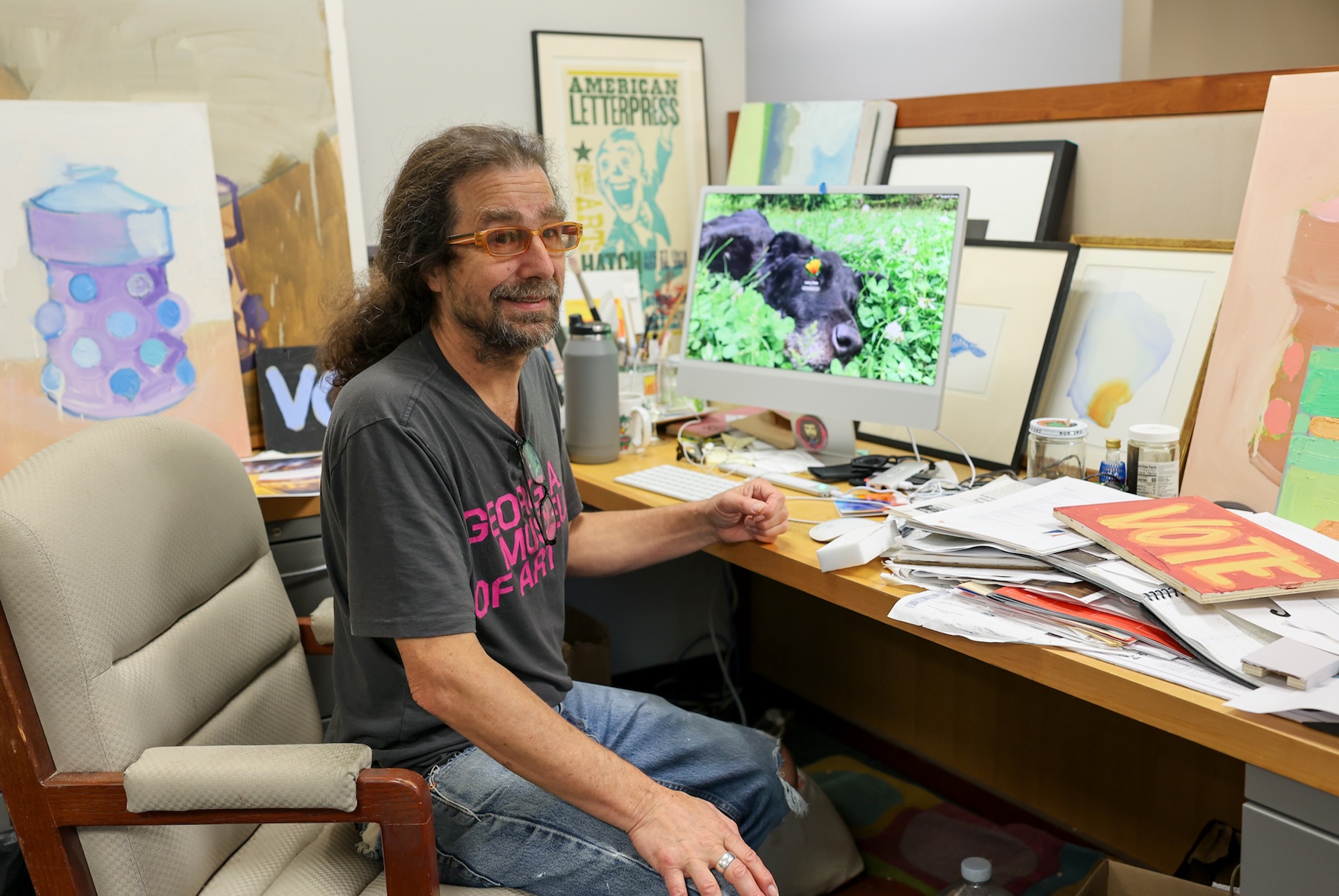
The Georgia Museum of Art is saying goodbye to a dedicated art handler, Larry Forte, as he enters retirement. After more than two decades with the museum — working on countless exhibitions and serving a vital role in the museum’s ecosystem — Forte is stepping into his next adventure, one that promises even more creative endeavors and plenty of walks in the park.
Before his last day, on August 31, we spoke with Forte about his career, his advice to others interested in working at a museum and his vision for the future.
Q: How long have you worked at the Georgia Museum of Art?
A: Let’s see, my official full-time employment began in April 2004. So, 22 years and some months. Before that, on occasion, I came in for freelance. Officially 22 years.
Q: How did you get your start in museum work and art handling?
A: I had gone to art school at the Ringling School of Art and Design in Sarasota, Florida. After that I was doing odd jobs, restaurant jobs, one prop painting job and one dock building job, but mostly restaurants. Then a friend told me about opening at the John and Mable Ringling Museum of Art, and I applied and got that job. It was an awesome experience. I joined the art handling/preparators crew, so I was the new guy in training. It was a really great environment for training because they house a large collection of baroque paintings and very large Peter Paul Rubens. They were called cartoons, but they were full-on paintings, and they were technically patterns or designs for tapestries. Some of them were 12 by 15 feet. I worked there during their renovation. They took a drop ceiling out of one gallery that had the Rubens and then restored these beautiful cherubs and angel-type arches in the ceiling, [where] the paint had been flaked off and just patched up all the plaster. So yeah, that was my first museum job. After two years at the Ringling, I moved to New York City and eventually was able to start working freelance at museums and galleries there.
Q: What is your typical day like as an art handler?
A: There’s a lot of variety. Specifically in a museum like this. We’re not only installing the art and changing out works when necessary. As an art handler, we’re shipping out, receiving and unpacking crates and going through the process of installing the shows. For instance, “Edmonia Lewis: Said in Stone” was all hands on deck to unload some of these large marble sculptures. Slowly and carefully, I guess is the best way to say it. Aside from that, there’s a lot of upkeep, like just painting walls, or building a pedestal or some specialized mount for a fragile object or something like that. No day is the same, so that is one thing to keep you interested. When we’re not too busy, I get to remind myself that I work in a museum packed full of artwork, so it’s not like a stuffy old office, you know?
Q: You have a unique position where you get to see the art up close and personal, and I understand you’re also a musician and painter. How did that access shape or change your own view of making art?
A: I definitely came to appreciate other artists and art history more than I did just coming out of art school. I wasn’t focused on art history. I was only mildly interested, and now I’m a little bit less self-centered and more interested in what other artists have done. I’m impressed by all the work that I’ve ended up handling. I think it just motivated me to stay involved, and sort of do my part, but not have any unrealistic expectations of myself. You witness a lot of geniuses when you’re working at the museum.
Q: What has been your favorite exhibition from your time at the Georgia Museum of Art?
A: Oh, boy. Yeah, that is a hard question. I don’t remember names, but one artist [DeWain Valentine] did these giant resin discs of different colors. There was a kind of a surrealist show that Giancarlo Fiorenza did in the early 2000s. He was our curator of European art for a while. I think he’s out in California now. And that was fascinating. Jeffrey Richmond-Moll did a really awesome show, “Extra Ordinary” — it was during COVID. The activities were memorable. He put a lot of good works together.
Q: What advice would you give someone who wants to pursue art handling?
A: Apply everywhere, intern somewhere. If you can afford it, intern for free. By getting your foot in the door, you’re putting your eyes on how it gets done. I didn’t start as an intern, but I didn’t know about it until I was lucky enough to take the opportunity, and then I was like, oh, this is a thing. I told Caroline, a current art handler, when she was an intern, to go to a big city where there’s more than one art museum and gallery, so you can network. However, she didn’t need to do that; she pulled it off. It’s not unheard of to get a full-time job if you can intern here, but my belief is that if you want to work as a handler, you have to work in New York or D.C. or Atlanta, somewhere where there’s more than just one museum. One of the benefits of living in a larger city is that freelance art handlers end up networking with one another. That makes it a lot easier to find the next job.
Q: What do you look forward to most in your retirement?
A: Painting, making my own paintings. I don’t have a really clear plan, but play a little more music, rekindle my podcast. Recreational outings with my wife. And then maybe a little traveling.
Q: Anywhere in particular?
A: Anywhere, everywhere. I don’t feel like we’ve thoroughly explored Georgia, so maybe we’ll start here. Start close to home, you know?
Authored by:
Paige Carter