Editor’s note: Today’s post was written by a recent visitor of the museum, Clara Butler, who dazzled our staff with their visitor survey answers. We hope you enjoy the story of their family visits as much as we did.
Last week, our kid’s school was off for two days. My spouse and I planned accordingly, which is kind of a big deal in itself, and we spent one night brainstorming fun (and free) things to do with a three-year-old for the long weekend.
“I wanna go to the museum,” our child exclaimed spontaneously.
Background story: He had been watching the television show “PJ Masks” lately and, if you haven’t seen the show, it’s about three superhero children who vow to save the day by fighting crime at bedtime. Frequently, the PJ Masks rescue the local museum from mayhem as ninjas and werewolves (also all children) swarm to abduct all the ancient artifacts within. Logistically, I have some questions about all these super-characters, like, where in the world are their parents? But I refrain from inquiring because, ultimately, it doesn’t matter. My kid enjoys it and it sparks his imaginative play. It was in this way that “PJ Masks” prompted him to ask if we had any local museums.
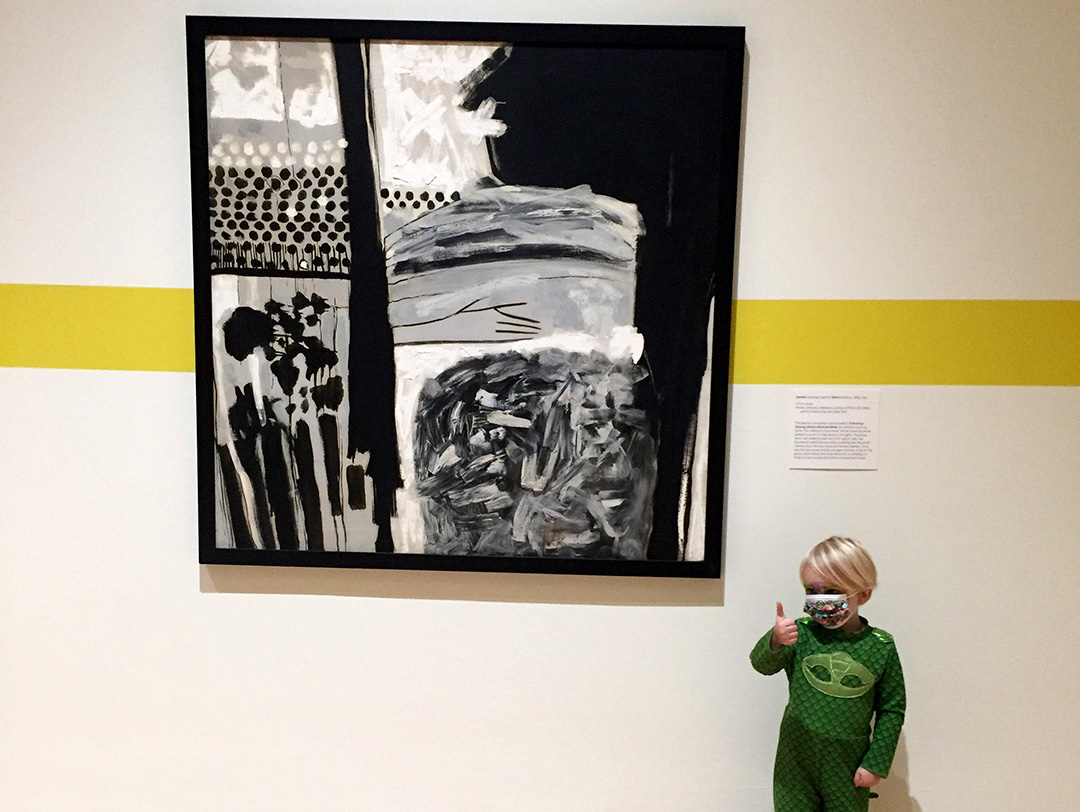
I grew up in Athens, so I immediately thought of the Georgia Museum of Art. I remember going there frequently as a kid and loving it. I checked out the coronavirus policies online, reserved two free tickets for my spouse and kiddo and called it a night. The next day while I went to work, my family went to the museum. Our child picked out his outfit, a costume of the character Gekko from “PJ Masks.” Since he is also obsessed with dinosaurs, this costume serves frequently as a shapeshifting Tyrannosaur, Spinosaurus or any other inspirational prehistoric reptile. After the museum, my spouse told me all about the Emma Amos exhibition; at the same time, my little dinosaur told me about the “circus work” and the “man inside the whale.”
Then, he surprised us with a request to go back to the museum.
I mean, as a parent you can’t deny that request. Dutifully, I booked two tickets online. The next day, it was my turn to visit the museum with our child.
When we first entered, we were checked in immediately. Not because we were the only ones needing to be checked in at that time (we were, thank you, COVID-19 policies), but because the employee at the desk immediately recognized my child’s green lizard costume. He told us, “Welcome back” and said we were ready to go. I then asked my child to be my guide, since I had literally not stepped into this museum for many, many years.
“First, we go to the elevator,” he said. And then he led me that way. He gleefully pushed the buttons, and when we got to the second floor, he took me the route that he and his dad took the day before. He asked a lot of questions, like, why was there a blond woman in blackface [an Emma Amos painting]? Why was there a woman holding up a black and white mask? Why was Martin Luther King Jr. there next to “an upside down guy” (Malcolm X)? I did my best to respond as honestly as I could, being as true as possible to the background information provided by the museum, while also trying to approach the concepts in a way a three-year-old might be able to follow.
Kids are pretty cool. They always understand more than we give them credit for, but they also don’t let details deter whether or not they enjoy something. When he took me to the gallery next to the Emma Amos exhibition, we looked at a lot of abstract art. I asked him questions, like, what did he see? What did he think was going on?
“That’s a house,” he said, pointing at one painting. We looked at each other and he asked my question back to me, “What do you think that is?”
“Flowers,” I said. I didn’t even look at the title at that point.
Then he took me to the Alonzo and Vallye Dudley Gallery, where we saw aerialists flying on a large trapeze to some string music. This was the “circus work” he told me about the night before. The aerial artists were wearing flower crowns, which he recognized in one of Emma Amos’ works. He told me he wanted to try it out, and I made a mental note to check out the local trapeze studio for age-appropriate classes.
When the video was done, he ushered me to see “the man inside the whale.” I knew he had been looking forward to showing me this piece. There was a sitting area right in front of it, so we parked our cabooses and I asked him about “the man inside the whale.” What was happening in the picture? Who were those people? Why was there a man inside the whale?
He shrugged his shoulders in the way a three-year-old shoves their shoulders up to their ears and drops them emphatically. “The whale ate him,” he said.
After that, he said it was time to go. Since the enormous staircase was before us, that is where he took me. When we went outside, he looked at one last piece, Charlie Lucas’ horse sculpture. He noticed that it was built from metal scraps. We both noticed there was a wheel inside of it. “How did they do that?” he asked me. I shrugged emphatically. “I don’t know,” I said. He took my hand and we meandered back to the car.