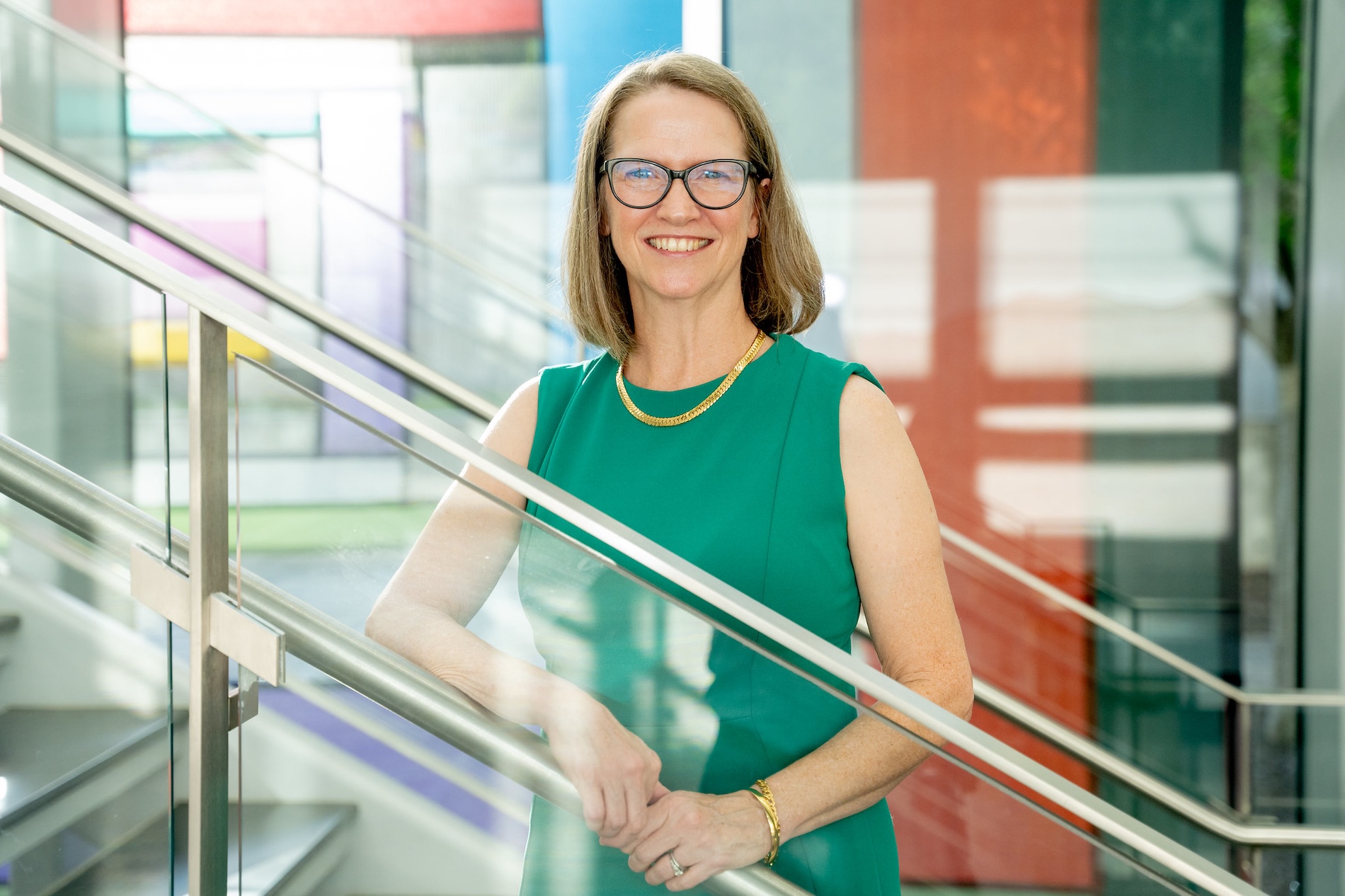
Tricia Miller, a familiar face to those acquainted with the Georgia Museum of Art, took on the role of interim director in late July when David Odo, who headed the museum for the past three years, departed for a new position as director and CEO of the Honolulu Museum of Art. This semester marks Miller’s 28th year with the Georgia Museum of Art. She came to the museum as assistant registrar in 1998 and later became head registrar and deputy director of collections and exhibitions.
Q: What drew you to work in art history and museum studies?
A: I was actually an English major in college, but I had a minor in art history. I had enough credits in art history, so after I graduated, I decided to shift over to the art history realm and get a master’s in art history. Before I left college, I had worked in a little gallery at the college that I went to. That really made me fall in love with that kind of space, so I knew I wanted to pursue that in some way. I got my master’s degree at the University of South Carolina, and they had a program back then that was called applied art history, which is essentially what we would call museum studies today. I took classes in art history, but then I also took classes in the local museums and learned about how museums operate. I just really loved that. I knew that’s what I wanted to do.
Q: What about that initial gallery made you fall in love with museum work?
A: I found that I enjoyed being around museum objects, and I enjoyed having the access that actually working in a place like that gives you to those objects. So not only the history and the background, but actually being able to physically handle objects and take care of them. I really liked the idea of taking care of objects as a part of history and making sure that they last.
Q: What drew you specifically to the Georgia Museum of Art, and what has drawn you to stay here for almost 30 years?
A: What initially drew me to Athens was that my then-fiancé, but now-husband, was getting a Ph.D. here in Athens, so he was already here. He started looking for jobs, and when he finished his degree, he ended up staying here in Athens for a postdoctoral fellowship. I ended up getting the job here. Then he ended up staying and progressing in his position, and I did the same thing, and it just sort of worked out that we were both at the same university, with jobs in our fields, and we decided not to mess with that.
Q: When did you know that you were going to be interim director, and what was that like?
A: I knew about two weeks before the director left. It was a surprise to me. I had to quickly shift my thinking and think about how to take this on and keep the ship afloat while we’re in a transition period. And of course, in that two-week time period, there was a lot of thought about how much I would be able to maintain from my deputy director position, and what duties and responsibilities I would need to lean on other staff for.
Q: What does a normal day at the museum look like for you? How has that changed with your new position as interim director?
A: For me, right now, I think my new normal is a lot of listening and learning. I was, of course, very familiar with the division of collections and exhibitions from my deputy director role. So I feel like I have a good handle on that division, but there are a lot of other divisions and departments in the museum. So I’m doing a lot of learning about them, what their priorities are, what their projects are, what their vision is for the future, and what they want to work on with the next director. In that way, I can kind of bridge this gap until that new director is on board. I also have a lot more opportunities now to interact with peers across campus and cross-departmentally. The director of the museum sits on the UGA Arts Council, so it’s been interesting to participate in that and see how the museum fits into the larger university system, particularly the university’s arts systems and collaborations.
Q: As the interim director, how have you balanced your new duties with your passion for archival work?
A: I’ve tried to keep my hand in some of that because it is my true love. I do like to go down to art storage and take a look around sometimes, or just keep tabs on what’s going on with exhibitions and collections. One thing that happened right away after I took on the position was the installation of the Edmonia Lewis exhibition. I did spend a couple of weeks right at the beginning being very involved in that installation. That was part of what I loved about being in that division. It was nice to still have that connection to that part of my career.
Q: What has it been like to be with the museum through so many periods of change? How are you feeling about this era of transition after David Odo relocated to the Honolulu Museum of Art?
A: It’s interesting to look back at how the museum has changed all these years. You know, I’ve been here 28 years now. Our previous director, Bill Eiland, was here for a very long time. Once he retired, I think it was expected that there was going to be a lot of change. David came on, and he did change things up. We had a new focus on our mission statement and our strategic plan and started moving in some new and different directions. Now that David has decided to move on, I would say, we’re in a period where we’ve sort of gotten past the big change, and we are looking to move forward with stable growth.
Q: What does stable growth mean to you in that context?
A: It means good financial resources to support the growth. It means maybe more of a focus on growing initiatives that we built in the period in which David was here. So I would say not necessarily a lot of new things or new initiatives, but more so finessing or tweaking the things that we’re already working on.
Q: What can you share about the hiring process for the next director?
A: I can give you kind of a general take on how the process will go. The museum director reports to the vice provost for academic affairs. The provost’s office is the one that will manage the hiring process. What they will do is form a committee of peers across campus, other deans, directors, department heads, plus a few staff members from the museum and some community stakeholders. And they will bring that committee together to identify candidates and choose finalists to come for interviews on campus.
Q: What’s the timeline for the next director to be hired?
A: We are looking at getting that whole process started this fall. It could take as long as next spring. It sort of depends on how the process goes. But I would hope that by next summer, we would have someone identified at least.
Q: So far as being the interim director, what part of your work have you treasured the most, and what new insight have you gained?
A: That’s a really good question. I have to think on that one for a minute. I think I would say what I’ve enjoyed the most so far is learning about all the projects and priorities of all the departments. Even though museum work is very collaborative and all the departments work together quite a lot, we do sometimes get focused on our own projects and don’t necessarily know what everyone else is working on. So it’s been really nice to learn about the big picture and see everything that’s going on at the museum and know what goes into making all those great programs happen.
Authored by:
Finn McClelion