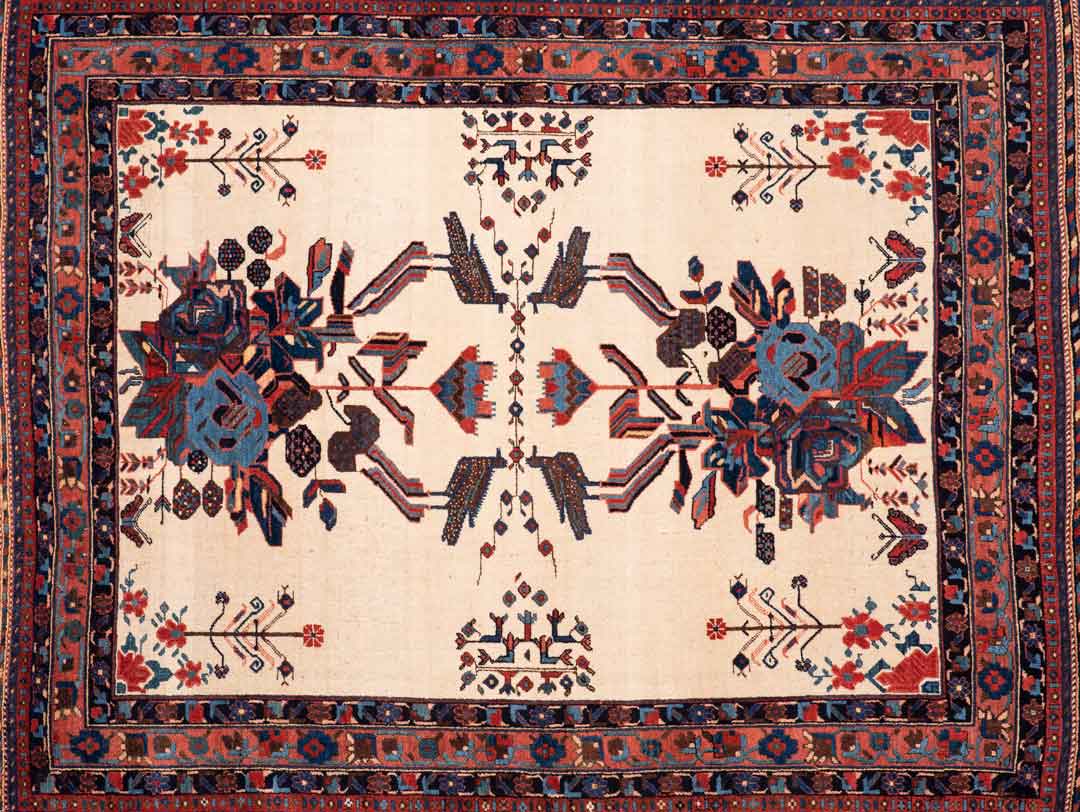
Even as the museum has been busy busy busy installing exhibitions in its galleries, it’s also been working on expanding its range of online exhibitions. Sometimes the online exhibitions mirror in-person ones, and sometimes, as with the brand-new “Beyond Utility: Rugs of Southwest Persia,”(opens in new tab) they exist only online. “Beyond Utility,” for which collector James Verbrugge served as guest curator, celebrates the diverse artistry in rugs from 19th-century Southwest Persia as works of art rather than simply tools within their communities. The exhibition provides an overview of the history behind the creation of these rugs as well as the influences the rugs reflect in their design. One nice aspect of the online format is the ability to provide close-up views of the objects.
In the 19th century, in Southwest Persia, weaving was a major artistic form among herding people; their animals were tied to their grazing ecology, economic survival and artistic production. This exhibition focuses on four groups of peoples to tell the complex story of how they captured the world within their designs: the Qashqai, the Lurs, the Khamseh and the Afshar.
The exhibition examines the rugs of these nomadic confederacies and tribes. The rugs often include the “Persian flaw,” or the idea of creating deliberate imperfections within one’s work to reflect the notion that human creations are flawed. These flaws also reflect the practical aspect of the rugs, which are more workman-like than individual artistic outlets. Because the tribes within the exhibition were primarily nomadic, the looms they used were made to be easily carried and the dyes were created from locally found plants and animals.
Rug patterns and designs were associated with specific tribes. Due to the rustic, imperfect weaving, it is unlikely that two rugs were ever identical. Even if two rugs did look alike a weaver would have included a unique feature while weaving, either intentionally or by mistake.
The primary influences of the designs on rugs came from tribal associations and intertribal influences. To understand how tribes interacted with the world and with each other, it is important to note that the tribes in southwest Persia were first organized independent groups but at the beginning of the 16th century moved to create confederacies, or alliances, for greater strength.
The Qashqai Confederacy was formed in the 16th century, and tribes and sub-tribes of the Qashqai include the Shekarlu. The exhibition pays special attention to the Qashqai Shekarlu weavings as this sub-tribe no longer existed after the late 19th century (having been absorbed into other groups). The exhibition includes 10 Qashqai rugs as the Qashqai Confederacy produced the greatest variety of rugs and the highest quality of rugs.
The exhibition also considers rugs from the Lurs tribe and Khamseh Confederacy. The Lurs tribe was in southwest Persia in the Zagros Mountains, near the Qashqai. The Khamseh Confederacy was nearby, to the southeast of the Qashqai. It was formed primarily to counter the influence of the Qashqai. The smallest tribe in the exhibition were the Afshar, located to the east of the Khamseh, near the city of Kerman. This proximity means that some Afshar weavings exhibit the urban influence of Kerman, which was and is an important weaving center of city workshop rugs.
We thank James Verbrugge, a notable collector and authority on rugs, for sharing his resources and collection for this exhibition, as well as the Material Culture and Arts Foundation for sponsoring the online exhibition.
By Emma Emery