Every year, the Georgia Museum of Art organizes tours for every 5th-grade class in the Clarke County School District (CCSD), with generous private donors funding bus transportation and other costs. In 2019, 2,274 CCSD students from all 14 elementary schools toured the exhibition “Mary Lee Bendolph: Quilted Memories.”(opens in new tab)
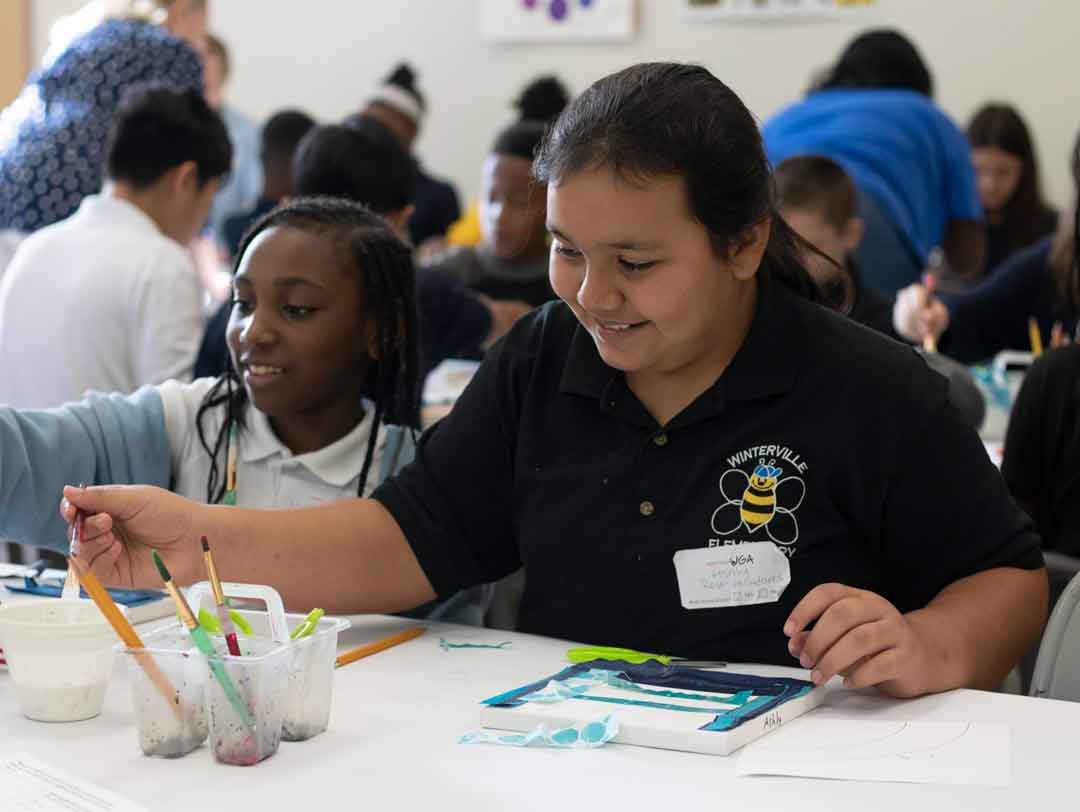
The museum’s education staff survey teachers and participants every year and take their feedback into consideration when planning the following year’s 5th-grade tours. This year, following a welcome and introduction in the auditorium, groups of 10 to 15 students proceeded on docent-led tours of the permanent collection. Students then explored “Quilted Memories” independently, using an activity guide that promoted close looking and emphasized their personal reaction to the quilts. They also engaged in hands-on, interactive learning in the galleries via the museum’s Art Carts. A studio session followed the tour; students made their own works of art on canvas by arranging fabric into patterns inspired by the exhibition. Outreach lessons following the program, funded by Georgia Council for the Arts, were scheduled for eight schools, although only six took place due to COVID-19.
One important goal for this year was for students to engage in self-guided learning. Students explored the galleries on their own using a self-guided activity with interdisciplinary questions and prompts for them to fill out. Art Carts with touchable objects and additional educational materials encouraged students to approach and learn more at their own pace. Students approached creative work in the art studios with imagination and ingenuity, using the provided materials to create their own versions of meaningful quilt patterns.
The touchable teaching materials for the Art Carts were successful in engaging students and enabling them to learn in the gallery at their own pace. Many docents commented on the usefulness of these and other interpretive materials, and a teacher remarked that the interactive learning component really helped students connect more to the art-making process and the quilts on the walls.
In previous years, teachers reported that students had a difficult time connecting the visit with the outreach lessons that followed, sometimes months after the original trip. This year, postcards featuring works from the exhibition were printed with a prompt that read “Today at the Georgia Museum of Art I learned . . .” on one side. Students wrote their thoughts on the cards and gave them to museum educators before completing the art project component of the tour. The cards were later distributed to outreach instructors to return to the students who wrote them when the outreach instructors visited classrooms. The postcards served to remind students of the museum visit in their own words and provided rich and powerful insights to museum educators. For example, some students described learning sweeping and meaningful things like “art works in mysterious ways” or “art is for everyone.” Other students overwhelmingly shared information on Mary Lee Bendolph’s involvement in the civil rights movement. They deeply connected with stories about her marching with Martin Luther King Jr. Other students recorded take-aways from the permanent collection in galleries that staff thought students appreciated less. Finally, some students wrote that the museum visit changed their opinions about museums — that visiting an art museum and talking about art was cool and interesting. This year, the museum added student evaluations of the program to the existing evaluations by teachers and other adults.
The outreach lessons that did take place were successful. Students were enthusiastic about sharing details of their museum visit with outreach instructors, and the outreach activity approached the work of Mary Lee Bendolph from a different perspective. Teacher feedback indicated that the outreach lessons were a success. Georgia Council for the Arts approved the re-allocation of remaining program funds that could not be used for outreach lessons for Art at Home kits, distributed via the school emergency meal food distribution program, that provided art experiences and supplies to CCSD students and families during COVID-19 closures. This re-allocation of funds helped the museum create and distribute 1,200 kits throughout the summer of 2020. Inspired by objects in the museum’s collection, each kit featured a different art-making prompt, art supplies and a description of a work of art that inspired the activity. CCSD administrators who passed out the kits frequently remarked that parents and students looked forward to the kits and appreciated the activities during such a tumultuous time.
Planning is ongoing for the 2020 – 21 school year 5th-grade tours, which will focus on the exhibition “Emma Amos: Color Odyssey”(opens in new tab) (opening January 31, 2021).
Authored by:
Hillary Brown