Since mid-June, if you walk toward the temporary exhibition galleries, where the exhibition “Southern/Modern” is on view (and will be into December), you’ll see a large abstract painting and a case full of dirt. What’s that all about?
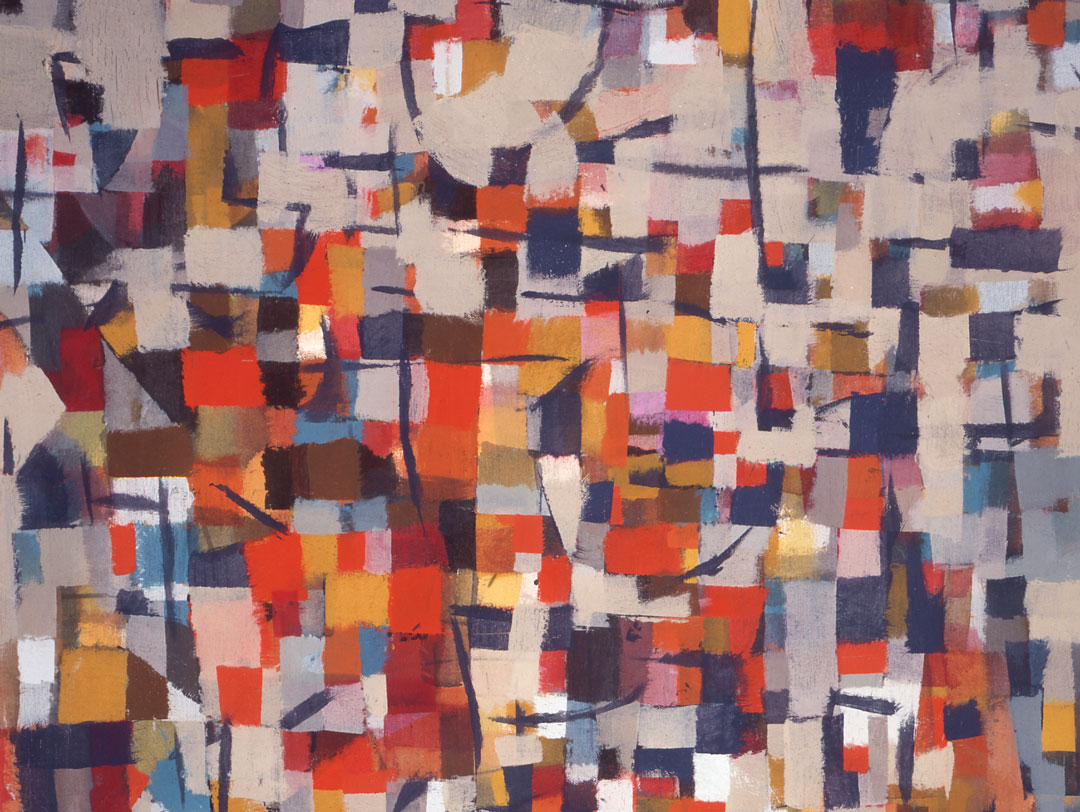
Howard Thomas made the painting “Little Grand Canyon Yellow” in 1964. It’s not in “Southern/Modern,” but another work by Thomas is, and it serves as a point of comparison with the show, an example of the modernism that was practiced in the southern U.S.
Thomas was from Ohio but made his way to Athens to teach at the University of Georgia from 1945 to 1965. He recorded observations from his many travels in vivid sketchbooks, which are part of our permanent collection(opens in new tab). He wrote, “I carry my sketch book with me and draw from nature constantly. I am inspired by the many nature-ordered transformations which I come upon unexpectedly. I seek out visually satisfying experiences in nature and in art.”
Thomas lived south of Pittsburgh, Pennsylvania, then attended the Ohio State University before enlisting in the Student Army Training Corps of the U.S. Army in 1918. He then worked in a steel mill before studying at the School of the Art Institute of Chicago. He taught art at State Teachers’ College in Milwaukee before coming to North Carolina in 1942 – 43 to teach at the then Woman’s College of the University of North Carolina at Greensboro. He then taught at Agnes Scott College in Decatur, Georgia, before joining the art faculty at UGA. He remained at Georgia until his retirement in 1965, after which he moved to Carrboro, North Carolina, with his wife and fellow artist Anne Wall Thomas, a North Carolina native.
Thomas often abstracted his images into small colored squares in a way that can resemble pointillism with bigger building blocks. In other cases, the inspiration isn’t visible at all. In 1967, he said, of his work, “I have wanted the arrangement of color shapes to be set into a particular rhythm which emerges as an ensemble within itself.” He made this statement at a time when his work had grown increasingly abstract. His earlier works share a similar aesthetic, although they remain more strongly tethered to the observable world.
“Little Grand Canyon Yellow” doesn’t appear to picture anything specific, but the earth samples in a wall case next to it provide a clue as to where its title comes from. Thomas kept a “marvelous collection of tiny jars of earth samples, all meticulously labeled” in his “orderly” studio. He often used this earth in the creation of his own pigments, especially after 1942. In this painting, Thomas included earth that he collected at Providence Canyon, commonly known to Georgians as “Little Grand Canyon,” a network of gorges caused by the erosion of soft, multicolored soils exposed by poor farming techniques in the early 1800s. The Little Grand Canyon(opens in new tab), in Stewart County in southwest Georgia, is one of the state’s Seven Natural Wonders. If you get up close to the painting, you can see a little sparkle in the pigments, from the mineral content of the dirt he used.
Thomas made this painting in about 10 days, a pretty fast turnaround for him, and listened to Vivaldi’s “Concertos for Diverse Instruments”(opens in new tab) as he painted. Click the link to hear that music. Does it evoke the painting for you? Lindsay Tigue also wrote a poem about the painting that was published in Diode in 2015. You can read it here.(opens in new tab)
Authored by:
Hillary Brown