Phillip Bond is one of our gallery guides. He agreed to write this brief essay for us on two of his favorite works in our collection.
The permanent collection at the Georgia Museum of Art features an intricately crafted mahogany chair and chest of drawers in the Nancy Cooper Turner Gallery, possibly crafted by Thomas Day. According to Dale Couch, the museum’s curator of decorative arts, “A similar carved face [to that of the chest] appears on a mantelpiece for which the original bill of sale exists from Day to his client.” Records also exist of Day purchasing chairs similar to the one displayed at the museum. But what these pieces don’t tell us is the story of Day’s life.
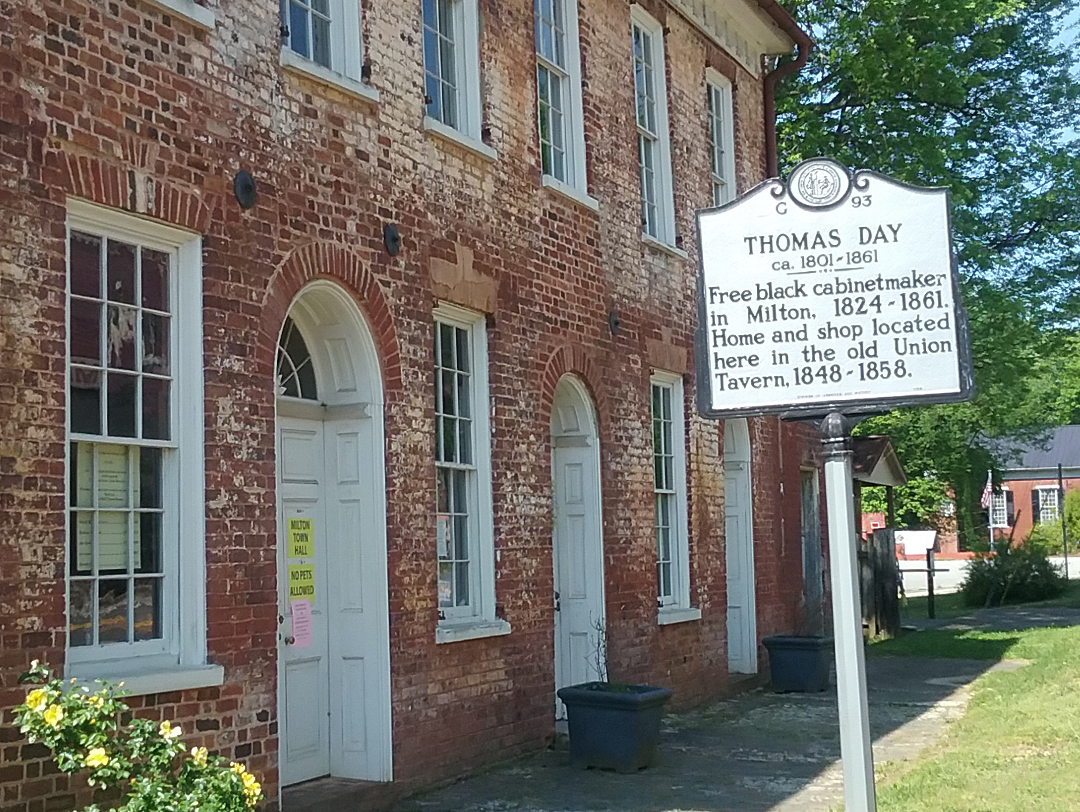
Day was a free African American born to a free family in Dinwiddie County, Virginia, in 1801. He learned his trade from his father, John Day Sr. As an adult, Thomas Day became a prominent cabinetmaker. He eventually relocated south to Milton, North Carolina. There he purchased an old tavern in the middle of town and transformed it into his craft shop. It was a bustling one. According to Couch, “He himself worked in it and, though African American, he owned skilled enslaved craftsmen. At some point, he also employed free white workers.”
Prior to moving to Milton, Day married, but his wife remained in Virginia for some time. At the time of their marriage, North Carolina prohibited African Americans from moving to the state. Because of Day’s prominence in the community, the North Carolina legislature granted a waiver that allowed Mrs. Day to join her husband in Milton. “Although [Day] operated within a slave society and used enslaved labor, he sent [their] children to abolitionist schools in Massachusetts and they later were engaged in teaching freed people to read and write,” said Couch. “His life and art point to the extreme complexity of American history.” Until his death, in 1861, Day produced furniture for people in North Carolina and Virginia.
Today, one can visit the craft shop in Milton and see where Day and his craftsmen produced fine furniture. Across the street from the shop is a large mural of Milton, featuring Day and his wife. Also near the shop is Milton’s Presbyterian Church, where Day handcrafted all the pews. It is said that he only agreed to finish the pews under the condition that he and his family would be allowed to sit in the nave of the church, overriding the rule that black people were restricted to the balcony. The request was granted, and the pews completed.
Nearby Milton, is Danville, Virginia, and in my travels, I have seen Day furniture at the Danville Museum of Fine Arts and History and at Mt. Vernon Methodist Church. There is also a collection of Thomas Day furniture at the North Carolina Museum of History in Raleigh, North Carolina.
Thanks for reading!
Authored by:
Phillip Bond