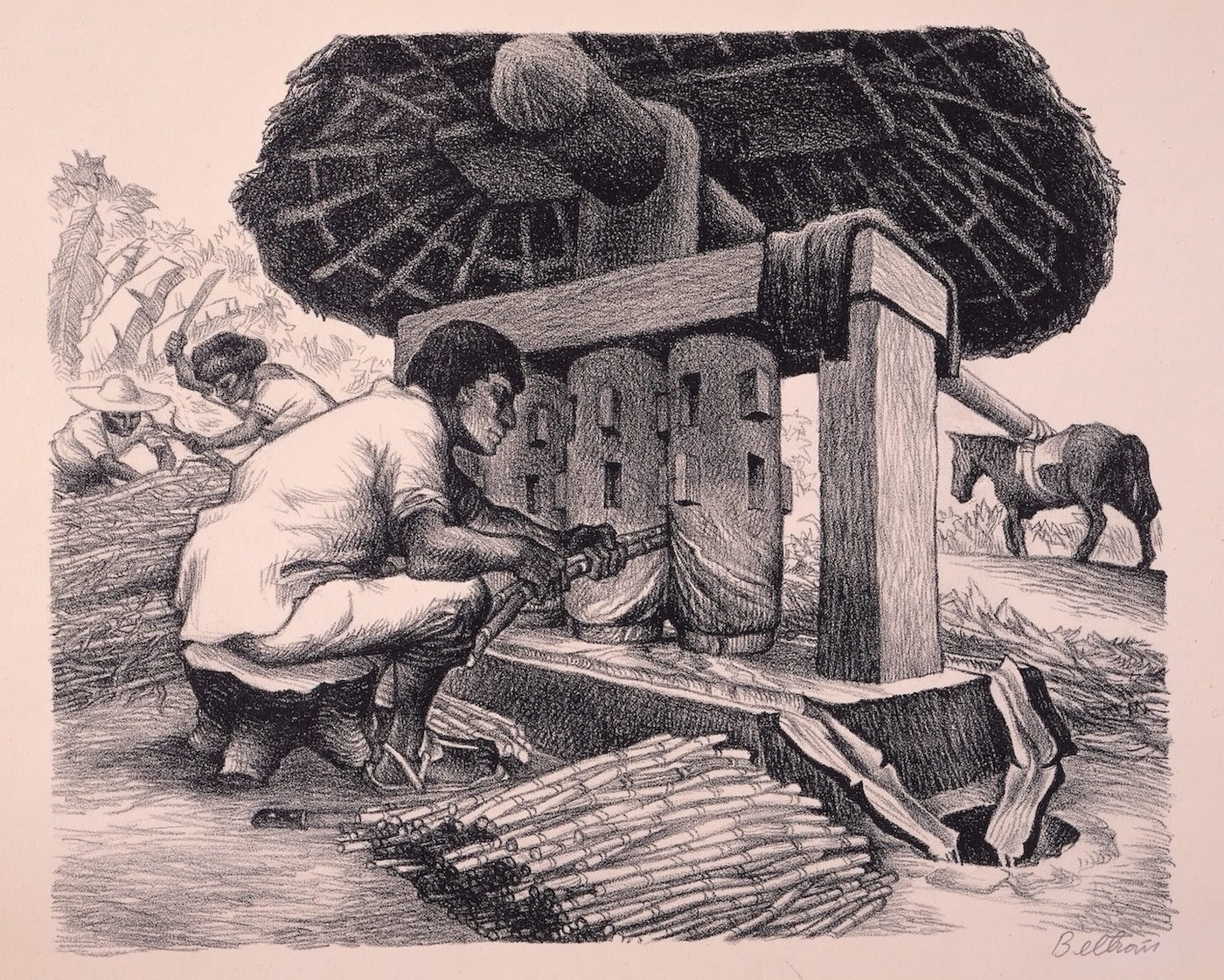
Is it possible to achieve environmental justice without justice for laborers in the Global South? Can we apply Western notions of environmentalism to Latin America? Why are workers’ lived experiences so often left out of conversations about resource extraction and allocation? Dr. Pablo Lapegna’s University of Georgia class LACS (SOCI) 4211/6211 (“Environmental Justice in Latin America and the Caribbean”) is examining these questions in a display at the museum titled “Fiber, Food and Fuel: Mexican Environments, Labor and the Taller de Gráfica Popular,” on view through September 4.
Lapegna, who is an associate professor of sociology and Latin American and Caribbean studies at the University of Georgia, shared that his class focuses on “ideas of environmental justice or the idea of the environmentalism of the poor, and the idea that people extract a livelihood from those environments, so they’re naturally environmentalists in a way. We also look at how people and governments react to those issues — how people organize collectively to address problems created with the use of resources, and how governments and international organizations also intervene.”
Alexis Gorby, the museum’s associate curator of academic and campus engagement, worked with Lapegna to select works by the Taller de Gráfica Popular (TGP) because they illustrated the course’s key theme: “the human side of resource destruction.” The TGP was an artists’ print collective founded in Mexico City in 1937. During this era between the Spanish American War and World War II, anti-fascist and leftist ideologies were prevalent in Mexico. The TGP produced accessible print materials to educate broad audiences about prevalent social issues, advance revolutionary causes and position art as a facet of popular culture. Many of their works were created collaboratively, embodying their collectivist ideals.
The selected works focus on “the essential materials of our everyday lives.” Western consumers seldom contemplate how food arrives on their tables, how fibers are woven into their clothes or how fossil fuels are siphoned out of the Earth to power their vehicles. “Latin America plays a big role in bringing a lot of things that we use here on an everyday basis,” Dr. Lapegna remarks. “We wouldn’t have avocados if it weren’t for Mexico. We wouldn’t have coffee or bananas. We wouldn’t have nannies, gardeners or the farm workers that pick a lot of the things that we eat every day without Latin American workers coming to this country in search of opportunities.”
Each UGA student in the class wrote a label for one of the works on display. Dr. Lapegna says that this process bolsters students’ understanding of the class’s themes because they “put themselves in the place of the people that are reflected in the work.” Similarly, Gorby believes that students gain “vital interdisciplinary and critical thinking skills” when visual arts are integrated into academic classes. “We went through the steps of visual analysis. Based on what you can see, how do you then apply what you know to this print? How does the print, perhaps, tell a different story or a different perspective than what you’re reading in class?” Gorby noted.
The selected works show how “essential workers” whose labor forms the basis for complex, globalized societies are paradoxically marginalized. Gorby and Lapegna hope that the display will humanize abstract, culturally relative notions of environmental justice and inequity for audiences and participating students alike. “In the exhibition, we would like to highlight the work of everyday people in supporting society, while also highlighting that many industries that we rely on on an everyday basis often contribute to exacerbating social and environmental problems,” said Lapegna.
“I’ve looked at these prints many times, but seeing them through the students’ eyes, through these environmental, social and labor justice perspectives, has taught me something about these prints,” Gorby shared. “I hope audiences are also really excited to see student work being celebrated in the museum.”
Authored by:
Nabiha Rahman