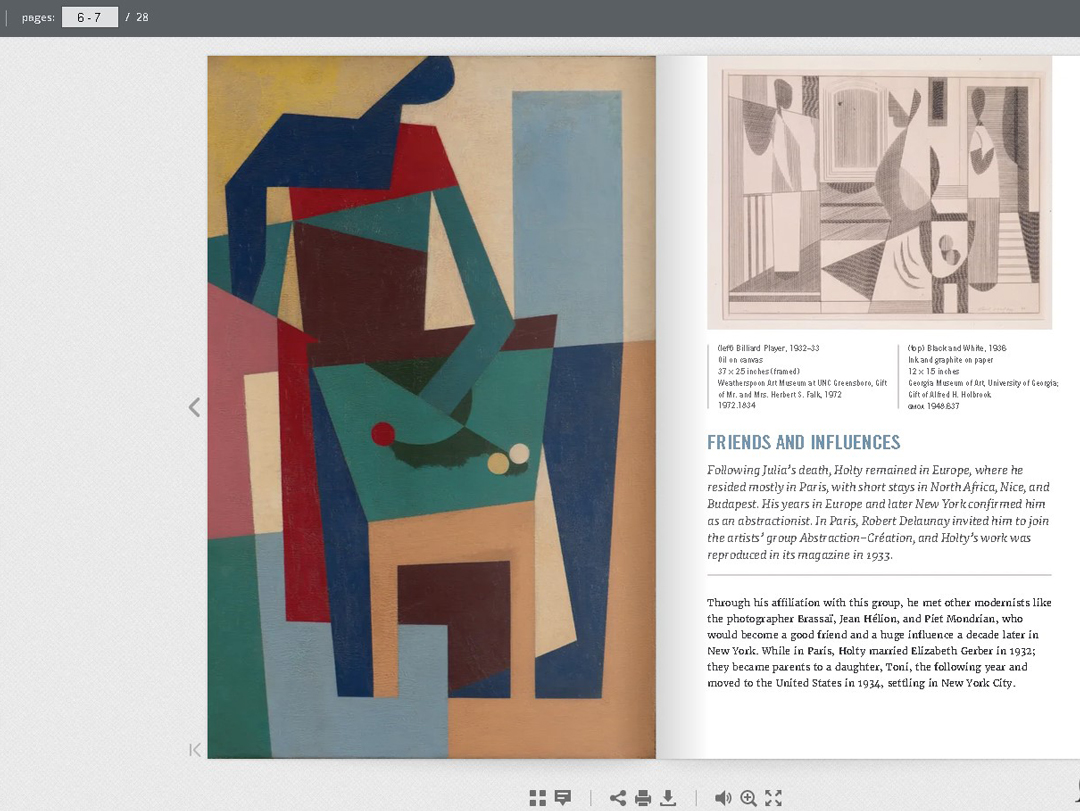
The Georgia Museum of Art has always been a bit old-school when it comes to digital publishing, preferring to put out physical books and brochures. But the novel coronavirus pandemic has pushed us into many arenas, and online publishing is one of them. With the opening of the long-planned exhibition “Carl Holty: Romantic Modernist” (on view through January 17), we had planned a print brochure, with an essay by guest curator Marilyn Laufer that helps explain who Holty was and why his work was important. Instead, that brochure exists in the digital realm, accessible through QR codes in the museum’s galleries and on our website.
QR codes (the QR is short for Quick Response) are two-dimensional barcodes that became popular with non-specialized audiences around 2011. At the time, however, they were more complicated to use. People had to download an app that was just to scan QR codes. Now, almost any smartphone can read one easily from its camera. If you turn on the camera and hold it over the QR code, a link will pop up that takes you somewhere. In our case, in the Holty exhibition, it will bring you to the digital brochure. We’re also using them for gallery maps and we’ll have a second digital brochure when the exhibition “Sarah Cameron Sunde: 36.5 / A Durational Performance with the Sea” opens, on September 16.
We also took the opportunity presented by using digital platforms to publish Virginia Rembert Liles’ biography of Carl Holty on our website. We’ve had the biography in typed manuscript form for years but never digitally, so we scanned the pages, used OCR (optical character recognition) to transform the images into text, cleaned up the results (OCR sometimes gets things wrong!), lightly edited Liles’ chapters (a thank you goes to Marilyn Laufer for that task) and put them up on our site.
Liles died in 2013, after a long career teaching at Beloit College, Massachusetts College of Art, Birmingham-Southern College (also the undergraduate alma mater of our director, William U. Eiland), the University of Alabama at Birmingham, the University of Arkansas at Little Rock and the University of Alabama, serving as the first woman to head the art department at three of them. She studied a wide range of artists and periods and, while writing her doctoral dissertation on Piet Mondrian, in 1967, asked Holty for help. He obliged, and they became friends for the next six years, until Holty died, in 1973. She also befriended his widow, Elizabeth, who allowed her access to Holty’s memoirs and journals. Out of those materials, which she referred to as “a remarkable record of an artist’s observations on himself, his art, other artists and the art world as seen from the inside,” came her book “Carl Holty: Search for the Grail.”
Liles wrote, in her foreword to the book, “Although the artist did not achieve the national forum that he deserved, there has long existed a strong interest in him and his art among artists who knew him or students whom he taught, especially in the South. Holty spent long stints as artist-in-residence at the Universities of Georgia, Florida, and the University of Louisville, where he influenced many students and left many friends who still remember him with great affection and admiration; he maintained a special fondness for the South and his Southern friends. Those from over the country who knew and loved him agree that he should be better known . . . . While I have pulled the material together, the same claim for it could be made as Ludwig Goldscheider made of his study on Leonardo (one of Holty’s heroes), that it was not a book of observations about that artist so much as one filled with his own observations.”
Although the original photographs that Liles used to illustrate her text were no longer with the manuscript (only grainy black-and-white photocopies of them), we have replaced them with relevant images wherever possible and are pleased to be able to share her work on this important artist at long last.
Authored by:
Hillary Brown