The fourth annual University of Georgia Humanities Festival will return March 16 – April 2 with a variety of public lectures, performances and special events that showcase the richness of on-campus research and practice in the humanities. The festival is organized by the UGA Humanities Council, which is supported by the Office of Research, the Office of the Provost and the Franklin College of Arts and Sciences, with the participation of more than 30 colleges, schools, departments and units across the university.
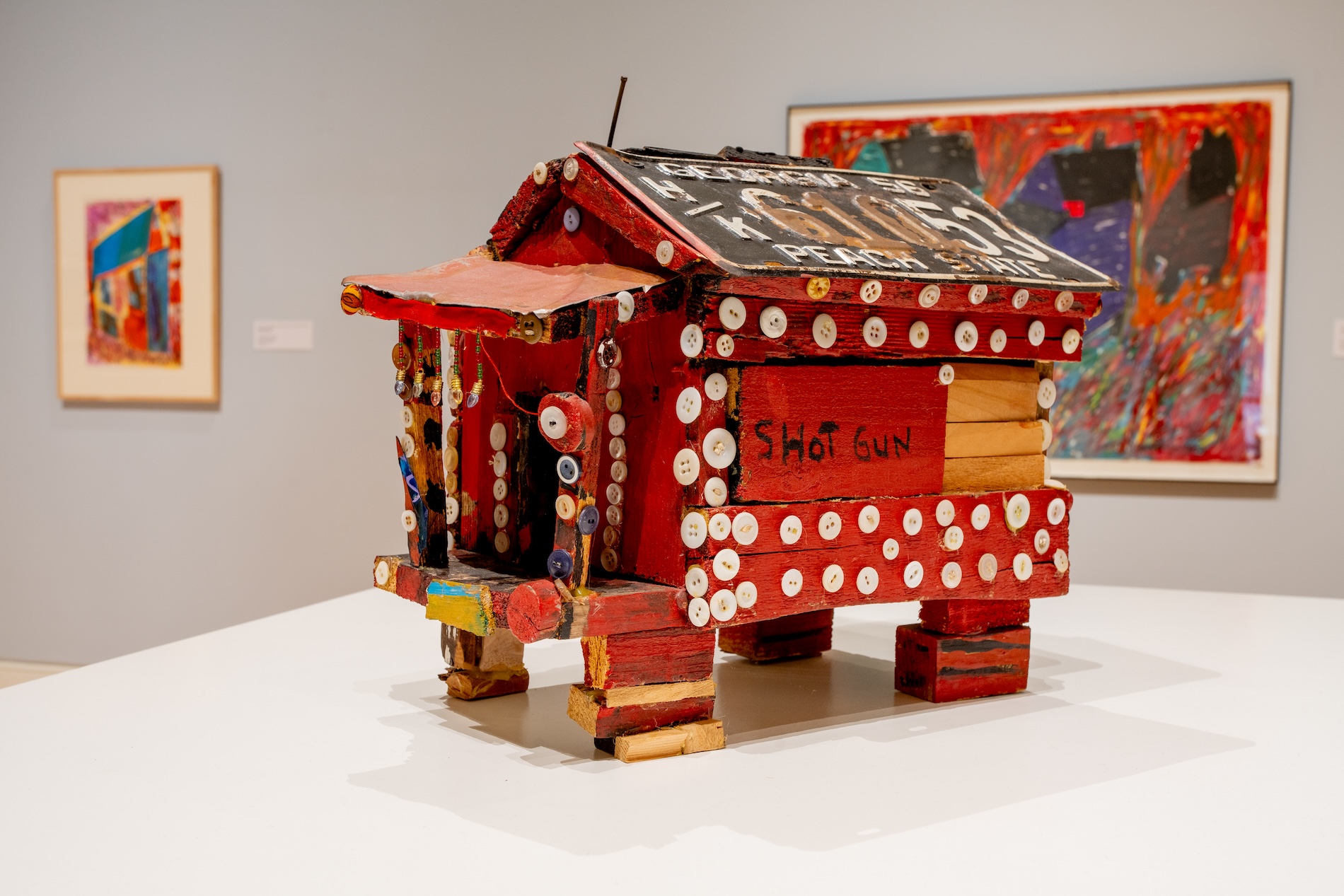
The Georgia Museum of Art will host two events as part of the UGA Humanities Festival. During Faculty Perspectives on March 18 at 2 p.m., Dr. Cecilia Herles, assistant director of UGA’s Institute for Women’s and Gender Studies, will give a gallery talk on the exhibition “Shacks, Stories and Spirit: Beverly Buchanan’s Art of Home.” Herles will examine Buchanan’s art through her expertise in ecological feminism, a theoretical framework that connects the exploitation of nature with the oppression of women. The museum’s exhibition emphasizes Buchanan’s fascination with southern vernacular architecture through her two- and three-dimensional depictions of shotgun shacks as well as her love for the natural world through vivid oil pastel flower drawings. While living in the South, Buchanan also became increasingly interested in what she called environmental sculpture, or site-specific installations that were allowed to decay over time.
On March 24 at 4 p.m. in the museum’s auditorium, UGA’s Institute of Native American Studies will present a discussion with Kat Gardner-Vandy, associate professor of aviation and space at Oklahoma State University and a citizen of the Choctaw Nation of Oklahoma. In addition to teaching college students, she combines her interests in planetary science and STEM education by developing curricula for middle school students of Native American nations. Her earth-sky STEM programming is interwoven with native stories and language in the hopes that native students will better identify with STEM concepts and pursue STEM careers. Held in conjunction with the exhibition “We, Too, Are Made of Wonders,” her discussion will explore Choctaw star stories, or ancient narratives passed down through generations that explain the cosmos.
The museum’s calendar is packed with over 20 events that take place during the festival. Students in Katelyn Stauffer’s course POLS 4575H: Women in US Politics developed the pop-up “Pretty Politics: Women as Symbols, Women as Subjects,” on view in the museum’s Shannon and Peter Candler Collection Study Room March 24 – 26. It features works selected from the museum’s collection. The Fontaine Center will host IMPACT: Intentional Mindfulness and Peace to Assertively Create Together on March 26 from 4:30 to 7:30 p.m., an evening of empowerment and healing from experiences of sexual violence through creative expression that includes live performances and sessions in art therapy, music therapy and dance therapy. The 13th annual España en Corto: Spanish Short Film Festival will showcase award-winning shorts selected by graduate students in the department of Romance languages on March 31 and April 1 at 7 p.m.
Check out the art-centric highlights below, and view the festival’s full schedule of events online.
March 16, noon – 2 p.m. Forecourt of Park Hall
As unique as the people who make them, zines are self-published, handmade or small-press booklets dedicated to special interests and circulated in small batches. Browse hundreds of zines, start your own collection or get crafty by making your own during zine-making workshops and activities. Supplies and snacks provided. FanZine Frenzy will conclude with zine creators sharing their works as part of Humanities Trivia Night, held at Ciné on March 18 at 5:30 p.m.
“Beverly’s Athens” Closing Symposium
March 21, 10 a.m. – 4 p.m. (symposium), 6 – 8:30 p.m. (film screening). Athenaeum
The exhibition “Beverly’s Athens” focuses on the more than two decades that artist Beverly Buchanan lived in Athens through assemblages, drawings, photographs, autobiographical ephemera and research materials. After a walkthrough with curators Mo Costello and Katz Tepper, the closing symposium will present keynote speakers Bryn Ashley (doctoral candidate at Stanford University) and Patricia Ekpo (assistant professor of African American and African diaspora art at Cornell University). The symposium will be followed by a documentary screening and discussion of “Beverly Buchanan, Athens, GA, 8 July 1995” with filmmaker, artist and professor emerita Judith McWillie.
Reception: Works by Sam Stabler
March 24, 5:30 p.m. Willson Center
Drawing inspiration from both Western art history and pop culture, Sam Stabler recontextualizes images into unique mashups with pops of fluorescent color. Using a sharp blade and fine pencil line, he layers processes such as painting, drawing, cut paper and collage. After receiving a bachelor of fine arts degree in drawing and art education from UGA’s Lamar Dodd School of Art, Stabler received his master of fine arts degree from Central Saint Martin’s College of Art and Design in London. He spent the next few years working in the commercial art world in New York City before returning to Athens, where he founded a design-build construction company and now teaches at UGA.
Odum Environmental Ethics Lecture: David Walter Banks
March 25, 6 p.m. Ciné
Over the course of three years, Atlanta-based photographer David Walter Banks paddled 500 miles and spent 69 nights deep in Georgia’s Okefenokee Swamp to capture what he calls “the unmistakable yet ineffably mystical quality of this primordial space.” Ninety of his photographs were compiled into “Trembling Earth: A Transcendental Trip Through the Okefenokee,” a personal essay published by the Bitter Southerner in 2025. Using in-camera techniques rather than post-production effects, his dreamlike images draw attention to the biodiversity, vulnerability and magic of this threatened ecosystem.
Georgia Museum of Natural History Lecture: Ashley Lemke
April 2, 5:30 p.m. Ciné
Ashley Lemke, associate professor of anthropology at the University of Wisconsin–Milwaukee, is an archaeologist and expert on submerged ancient sites. As a remote-operated vehicle pilot, sonar technician and scuba diver, Lemke uses robots to find and map archaeological sites underwater. She also collaborates with computer scientists to build virtual worlds of past environments, demonstrating how artificial intelligence and virtual reality can be applied for archaeological discovery.
Authored by:
Jessica Smith