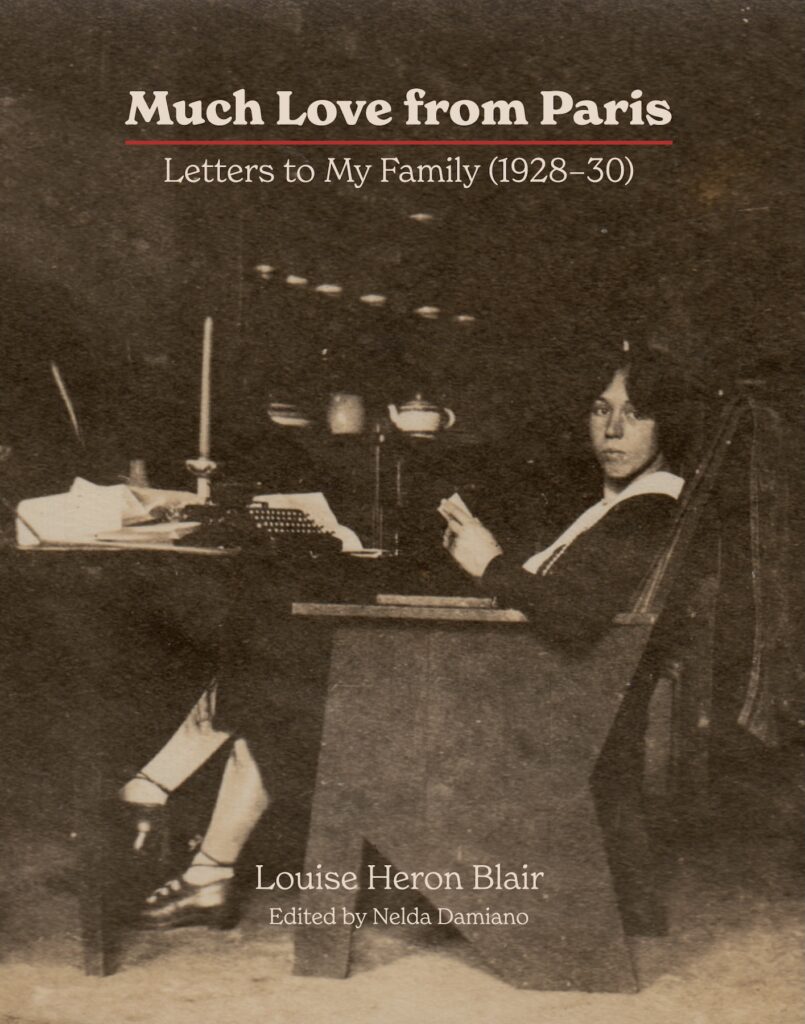
The Georgia Museum of Art is the final destination for “Brilliant Exiles: American Women in Paris, 1900 – 1939,” a traveling exhibition that focuses on American women who visited or resettled in Paris to escape the social and economic constraints of American society. In the vibrant, cosmopolitan milieu of 20th-century Paris, these women had the freedom to reinvent their identities, often using fashion to do so.
Organized by the National Portrait Gallery in Washington, D.C., “Brilliant Exiles” features over 60 portraits of remarkable women. The Georgia Museum of Art’s presentation of the exhibition is unique in that it spotlights historical clothing from early-20th-century Paris to complement the portraits. The museum collaborated with the University of Georgia’s College of Family and Consumer Sciences to include objects from its Anne Barge Historic Clothing and Textile Collection.
Paris is known to many as the capital of the fashion world, but what many don’t know is that this preconception was cemented into cultural consciousness in the early 20th century. Dr. Monica Sklar, associate professor and curator of the Anne Barge Historic Clothing and Textiles Collection, said, “20th-century Parisian fashion was the height of luxury and craftsmanship. That was the rise of the haute couture house system in France – it’s the rise of the name designer and the esteemed fashion houses. Ready to wear and everything that would spin off of that afterwards is all, in many ways, aspirational to those Parisian designers.” She describes Parisian women’s fashion from that era as “leaning toward kind of an elevated femininity.”
In the 20th century, women’s fashion moved away from corsetry, boning and tight lacing in favor of clothes that allowed more physical mobility. This physical freedom reflected women’s new upward social mobility and the loosening of strict gender roles. American women in Paris were uniquely positioned to transform their personal style by embodying new trends to convey their sense of individuality. For example, Anaïs Nin wears a blue velvet coat in a portrait by Natashia Troubetskoia in the exhibition. Nin said she used “original, striking clothes which distinguish me from other women” to disguise her insecurity. Similarly, Mercedes de Acosta, thoughtfully rendered in a portrait by Abram Poole, sported an androgynous style of dress to express her queer identity.
The selection of historical clothing that is displayed alongside the portraits in “Brilliant Exiles” was curated by Noel Corbin, a doctoral student in fashion history and culture at UGA. She and Dr. Sklar will offer a gallery talk focused on fashion in Parisian culture from 1900 to 1939 on September 10 at 2 p.m.
Corbin carefully selected pieces with the main goal of “finding something that brought the portraits to life.” She helped create an immersive experience by finding pieces that “accessorize the beautiful portraits that were already curated.” The physical presence of an orange velvet coat by Marius L. Fischer and a black lace dress and shawl from an unidentified designer help contextualize that moment in fashion in a way that would be difficult to achieve with two-dimensional portraits alone.
The Anne Barge Historic Clothing and Textile Collection supports product development, fashion history, art history and sociocultural history not only for UGA students, but for the broader public. “By studying fashion history, such as the time period of ‘Brilliant Exiles,’ we can have a greater understanding of what was going on with status, gender, economics, textile science, supply chain, business, art. It all folds into this 3D object that every single person on the planet uses in some manner or another. So, by looking at that object, you get clued in the color of an era, the pattern, the silhouette and the gender relations,” said Dr. Sklar. The pieces borrowed from the Anne Barge Historic Clothing and Textile Collection were essential for illuminating this transitional moment in women’s rights.
Want to learn more about the exhibition? Upcoming related events include:
- A gallery talk by Noel Corbin and Dr. Monica Sklar on fashion in Parisian culture from 1900 to 1939, on September 10 at 2 p.m.
- A Studio Workshop on Portraiture on September 18, September 25 and October 2 from 6 to 8 p.m. A fee of $45 covers all three classes and includes all materials ($35 for Reciprocal-level Annual Fund members). Register and pay for the class.
- A French language tour on September 24 at 2 p.m.
- A gallery talk by Susan Rosenbaum, associate professor of English at the University of Georgia, on the exhibition through the lens of her expertise in modern literature on October 8 at 2 p.m.
- A Student Night on October 9 at 6:30 p.m.
- A film screening of “Coco Before Chanel” on October 16 at 7 p.m.
- A gallery talk by Callan Steinmann, director of learning and engagement, that highlights the work of groundbreaking women artists in our permanent collection on October 22 at 2 p.m.
Authored by:
Nabiha Rahman