The Jurii Maniichuk and Rose Brady Collection(opens in new tab), which donated six paintings to the Georgia Museum of Art in 2019, is a collection of Ukrainian socialist realist art. The works of art included in this collection were made while Ukraine was under Soviet rule, following the required conventions of Communist government art. Originally dismissed as Soviet propaganda, socialist realist art is now seen as vital to understanding people’s lives under Soviet rule as well as having the potential to condemn that rule subtly.
According to Brady’s book “The Jurii Maniichuk and Rose Brady Collection of Soviet Ukrainian Art: A Journey of Art, Politics, and Life,” Maniichuk began collecting socialist realist art in Ukraine after the dissolution of the Soviet Union. With the collapse of the Soviet Union, many people in Ukraine were eager to remove traces of living under totalitarian rule, resulting in Ukrainian socialist realist art being neglected and beginning to disappear from the art historical record. Maniichuk collected these works of art to preserve them and give them a chance to be viewed by future generations.
Thanks to the efforts of Maniichuk and Brady, Ukrainian socialist realist art can be seen and studied by art-lovers and scholars alike. According to Dr. Asen Kirin, the museum’s Parker Curator of Russian Art, this collection allows for “the opportunity to preserve, study and display a minuscule part of the Ukrainian cultural heritage. This endeavor gains in significance at the time of suffering, losses and utter destruction in Ukraine.” As for the question of whether this art is propaganda or not, Dr. Kirin said, “All art is propaganda. Even when an artist intends to reject or oppose it, the cultural context in which the work of art is created bestows societal, political and ideological meanings on every work, regardless of any original authorial intent.” Kirin went on to propose changing the conversation from debates about propaganda to examining how art, and this art in particular, can “enrich our knowledge of 20th-century visual culture in its totality.”
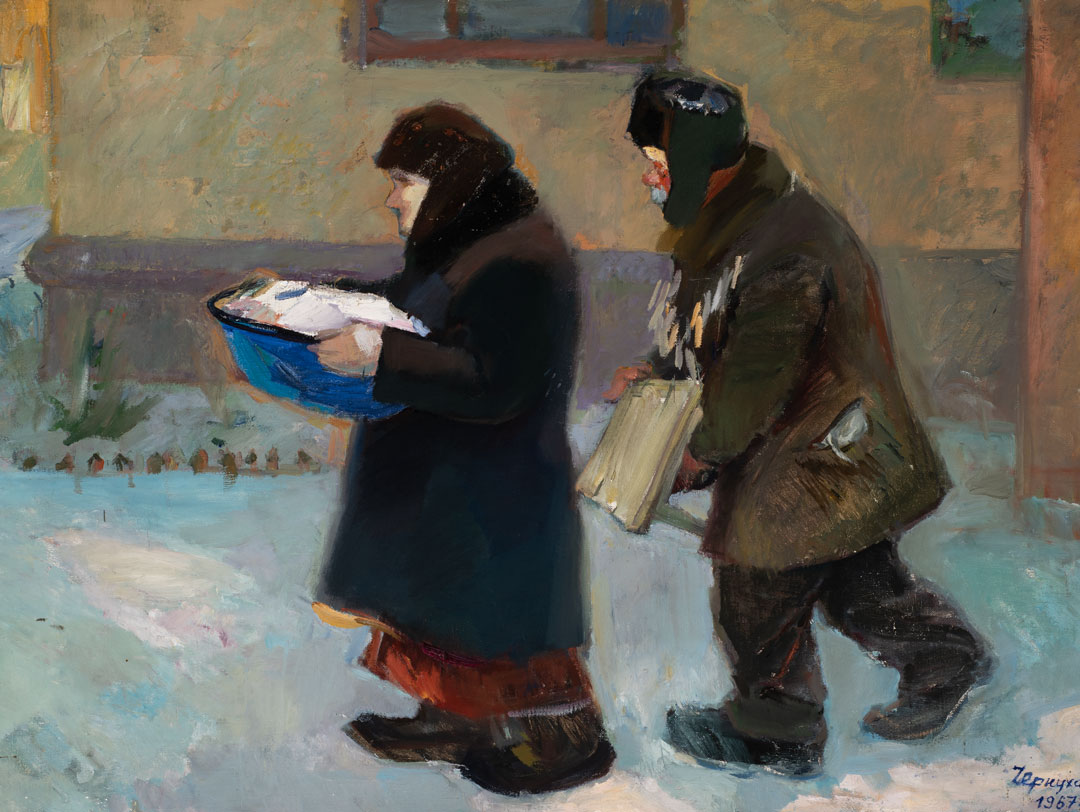
Two paintings in particular, “V. Lenin in the Hours of Rest” and “Elders,” helps give us better insight into the importance of the collection. “V. Lenin in the Hours of Rest” shows Lenin with his wife Nadezhda Krupskaia. The two of them sit around a table at night, with Krupskaia reading and Lenin resting his head against his fingers. The Communist government’s goal was to humanize Lenin, but Kirin argues that “the subversive reading is about privilege, rich and luxurious existence and the hypocrisy of the Communist ruling class.” The second painting, “Elders,” shows an elderly couple carrying laundry to be washed outdoors. The weather looks cold, with what appears to be snow covering the ground and both figures wearing heavy winter clothing. A favorite of not only Kirin, but also of Maniichuk and Brady, “Elders” demonstrates a routine part of living in Soviet Ukraine. Kirin says, “This painting is a celebration of old ladies’ strength, goodness and ingenuity. Marginalized, struggling to survive and looked down upon elderly people strove to preserve their dignity in a brutal world.”
The six paintings at the Georgia Museum of Art from the Jurii Maniichuk and Rose Brady Collection(opens in new tab) are Ivan Babenko’s “Waiting,” Valentin Chernukha’s “Elders,” Danilo Dzevanovsky’s “Kherson,” Mikola Kravtsov’s “Autumn,” Serhi Lisenko’s “V. Lenin in the Hours of Rest” and Zinayida Volkovinska’s “At the Exhibition.” We are thankful for the gift and to be a small part of preserving the cultural heritage of Ukraine.
By Kaitlyn Page