August always brings the start of school tours at the Georgia Museum of Art, with thousands of elementary, middle and high school students cheerfully making noise throughout the building. Our 5th-grade tour program, which dates back decades, usually brings every 5th-grade class in the Clarke County School District (CCSD) to the museum for a tour and a hands-on art project, as part of Experience UGA. So how do you translate those tours into a format that keeps everyone safe?
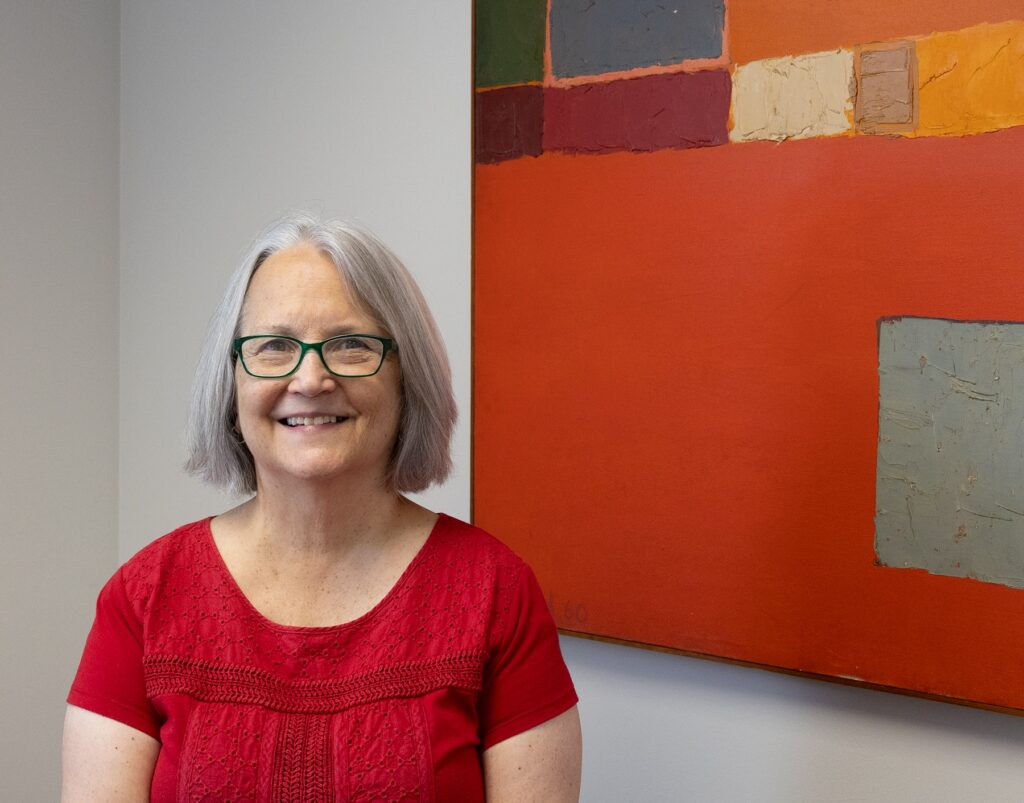
Emily Hogrefe-Ribeiro, our assistant curator of education, who also works directly with the museum’s community docents, jumped in with both feet to help figure that out alongside her colleagues. These days, school tours take place synchronously through Zoom or Google Meets or Microsoft Teams or any other video software a school might be using. The museum’s educators, communications department and others worked together on a short video that students on a virtual tour see first, to introduce them to what the museum is and what it does. Then they “walk” through the galleries, spying a work of art and zooming in close to it.
Virtual tours require a little more focus than in-person ones, meaning that the museum usually only delves into one or two works of art with the students (as opposed to the usual seven), plus an activity, but they have benefits, too. Hogrefe-Ribeiro points out that the museum doesn’t have to stick to what’s on display at the moment. It can use all of its considerable collection to engage students. Close-up photography allows them to get much closer to a work of art than they could in person.
In-person tours are limited by gallery and school logistics. The number of kids who can be in a given area at a given time is relatively small, meaning large schools tend to have their tours broken up over a number of days and students move through the galleries to multiple stops, meaning less sustained engagement with a single work of art. Those limitations evaporate in the digital realm, and although most of the classes Hogrefe-Ribeiro has given tours to so far top out at 20 or 30 students, the museum can host an entire grade at once, even from a large school.
The museum’s docents, who normally help with school tours, will be shadowing the education staff, learning how to give tours in this new format. So far, most participants have been 1st-graders, 3rd-graders and kindergartners, but tours can be customized for any grade level and interest. Hogrefe-Ribeiro has been working on a STEAM tour for West Jackson Elementary School, which is studying pollinators, that includes a project in which they’ll make a bee hotel out of an empty can and look at flower-filled landscapes from the collection. The museum is also working on asynchronous tours because teachers have asked for those as well.
There’s plenty of interaction on these tours, sometimes even more than in person. The educators have made sure to build in moments where students can vote in polls, fill in the blanks of what figures in a painting might be thinking or talk about what they collect. Hogrefe-Ribeiro says that she thinks there’s more participation partially because students can’t see each other on Zoom, just the screen that she’s sharing. Shy students can use the chat to type their answers. And, of course, she’s seen a lot of cats as students participate from their homes. With CCSD going back to in-person school in November, virtual tours are still here to stay because of the way they expand the pool of people able to experience the museum. We miss the noise as 120 5th-graders walk up the stairs to the galleries, but we’re happy that we still get to reach them.
Thanks to Georgia Council for the Arts for providing funding for 5th-grade tours for “Emma Amos: Color Odyssey” and to the Junior League of Athens for providing funding for STEAM tours.
Authored by:
Hillary Brown