The Seated Child: Early Children’s Chairs from Georgia Collections
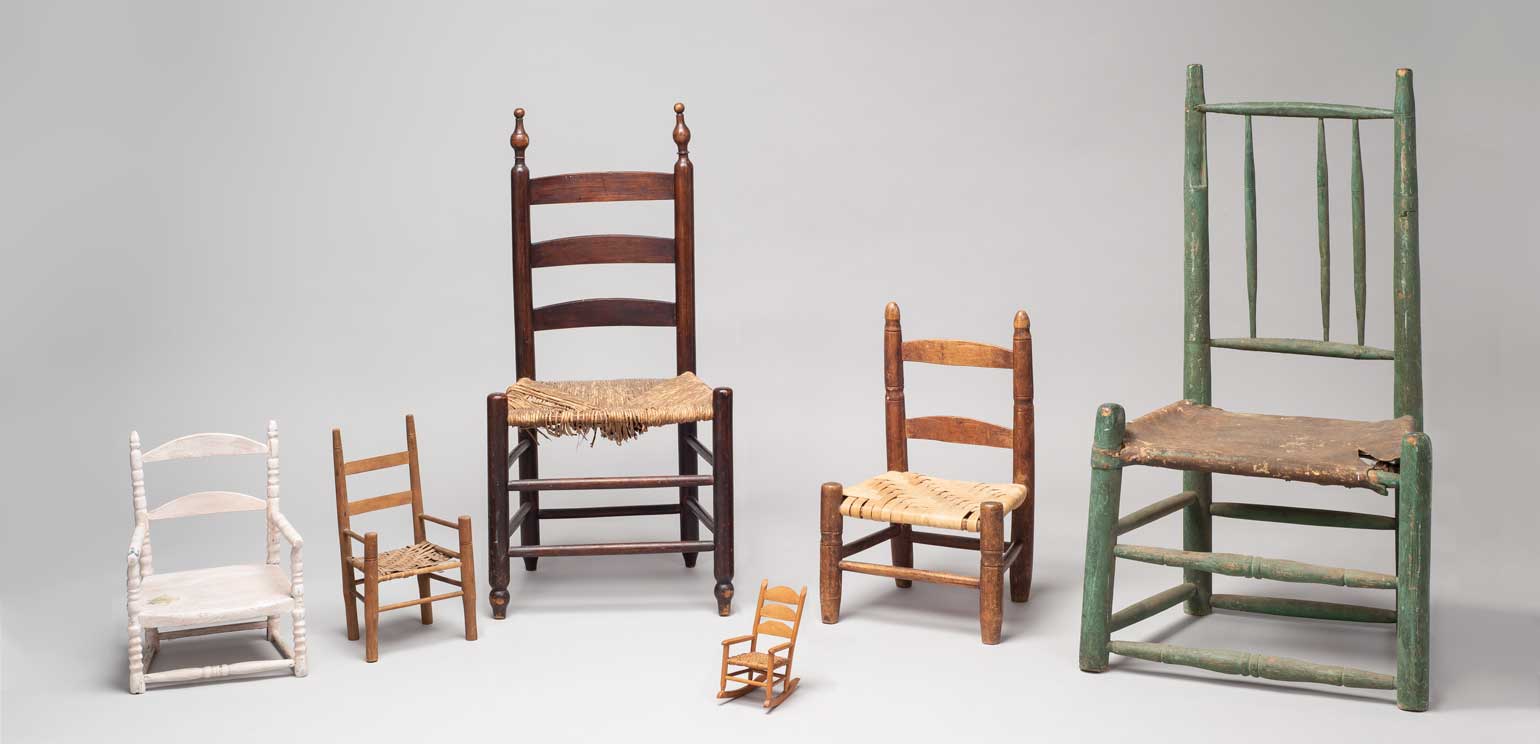
This online version of an exhibition that was on view at the Georgia Museum of Art from October 17, 2020, to January 3, 2021, presents about two dozen small chairs in a variety of sizes. Not all of these chairs were made in Georgia, but all come from Georgia collections. Most of the chairs are handmade in the tradition of turned chairs; some are the products of proto-industrial shops called variety works. Most of them also retain their life histories of paint and wear from being used as a support while children were learning to walk.
Relative Scale
Architectural analysis often refers to “human scale.” With furniture, there are many human scales. Within children’s chairs, we have infant high chairs, toddler chairs and youth chairs. We have chairs for symbolic people, dolls and even for imaginary miniature people. These chairs show some of these different scales.
[metaslider id=”24504″]
Baroque Style Origins and Retention
Green wood working techniques and lathe turning date back to medieval times. Turned chairs flowered in the baroque period (ca. 1600 – 1740s), and this influence lasted into the 20th century. Vasiform (vase-like) turnings come from 16th-century Italy and resulted from Asian porcelain trade with that country. The endurance of style is as interesting as changes in style.
[metaslider id=”24551″]
A Southern Vernacular
Southern vernacular (domestic and functional) chair style shows the influence of Continental European design. A notable characteristic is the overhanging arm. The arm hangs over the front post instead of being tenoned into it, as in early New England. This style of arm might be seen as encouraging a more relaxed posture, showing how children were intended to learn gestures from their elders.
[metaslider id=”24566″]
A Rugged Patination
Children’s chairs received and were intended to receive hard use, including as a “walker.” Toddlers were expected to learn to walk by pushing the chairs across the floor and using them as a frame for support. This “rugged patina” becomes part of the object.
[metaslider id=”24578″]
Shaved Chairs
Simple lathes made with treadles or even flexible poles and cord could rotate wood for a chisel and create shapes from rough, riven pieces of green wood. Some makers used tools like a draw knife to make “shaved” chairs.
[metaslider id=”24590″]
Mass Production
Most of these chairs were made by individual craftsmen working on farms. Chair factories, still using much handicraft, emerged by the early 19th century. By the mid-19th century, “variety works,” or small factories that made things of wood on a larger scale, were common in the South as well as the North. Eventually, fully mechanized furniture factories mostly eliminated small hand production of chairs.
[metaslider id=”24593″]
[metaslider id=”24606″]