Eleanor Himmelfarb (née Gorecki) was an American abstract painter, conservationist and educator who was born in Illinois and stayed there throughout her life while advocating for responsible land stewardship. Her early life on farms during the Great Depression era marked her formative years with a deep connection to rural landscapes and understanding of resilience through economic hardship. Her son John Himmelfarb shared that these early influences shaped her later work. “She loved the forest, she had a passion for plants and animals. Looking at her work, there’s a lot of nature references.”
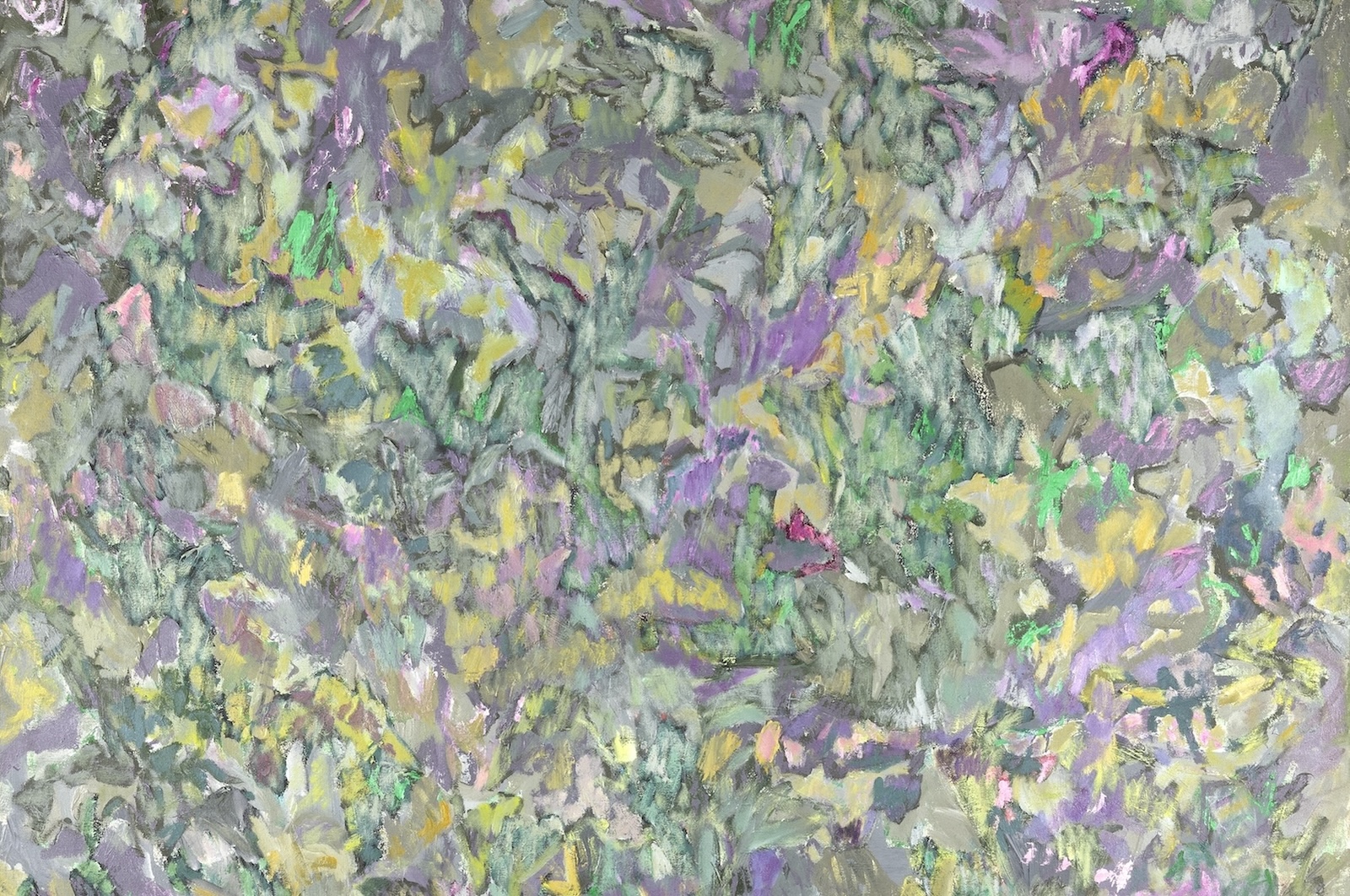
Visitors can see these influences in her transcendental painting “On the Fourth Day,” now on display on the second floor landing at the Georgia Museum of Art. The painting became part of the museum’s collection in 2024 and will remain on view through June 6, 2027.
Himmelfarb studied fine art history and nature at the University of Chicago and graduated in 1930. Throughout the next decade, she worked as a proofreader, traveled to Mexico with women friends and became engaged in progressive politics. She met Sammuel Himmelfarb at a Hyde Park activist meeting in the late 1930s, and they were married in 1939. Samuel and John Himmelfarb are also accomplished artists whose works are included in the Georgia Museum’s collection.
In the early 1940s, Himmelfarb assisted her husband in designing the Samuel and Eleanor Himmelfarb Home and Studio, a Usonian-style house with floor-to-ceiling studio windows overlooking the DuPage River and surrounding woodlands. Usonian homes are a group of approximately 60 middle-income homes designed by architect Frank Lloyd Wright, recognized for their use of native materials and rear facades with spectacular outdoor views. Listed on the National Register of Historic Places, the Himmelfarb home is recognized for its unique Y-shaped midcentury design influenced by both Wright and the Bauhaus. Being surrounded by natural beauty was a lifelong source of inspiration for Samuel and Eleanor.
Eleanor emerged as a contemporary abstract painter in the mid-1950s following the birth of her two children. Her work ranged from stylized representations to abstraction rooted in real sources — landscapes, human figures and architecture. “Ideas are the basis of my paintings,” Himmelfarb said. “Subject matter enters, not as something to be represented, but as an instrument for conveying an idea.” Following the death of her husband in 1976, Himmelfarb earned a master’s degree in fine arts at the University of Chicago, and her art began to take on a more reflective and non-literal tone. Works from this era express ideas about natural beauty with subtle colors and figurative representations.
“On the Fourth Day,” painted in 1981, embodies these themes. This asymmetrical composition lacks a single focal point and echoes the unpredictable movement of a butterfly or the path of a babbling brook. The painting contrasts calming colors with heavy layers and lack of clear focus, echoing the tranquility and disorder of nature.
“The interplay of opposites — abstraction with representation, organic with geometric, floating forms against those which are static, as well as the use of color that moves around the canvas, are some of the tools used to determine the formal expression of the original idea,” Himmelfarb said in an artist statement.
Although Himmelfarb began working on conservation projects in 1962, the bulk of her land protection efforts took place in the 2000s. At 93 years old, she worked with the Conservation Foundation to establish a conservation easement that permanently restricted development on her land. She received the foundation’s Open Space Award in 2003, and the Forest Preserve District of DuPage County accepted the easement in 2005. Following this victory, she organized a meeting between the Conservation Foundation and her neighbors — many of whom went on to establish their own easements.
Himmelfarb died at the age of 98, in 2009. She is survived by her three children, five grandchildren and two great-grandchildren. Her work and influence live on in collections and exhibitions, the land she protected and the generations of artists she taught.
Authored by:
Nabiha Rahman