The Georgia Museum of Art recently acquired two pieces of 16th-century Italian Renaissance maiolica with funds provided by the Virginia Y. Trotter Decorative Arts Endowment and the William Underwood Eiland Endowment for Acquisitions. The museum has a long history of studying Italian Renais¬sance art and already owned two other pieces of maiolica, purchased in 2011 with funds provided by the Trotter endowment and on display in the Samuel H. Kress Gallery.
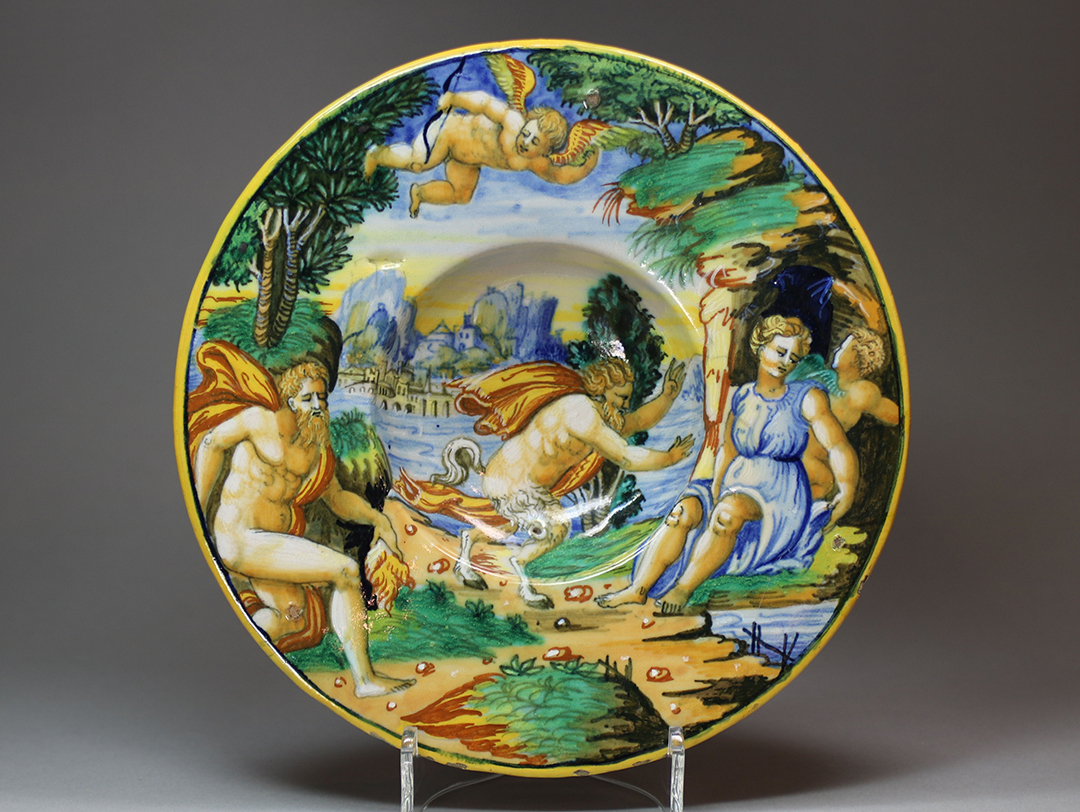
The two new pieces of tin-glazed pottery come from the workshop of Guido Durantino (also known as Guido Fontana, active 1520–76) and his son Orazio. Both works depict subjects from classical mythology as recounted in Ovid’s “Metamorphoses,” a Roman narra¬tive poem that was a popular source for maiolica images in this period.
The smaller dish represents the myth of Jupiter surprising Antiope. According to Homer, Antiope was the daughter of the river god Asopus, which may explain the river in the foreground. Her beauty attracted Jupiter, the king of the gods. Jupiter is depicted twice—on the rim of the dish at the left, with his characteristic thunder¬bolts, and in the center on the recessed surface of the dish, transformed into a satyr and energized by lust. Antiope, as yet unharmed, is seated on the right side of the bowl’s rim, accompanied by one of Cupid’s helpers.
The second piece purchased by the museum is a large dish that shows Diana, virgin goddess of the hunt, resting with her nymphs in a lush forest setting. In “Metamorphoses,” Ovid describes her sacred grove as “dense with pine trees and sharp cypresses,” alongside “a spring of bright clear water . . . murmuring into a widen¬ing pool enclosed by grassy banks.” The visually literate Renaissance viewer would have easily recognized the subject matter and known the story’s ending: the tragic death of the young hunter Actaeon, who sees Diana bathing; turned into a stag by the goddess for violating her privacy, he is pursued and killed by his own dogs.
To celebrate adding these two objects to its collection, the museum has organized the exhibi¬tion “Storytelling in Renaissance Maiolica,” with the goal of highlighting them and placing them in context. This exhibition is on view April 27 – September 29, 2019.
Perri Lee Roberts, guest curator
University of Miami