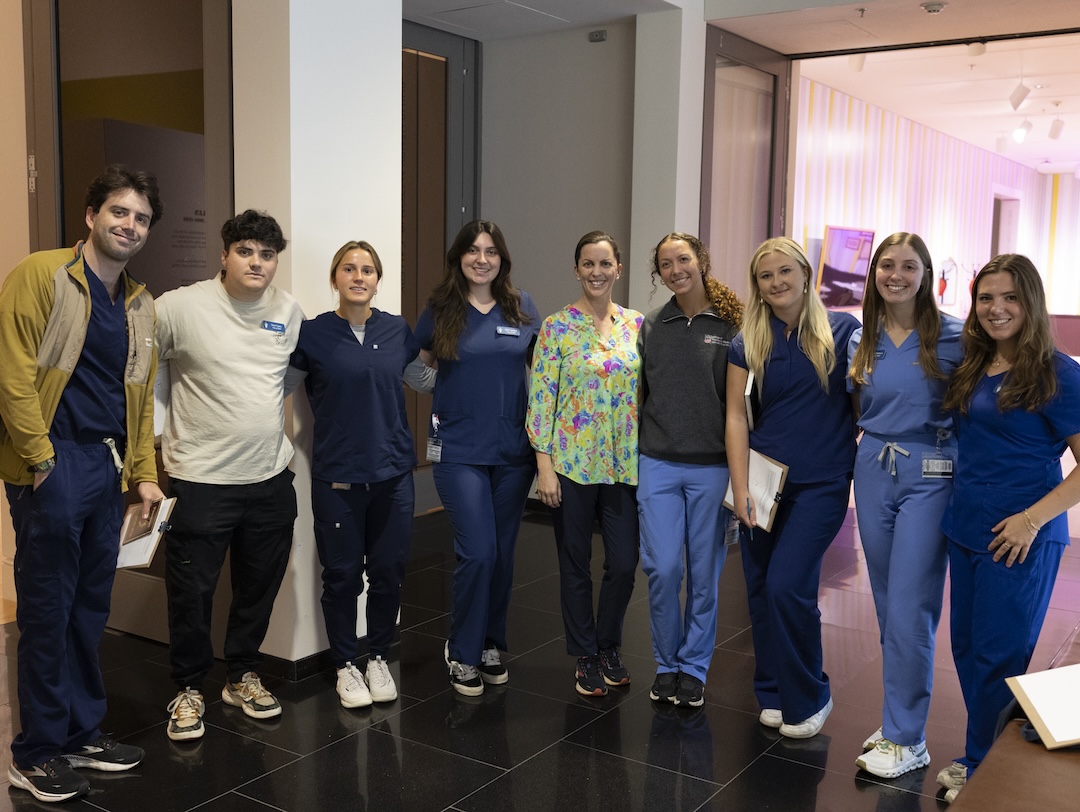
As the official state art museum and an academic museum, the Georgia Museum of Art is always looking for opportunities to enhance education at the University of Georgia. In September, the museum partnered with UGA’s College of Veterinary Medicine to host a well-being program for veterinary students. One hundred fifty vet med students attended the program, making it the largest program the museum has ever collaborated with a class on.
The program focused on overall well-being for vet med students and how humanities practices, such as observing and analyzing art, reading literature and writing poems, can enhance that well-being. Instructors at the college reached out to the museum’s associate curator of academic and campus engagement, Alexis Gorby. Because vet med students tend to experience high burn-out, the college’s instructors wanted to introduce students to humanities practices that can be incorporated into their lifestyles to help prevent it.
Research on medical and veterinary professionals has found that studying humanities helps support clinical skills and improves overall well-being. Humanities practices such as reading, looking at art and writing can improve mental health skills such as attunement to well-being and clinical skills like critical thinking. Critical thinking can be useful for medical professionals navigating moral dilemmas and high-stress situations. These new findings have led to the development of a new subject within medical curricula called “medical humanities.”
The well-being program at the museum drew from existing medical humanities research to introduce students to the significance of medical humanities and give them exercises to try on their own.
The first station was a back-to-back drawing exercise set up in the exhibition “Brilliant Exiles: American Women in Paris 1900 – 1939.” Students were asked to draw a work of art without looking at it, based solely on how another student described the work to them. Research suggests that the visual analysis and communication skills practiced here are critical for observation, diagnoses and communicating cases to other colleagues.
The second station was a close-looking exercise with a similar goal of improving diagnostic skills. Students observed and analyzed a contemporary painting by drawing out visual clues to formulate their own interpretation. At the third station, students analyzed a painting through slow looking. While the goal of the close-looking station was to determine an interpretation based on analysis, the goal of the slow-looking station was to demonstrate how regulating breathing and focusing on observation can encourage mindfulness and relaxation.
The final station was based on narrative medicine and used reading a story to practice listening and empathy. The station also used “Buried Treasure: Funerary Ceramics from the Han and Tang Dynasties” to incorporate an art component. Students practiced close looking at ceramic animal mingqi (grave goods), listened to an ancient Chinese folktale about an animal and responded with a creative writing exercise. One story that students listened to originated in medieval China and was based on a dog that saved its owner. Research suggests that by listening to a story with an animal subject, veterinary students experience increased empathy for their animal patients and practice close listening, which is necessary for diagnosing. After the exercise, students wrote a six-word poem about one of the animal characters. Gorby added, “Narrative medicine is linked to less burnout because it fosters self-reflection and mindfulness, and it increases empathy.”
At the end of the program, students were asked to reflect on their experiences. When asked what the program had to do with being a better veterinarian, one student responded, “Everything! Observation, difference in perspective, simple communication.” When asked if they would incorporate any of the exercises going forward, another student said, “I think that this experience has shown me the importance of being thoughtful and the importance of being able to properly describe details of a situation or case.”
Authored by:
Jisu Stanfield