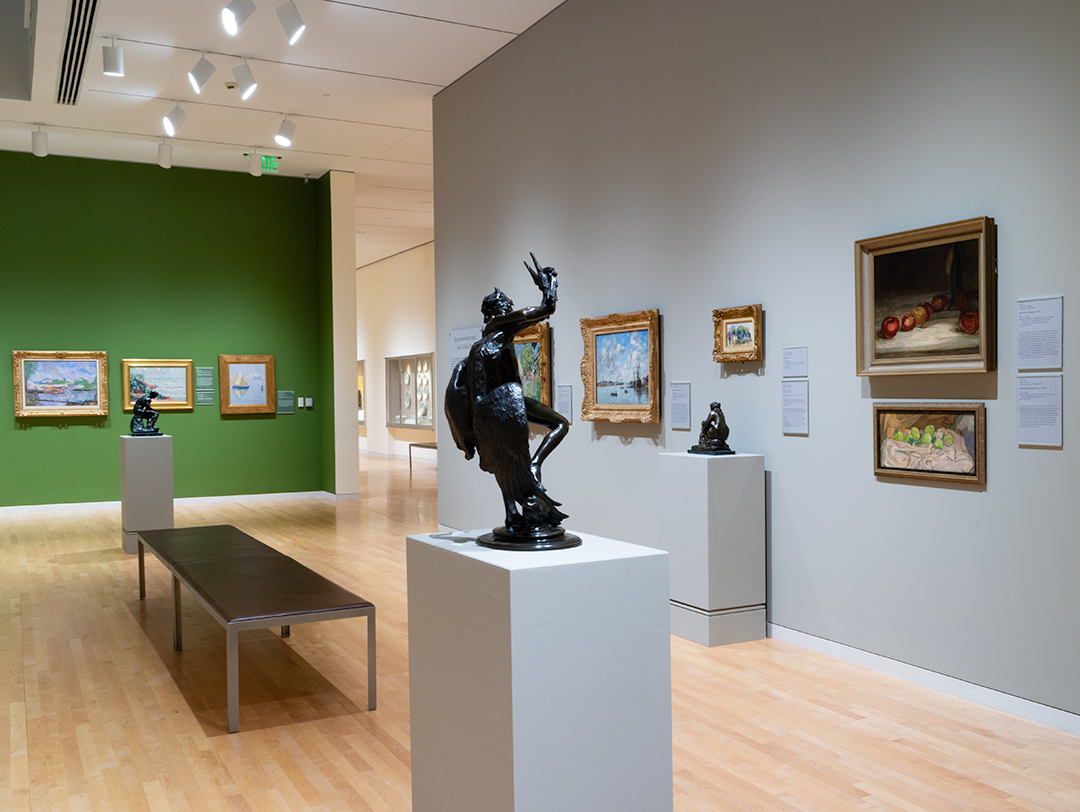
If you’ve been to the museum recently, you may have noticed the Letitia and Rowland Radford Gallery roped off as our team worked on reinstalling it. Like the reinstallation of the Marilyn Overstreet Nalley North Gallery earlier this year, it’s part of a project to refresh all the permanent collection galleries while keeping the majority of them open to the public. The galleries are always a work in progress as new acquisitions enter the collection and delicate works on paper need to be rotated on and off display, but reinstalling a full gallery at once is an opportunity to rewrite wall text and consider all the objects a given gallery contains in relation to one another.
The museum’s curator of American art, Jeffrey Richmond-Moll, spearheaded the Radford reinstallation, but worked closely with his fellow curators, especially Shawnya Harris and Nelda Damiano as well as the museum’s preparators. He says, “This was a highly collaborative process. . . . We read each other’s labels, discussed together the various object groupings and points of emphasis, and reviewed colors and design ideas.”
What goes in and what doesn’t? Richmond-Moll says,
As with the reinstallation in Radford in early 2020, I wanted to bring a more diverse set of perspectives, a more integrated series of objects and a more critical approach to the museum’s permanent collection. As museums continue to reflect on their fraught pasts and rethink who or what is (and is not) represented in their collections, I wanted to create opportunities in these galleries to speak to viewers in the present tense. Reconceiving and rewriting our labels throughout the gallery was one key way to do this. I also wanted to create thought-provoking pairings of objects (like a pairing of a Cherokee basket with Francis Criss’ ‘Indian Relics’ in Nalley North(opens in new tab), and a pairing of still-life paintings of apples by Pierre Daura and Henry Ossawa Tanner, both clearly inspired by Paul Cezanne), as well as places to spur conversations between different media (painting, works on paper, decorative objects), which often end up in separate galleries.
We were able to emphasize the transatlantic nature of art-making in the period of Impressionism and the Gilded Age, but I look forward to opportunities in the future to create more cross-cultural conversations, particularly through our existing collection of Asian pottery. Collectors in this period like Charles Lang Freer mixed their American paintings with decorative objects like Japanese ceramics, finding conversations between the aesthetic principles of diverse global cultures. Hopefully, through future conversations with specialists on campus in Asian art and culture, we can highlight those kinds of international links.
One thing visitors will find in the reinstalled Radford Gallery is a permanent home for the C. Herman and Mary Virgina Terry Collection, which includes paintings by Ernest Lawson, Maurice Prendergast, John Henry Twachtman, John Leslie Breck, Albert Lebourg and Armand Guillaumin, donated to the museum in 2018(opens in new tab). A newly green wall helps define the paintings as a discrete collection, the color drawn from the era in which these objects were made. Some works that have been in the vaults (paintings by Eastman Johnson, Elihu Vedder and Albert Blakelock) are on view once more, “helping to build out a larger view of the visionary qualities of Gilded Age-era painting in the U.S. around the turn of the 20th century,” Richmond-Moll adds. He also points out that the reinstall has allowed the museum to hang a newly conserved recent major acquisition by Eugène Boudin, a mentor in Paris to Claude Monet.
The original schedule for reinstalling the permanent collection galleries was disrupted by the COVID-19 pandemic, but the Marilyn Overstreet Nalley South Gallery is next on the agenda, coming up in the spring.
Authored by:
Hillary Brown