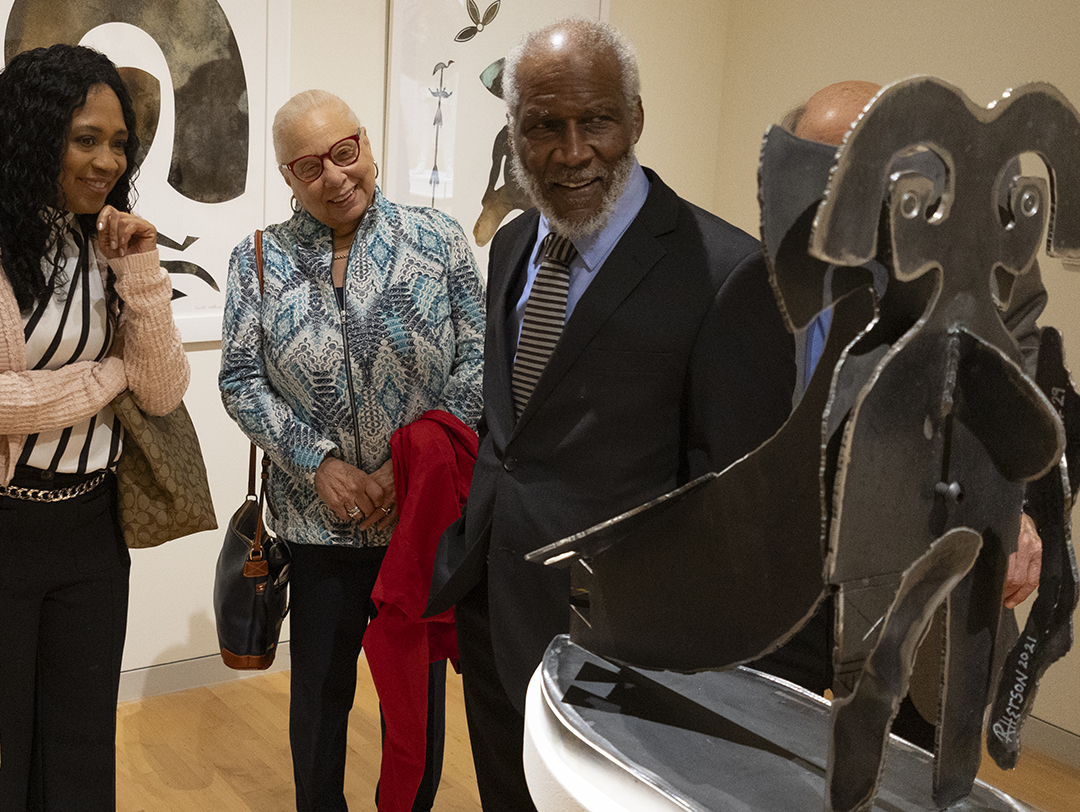
Held for more than a decade now, the museum’s Black Art and Culture Awards continue to inspire. This year’s event, on March 22, 2024, honored sculptor Curtis Patterson and educator Marie T. Cochran.
Event chair Shanell McGoy welcomed all in attendance and thanked attendees, sponsors, event committee members and VIPs in attendance including: Lamar Dodd School of Art director Joe Peragine, Vice Provost for Academic Affairs Jeannette Taylor, Senior Vice President for Academic Affairs and Provost Jack Hu and President Jere W. Morehead.
Before award presentations, UGA President Morehead took the stage, encouraging attendees to take time to explore the galleries after the formal presentation and thanking museum patrons Larry and Brenda Thompson for their generous and longstanding support. In particular, he praised the Thompsons’ willingness to share their love and joy of African American artists’ works with everyone else “so that what has been meaningful to them can now be meaningful to others.”
Monica Parker, representing the Athens Chapter of the Links, Inc., presented the Lillian C. Lynch Citation to Marie T. Cochran. The award honors an African American leader who has made a significant contribution to Black cultural education and service and is named for the late Ms. Lynch, a charter member of the Athens Links.
Cochran is an artist, educator and curator with a bachelor of fine arts degree in drawing and painting from the University of Georgia (’85) and a master of fine arts degree from the School of the Art Institute of Chicago (’92). Born and raised in Toccoa, Georgia, she is the founder of the Affrilachian Artist Project, which celebrates the intersection of cultures in Appalachia and nurtures a network of those committed to the sustainability of a diverse region.
As Cochran accepted the award, she referred to it as “a full circle moment” and reminisced on her early days as a 20-year-old first-generation college student at the Lamar Dodd School of Art. She referred to herself as the child of textile workers, the grandchild of sharecroppers and the great-great-grandchild of enslaved people and vowed to “honor the messy bittersweet contrast of my home region’s historic challenges and the courageous accomplishments of [Black and Indigenous people] there.”
Shawnya Harris, the museum’s deputy director of curatorial and academic affairs, presented the Larry D. and Brenda A. Thompson Award to artist Curtis Patterson. A short video on his career created with UGA student and curatorial intern Emma Grace Moore preceded the presentation of the award. The award honors African American artists who have made significant but often lesser-known contributions to the visual arts tradition and have roots in or major connections to the state of Georgia.
Patterson was born in Shreveport, Louisiana, as one of five siblings. But his humble beginnings and struggles growing up during the segregation era did not derail his path toward expression through art. He studied art at Grambling State University and Georgia State University, in Atlanta, where he became the first African American to receive a master of visual arts in sculpture. He taught sculpture at the Atlanta College of Art for 29 years. In the 1970s, he began making commissioned large-scale public art and went on to produce several major works of art in prominent U.S. cities.
Patterson thanked the Thompsons for “all of the tireless hours they’ve spent going around the country and finding [artists] we might not have known if not for their efforts” and said he wished he could “clone both of them” due to their commitment to collecting art by African American artists as a way “to preserve our culture.” While an undergraduate at Grambling, he helped a professor build a crate for a painting destined for Hale Woodruff’s Atlanta University Annual Exhibition. It was an indelible experience that shaped his desire to come to Atlanta after he graduated, he said. There, he saw a mural of Woodruff’s that included the figure of Shango, a Yoruba spirit associated with lighting, thunder and power. Patterson has incorporated Shango and related symbolism into his own work for years as a means to make people who see his art aware of the relationships between antiquity and modernity, especially when it comes to older African art and its influence on contemporary art.
Brenda Thompson also spoke about the event as a whole and her and Larry’s relationship to Patterson. Tina Dunkley, the former curator and director of the Clark Atlanta University Art Museum, was “relentless” in encouraging the Thompsons to buy Patterson’s work, and Brenda remains thankful for that push, she said. She sees his work as not only beautiful but culturally rich, with Shango serving as a symbol of both ancestry and the beauty and elegance of African art. She encouraged attendees not to wait for a special event to visit the “jewel” that is the Georgia Museum of Art, but to visit regularly and find art that takes you to a special place.
We thank all who contributed to, sponsored or attended the event.
Authored by:
Hillary Brown