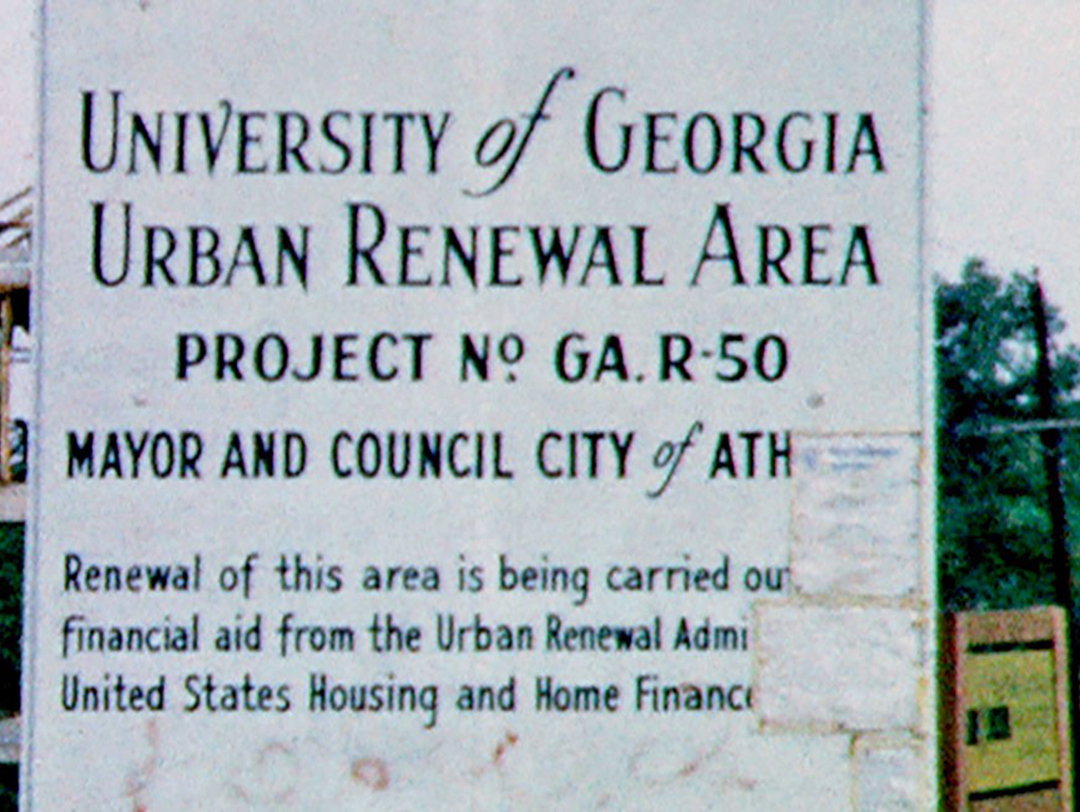
Made up of 50 Black families, Linnentown was a thriving community that existed on Baxter Street in Athens. Many of the families had employment with the University of Georgia just a short walk away. In 1962, a sign went up stating “Urban Renewal Area” without a warning, changing the lives of the Linnentown community forever.
UGA entered into a federal urban renewal contract with the city of Athens to build then-luxury residence halls Brumby, Russell and Creswell. Compensated unfairly for the homes and land they owned, the families were bullied out of their community. First descendants Hattie Thomas Whitehead and Bobby Crook described the tensions they faced as children during this time of desegregation. Power equipment ran throughout the night, UGA students threw trash as they walked by and ditches were dug that children had to jump over to get to school. The community dispersed across Athens, and any trace of Linnentown was gone by 1966.
On February 16, 2021, the Unified Government of Athens-Clarke County adopted the Linnentown Resolution for Recognition and Redress, the first official call for reparations in the state of Georgia. To this day, UGA refuses to come to the table for a discussion of their role in displacing and destroying the Linnentown community. Upon hearing of this movement to acknowledge the story of the descendants, graduate students Sarah Livant, Meghan Manis Holcomb and Gabriella Victorio decided to start the Linnentown Quilt Project.
As a part of their art education program, Livant, Holcomb and Victorio wanted to involve the greater community of Athens. With the support of the Linnentown descendants, they hosted workshops with the community teaching techniques like embroidery and fabric piecing for participants to create their own quilt square. By the end of 2021, they collected 86 quilt squares representing the memories shared by the descendants. The finished quilt will be on display for the first time Sunday, April 10 from 1 to 3 p.m. at the museum. Join us in honoring the quilt and learning about Linnentown. Visitors can also take a tour of the permanent collection with an emphasis on community-centered works.
To learn more, read “Giving Voice to Linnentown” by Whitehead or visit redressforlinnentown.com(opens in new tab).
By Gabriella Victorio