As we celebrate the 75th anniversary of our museum, it’s an opportune time to look back at our history. From now until the end of the year, we’ll be featuring a post once a month about the history of the museum through the decades. This month, we take a look at the museum’s presence and history on campus in the 1960s.
In the 1960s, the Georgia Museum of Art found its footing as a major museum and source for inspiration that hosted internationally renowned artists and curated exhibitions, alongside local and regional art exhibitions such as the Athens Art Association’s artists’ works and, of course, the expanding permanent collection. By one account from a Red & Black article late in the decade, the permanent collection that Alfred Heber Holbrook donated at the museum’s founding had grown to include over 2,000 works in 1967. The expanded permanent collection and increased prominence of many of the exhibitions on view ultimately resulted in a significant increase in attendance by not only students, professors and other campus members, but patrons from all over. As one article noted, in 1966, the museum had more than 16,000 visitors that year and attendance numbers in 1967, halfway through the year, were set to greatly surpass patron attendance for the previous year.
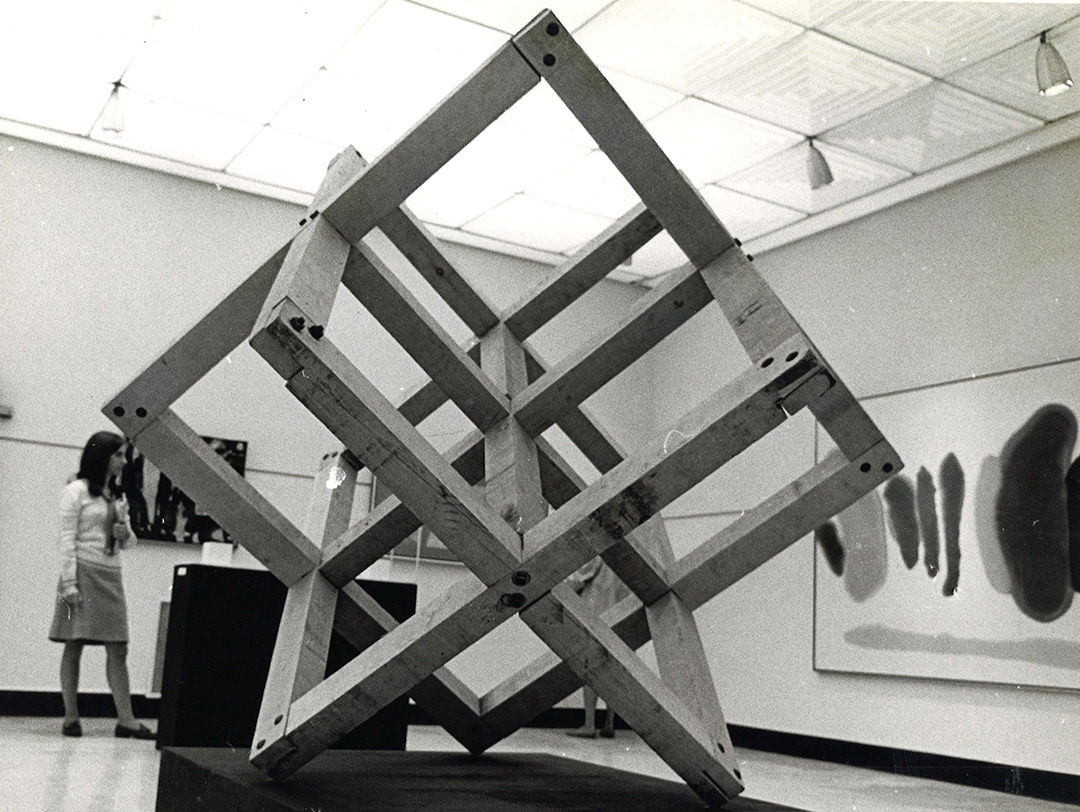
So what did the 1960s look like at the Georgia Museum of Art? Much like the rest of the country, the UGA campus experienced many cultural shifts–in cultural norms, fashion, art, literature and movies. These shifts didn’t happen all at once and happened, most noticeably, in the last few years of the decade and into the 1970s. A look back at newspaper archives from the Red & Black and UGA’s Pandora Yearbook from the time show just how visible some of these cultural changes were on campus. The Georgia Museum of Art’s exhibitions and direction during the time underlined the changing times, with major exhibitions showcasing abstract expressionism and pop art and other recent trends in the art world.
To begin the decade, the museum building, which is now the administration building on North Campus, went through some exterior changes. One Red & Black newspaper archive article from 1962 noted that “six abstract paintings symbolizing six phases of University life have been painted on the front of the Georgia Museum of Art as part of a face lifting project for the building.” Painted on sealed windows in the building, eight by 12 feet in size, the images represented a variety of developments and entities on campus. Strangely, we have not yet found a full set of images depicting these paintings at the time in our archives or any of the digital archives available through UGA’s archives. We have, however, stumbled upon one photo in our archives of one of the six paintings.
Beyond the exterior aesthetics of the museum at the beginning of the decade, the museum also saw changes in the types of exhibitions and artist’s works on view at the museum. Local and regional artists, including UGA faculty such as Lamar Dodd, continued to have a significant presence, with regular exhibitions of works on view by the Athens Art Association and Georgia Association of Artists. However, in the latter years of the 60s, the museum saw more and more exhibitions of artists’ works from outside the state.
The first part of the decade saw myriad exhibitions on view at the museum, including:
- A Moscow Art Theater photography exhibition in December of 1960.
- An exhibition from the Jewish Museum traveling collection, which was put together by the Hebrew Union College, Jewish Institute of Religion in Cincinnati, Ohio, and sponsored by the Atlanta Art Association and Davidson Paxson Company. The exhibition was on view in August of 1961.
- An exhibition of nine Southern artists including four from Athens: Lamar Dodd, Howard Thomas, Joseph Schwarz and Meroe Messer in November of 1961;
- An exhibition of paintings by the late Mary Thomas, the first art supervisor of Clarke County Schools and wife of UGA art professor Howard Thomas in February of 1962;
- An exhibition featuring Asian artifacts from the 8th century in July of 1964;
- An exhibition for the Association of Georgia Artists in September of 1964;
- An exhibition a historic Forsyth stone that was moved to the museum so archaeologists could study the artifact in February of 1964.
The latter half of the decade saw a noted increase in major exhibitions from internationally renowned artists. Some of these exhibitions were promoted by nonprofit organizations and federal government initiatives that aimed to increase exposure to arts in the United States. Others were curated and brought to UGA thanks to a new curator at the Georgia Museum of Art. In 1966, assistant professor of art William D. Paul Jr. was appointed curator at the museum and his role helped elevate the exhibitions on view at the museum significantly.

The latter half of the decade brought many significant exhibitions to the museum, including:
-
“Old to New” exhibition, the artist of today paints for himself and ancient artists painted to please a patron. 40 paintings by master European artists; September 1965.
-
Burr Artists paintings exhibition, originally exhibited at the World’s Fair New York. The 14 artists assumed the name of George Brainerd Burr because he was an inspiration to their generation, they said. Abstract expressionism, classical painters and a few representatives of a contemporary portrait school were included; December 1965.
-
Swedish artist Joy Egnel’s first American exhibition featured works in a four dimensional or counterpoint style; August 1966.
-
An exhibition of artist Anna Richards Brewster featured 30 oils and watercolors based on sketches made while traveling through countries in Europe, Asia and Africa; August 1966.
-
The “Eyewitness to Space” exhibition featured 69 paintings, drawings and watercolors by 17 artists invited to Cape Kennedy by NASA in cooperation with the National Gallery of Art to record their impressions of the historic events connected with the space program; January 1967.
-
An exhibition that featured rugs from Argentina via the Smithsonian Institute; February 1967.
-
An exhibition of works by American painter Carleton Wiggins; March 1967.
-
An exhibition of works by medical illustrator Jeanet Steckler Dreskin; July 1967.
-
“American Painting: 1940s” featured works by 22 artists that were selected by Harris K. Prior of the American Federation of Arts and included works by Salvador Dali and Thomas Hart Benton. The first in a three-part series that doubled museum of attendance when it was showing at the museum; September 1967.
-
“American Painting: 1950s” featured pioneers of abstract expressionism including Pollack, de Kooning and Motherwell and was part of the museum’s 20th anniversary celebration events; November 1968.
-
The “Art in Process: Visual Development of a Collage” exhibition was one of several exhibitions in a series that depicted the process of art, from original idea to the final presentation; October 1967.
-
An exhibition titled “The Visual Assault” was curated by newly appointed museum curator William D. Paul Jr. and featured 46 artists’ modern works “of all imaginable mediums from oil on canvas to welded automobile bumpers.” Works by Lichtenstein and Warhol were featured; November 1967. You can see installation photos of it here.
-
An exhibition of etchings by artist William Meyerowitz; May 1968.
-
An exhibition from the David E. Bright Venice Biennale Collection that featured 55 works, mostly abstract expressionism, and included paintings, sculpture and graphics; April 1968.
-
An exhibition featuring works by younger British artists who began an independent English pop art movement in the early 60s. Selected by the Museum of Modern Art’s assistant curator of the department of painting and sculpture, the exhibition featured artists Peter Blake, R.B. Kitaj, Richard Smith, David Hockney, Allen Jones and Peter Phillips, all graduates of the Royal College of London; March 1969.
-
An exhibition on the history of the chair featured a 4,000 year survey tracing the history of the chair from its earliest beginnings in ancient Egypt to a U.S. astronaut training couch; November 1969.
-
An exhibition called “Inflated Images” that featured works that explored the modern artist’s use of disproportionate scale; July 1969.
-
An exhibition called “Good Design in Toys” featured an array of toys and interactive activities that focused on well-designed toys and games; April 1969.
Authored by:
Jessica Luton