An idea
Collaboration and planning are key, but it all begins with a great idea. Most often, that great idea comes from one of the museum’s curators, who brings an exhibition concept to an internal committee, either with the Georgia Museum of Art or another collaborative institution. Advocating for the concept to the committee, the curator makes the case for the importance and impact of a potential exhibition. With unique knowledge and expertise, curators promote art and artists they want to showcase to the committee and provide a plan to make it possible. “I always say the biggest job of the curator is to have a strong checklist. It is from there that everything springs, from negotiation to programming,” said Shawnya Harris, deputy director of curatorial and academic affairs and Larry D. and Brenda A. Thompson Curator of African American and African Diasporic Art.”
Initial planning
For the museum’s recent exhibition “Nancy Baker Cahill: Through Lines,” museum staff, including preparator Elizabeth Marable and associate curator of modern and contemporary art Kathryn Hill, met with artist Nancy Baker Cahill to discuss and imagine the many possibilities for the exhibition. They talked over the basic details, including how much space the exhibition required, what gallery spaces were ideal and what technological requirements were needed. With Baker Cahill’s use of augmented reality, the exhibition had some unique requirements, but requirements are different for every exhibition that the museum hosts. For “Through Lines,” museum staff and Baker Cahill decided that the exhibition was well suited for three museum spaces — the Roush Gallery, the Dudley new media gallery and the Jane and Harry Willson Sculpture Garden. With those decisions made, the exhibition was added to the museum calendar and more detailed planning for the show could begin.
Moving art
THE NUMBER OF ARTWORKS AN EXHIBITION INCLUDES OFTEN DETERMINES HOW COMPLICATED IT WILL BE TO GET THEM TO THE MUSEUM.
For the Nancy Baker Cahill exhibition, there was only one artist’s work being showcased, but often getting works to the museum can be a much more complicated endeavor. Staff must plan for aspects such as the location of works and how to transport them, how to orchestrate shipping them from many locations and the sheer physical requirements for moving them. The process often requires detailed logistical planning and can take quite some time. Depending on the size of the exhibition, the number of works being borrowed or purchased and the necessary fundraising when acquiring works, the whole process can often take years.
None of this would be possible without the diligent work of museum registrars, who manage and monitor every move of works. Registrars arrange transportation and movement logistics, make sure pieces are moved with care and keep a record of the condition of works throughout the process. Whether pieces are from the Georgia Museum of Art’s permanent collection or on loan from an artist, a collector or another institution, this is no small task. When “Through Lines” was still being planned and designed, registrar Amber Barnhardt was also hard at work getting loan agreements and contracts signed and ironing out other details that make it possible to get works to the museum.
Design
WHILE REGISTRARS ARE WORKING ON THE LOANS PROCESS, CURATORS ARE CHOOSING WHICH WORKS WILL BE PART OF AN EXHIBITION.
When the checklist of works is (mostly) finalized, exhibition designers begin building a digital, to-scale version of an exhibition using 3D modeling software. Collaborating with curators to bring their vision to life, designers must consider a variety of factors to create a polished exhibition that museum visitors will enjoy. Which sections will be important? In what order should pieces or sections be arranged? Which objects illustrate the theme of the exhibition? Which layout makes sense? These are all major questions that designers and curators plan and discuss many months before works are installed.
For “Through Lines,” chief preparator and head exhibition designer Todd Rivers and curator Kathryn Hill worked with the artist to meet the technological needs for the exhibition. Marable and Baker Cahill walked through every detail of the exhibition checklist and model to develop a first draft layout. With two site-specific installations, the artist’s input was especially vital.
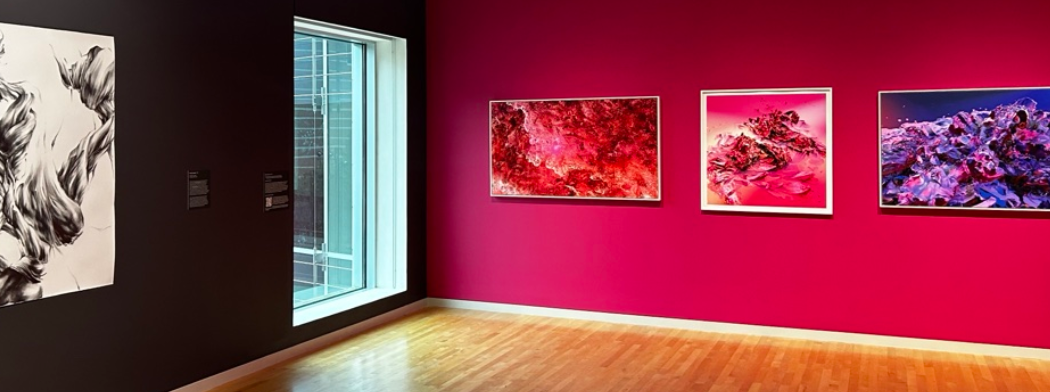
The design of an exhibition is integral to great visitor experience. A good flow in a gallery space, with a layout that gently guides visitors to works and information, can give visitors space to contemplate, find inspiration or have discussions along the way. Aesthetic choices, such as font and color scheme, also play an important part in exhibition design, noted Marable. “The color and text elements serve to enhance the viewing experience and better tell the story,” she said. These choices help visitors understand exhibition concepts without even reading a label, at an almost unconscious level, and help make a visual story accessible to as many people as possible. Each visitor deserves to have an experience that is uninhibited and accommodating, so designers are purposeful about aspects such as lighting, font size, label height and even viewing angle. In “Through Lines,” the wall color was a deliberate choice, said Marable. “[It helped] guide the viewer through the themes discussed [with] a very bold pink tone that we were able to pull directly from one of Baker Cahill’s artworks,” she said.
Installation
FOR EXHIBITION INSTALLATION, MUSEUM PREPARATORS EACH HAVE SPECIALIZED SKILLS, AND THEY COLLABORATE AS A TEAM TO GET THE JOB DONE.
While Marable focuses on layout and design and works with an artist before the gallery is installed, other preparators, such as Larry Forte and Robert Russell, oversee physically putting the exhibition together. Forte handles most of the construction and mount-making, and Russell is responsible for matting and framing works on paper and for lighting. Working together is crucial because each part of an exhibition is dependent on another, noted Russell. “The design may call for a sculpture with very few lighting requirements to be installed next to a work on paper or textile that requires a very low light level,” he said. “It can be difficult to light the sculpture appropriately while also keeping light-sensitive works at a safe level.” Knowing the light restrictions and matting and framing requirements ahead of time helps preparators work together to make the initial ideas and designs a reality.
The Reward
“EXHIBITS ARE NOT BOOKS. THEY ARE THREE-DIMENSIONAL STRUCTURES MEANT TO TELL A STORY,” NOTES THE SMITHSONIAN’S GUIDE TO EXHIBIT DEVELOPMENT.
Through careful planning and collaboration among staff across many departments at the Georgia Museum of Art, the museum creates exhibitions that bring prolific artists and their works to life for the public. Every aspect is carefully considered and when all is said and done, the process creates the greatest reward of all — an experience that educates, inspires and brings joy to everyone who walks through our doors. Next time you’re in the galleries, take a moment and admire the work that went into the exhibition you’re enjoying.
Want to view the reward mentioned in this piece? You can view Nancy Baker Cahill’s works at the museum until May 19, 2024.
Authored by:
Kristina Durkin