

John Haley: Berkeley School Abstract Expressionist
November 10, 2012 – March 3, 2013
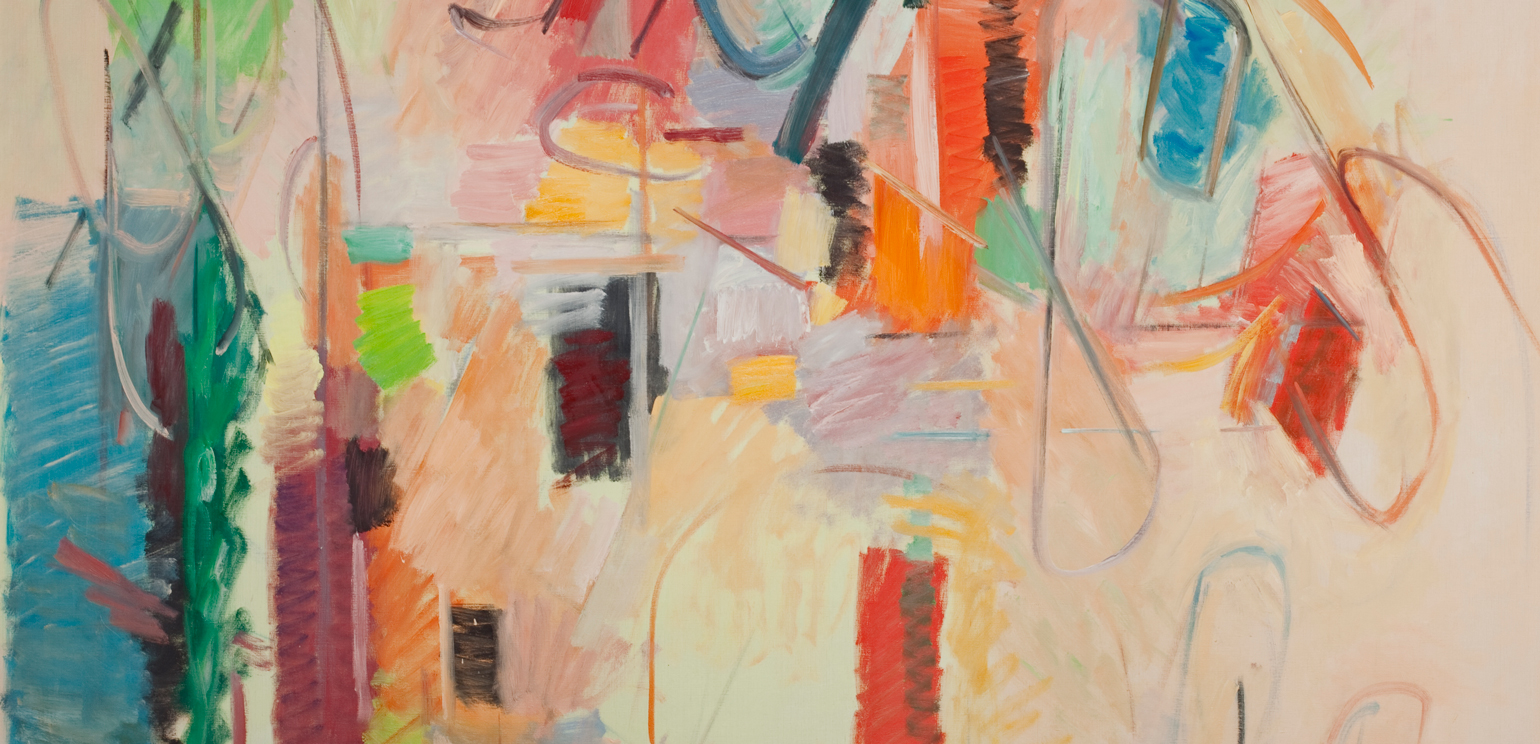
loosely defined forms and bright colors
Organized by the Monterey Museum of Art, this exhibition included abstract paintings by the American artist John Haley (1905 – 1991) from the collections of several private lenders. Haley studied with Hans Hofmann in Germany in the 1920s and became an important and influential art instructor at the University of California, Berkeley, one of the most innovative art departments in the country at that time. Hofmann’s influence permeated the “Berkeley school” of abstract expressionism that sprang up on the West Coast, of which Haley was a crucial member, and the two artists both taught at UC Berkeley in the 1930s.
Haley served in the U.S. Naval Reserve during World War II, drawing landscapes to assist with invasion strategies. Trained in the Beaux Arts style, he moved steadily toward abstraction beginning in 1949, and his style evolved from geometric compositions to a focus on more loosely defined forms and bright colors. Haley retired from teaching in 1972, but his students included Elmer Bischoff and Walter De Maria, and his influence was profound. This exhibition highlighted a prolific but lesser-known artist whose reputation as a mentor has perhaps overshadowed the impact of his own paintings.
Curator
Paul Manoguerra, chief curator and curator of American art (in-house)
Sponsors
YellowBook USA, the W. Newton Morris Charitable Foundation and the Friends of the Georgia Museum of Art