

Icon of Modernism: Representing the Brooklyn Bridge, 1883 – 1950
September 17 – December 11, 2016
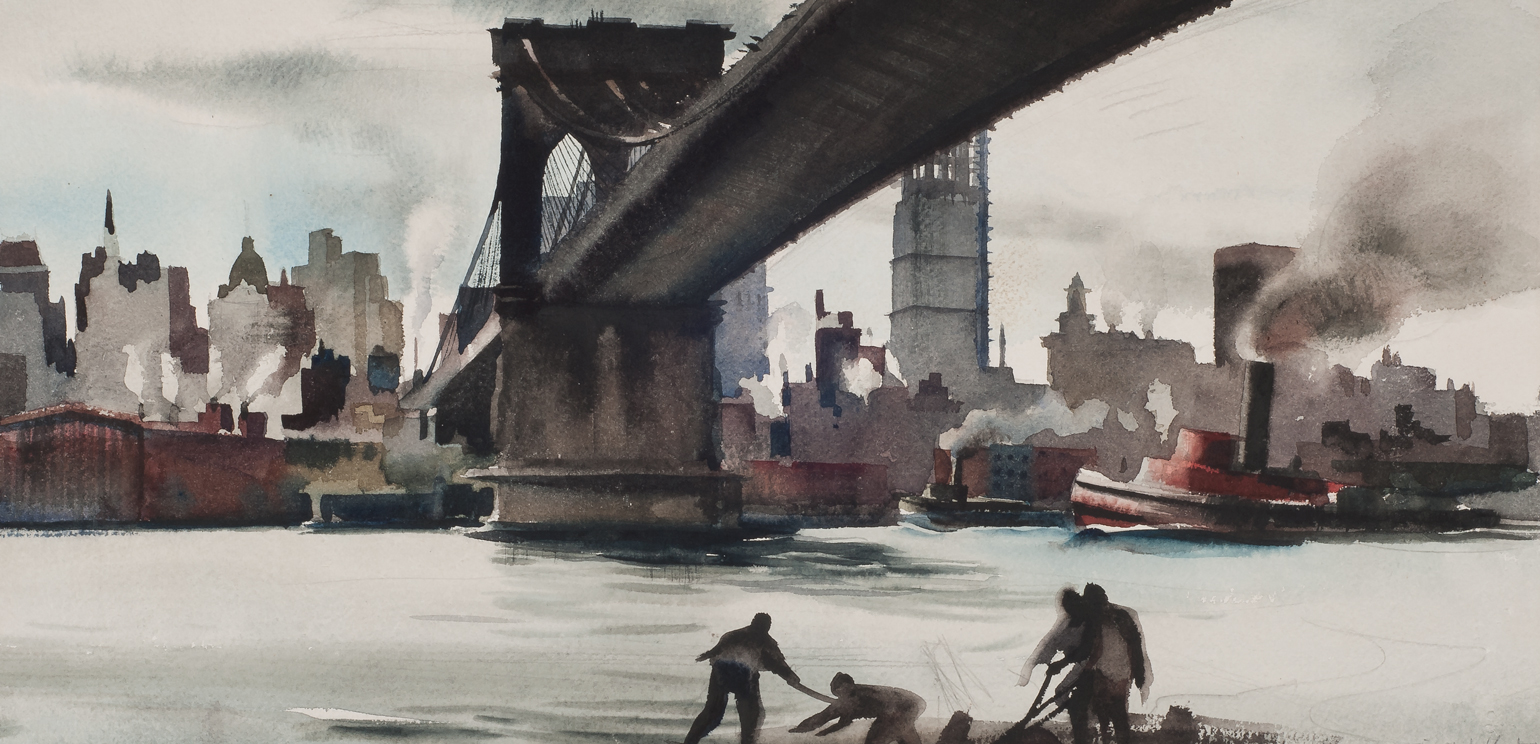
a stand-in for the idea of modernity
From its opening in 1883 to the present day, artists repeatedly depicted the Brooklyn Bridge as a stand-in for both the city of New York and the idea of modernity as defined by that city’s urban life. During the period this exhibition treated, artists were engaging with new forms of visual representation such as impressionism, cubism and precisionism. These innovative formal techniques were used in conjunction with newly built structures such as the bridge, the Woolworth Building and the Flatiron Building to underscore the contemporary nature of their artistic production. This exhibition examined these modes of representation and how artists grappled with a particularly American brand of modernity as both positive and negative from U.S. and European perspectives.
This show featured 42 paintings, works on paper and photographs by major American and European artists. Artists included Edward Steichen, Joseph Stella, George Luks, Jonas Lie, Georgia O’Keeffe, William Louis Sonntag Jr., Reginald Marsh, Louis Lozowick, John Marin, Childe Hassam, Ernest Lawson and Samuel Halpert, among others. The museum published a fully illustrated hardcover catalogue(opens in new tab) with essays by curator of American art Sarah Kate Gillespie on the history of the Brooklyn Bridge as a symbol of modernity and on photography of the bridge, by Janice Simon on images of the bridge in the popular press, by Meredith Ward on John Marin’s renderings of the bridge and by Kimberly Orcutt on Joseph Stella’s paintings of the structure.
Curator
Sarah Kate Gillespie, curator of American art
Sponsors
The National Endowment for the Arts, Shannon and Peter Candler, the Irwin and Hannah Harvey Family Fund, Teddy Johnson, the Piedmont Charitable Foundation, Margaret A. Rolando, the W. Newton Morris Charitable Foundation and the Friends of the Georgia Museum of Art