Edmonia Lewis: Said in Stone | Study Day and Convening: Research, Materiality, and the Archive
Thursday, November 5, and Friday, November 6, 2026
How do we reconstruct the history of an artist when the traditional archives are silent? How does the historical narrative come together to engage new audiences and give new insights into the work of artists from previous eras like Edmonia Lewis?
In conjunction with the landmark exhibition “Edmonia Lewis: Said in Stone,” the Georgia Museum of Art will present a convening centering on the methodologies used to reconstruct the life and legacy of this artist whose personal and professional archive remains fragmentary. This program pulls back the curtain on the years of detective work, technical analysis and digital innovation that brought this exhibition to life. We will explore how 21st-century tools, technology and interdisciplinary research can illuminate Lewis’s 19th-century mastery of sculpture.
Thursday, November 5, 2026, 5:30 p.m.
Kirsten Buick, “Who Is Responsible for Remembering? Three 19th-Century Case Studies @ Visuality and Forgetting”
Kirsten Pai Buick is a professor of art history at the University of New Mexico, where she has taught since 2001. Buick specializes in American art, focusing her research on African American art, the impact of race and gender on the history of art, representations of the American landscape and the history of women as patrons and collectors of the arts. She has advanced scholarship of the work of numerous African American artists through publications, including the first book-length examination of the life and career of Edmonia Lewis.
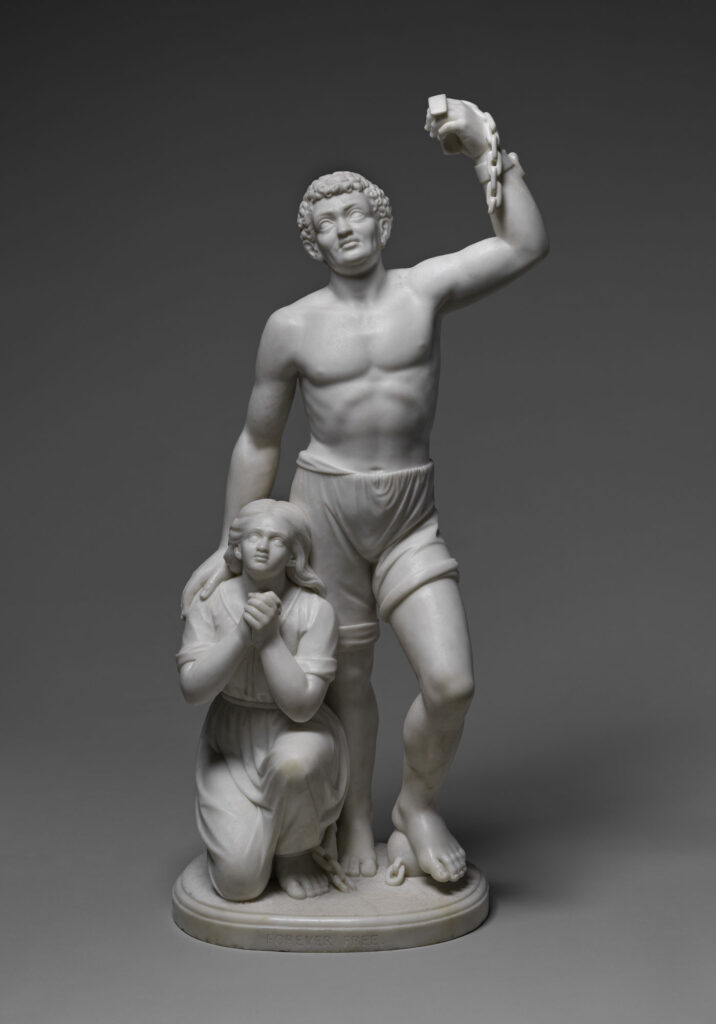
In a cultural climate where we are being actively encouraged to forget or mis-remember, this lecture argues that forgetting can be constitutive of visuality itself — that we must forget as the very condition of seeing. What does the slave narrative of James Williams mask, for example? What of Edmonia Lewis’s sculpture “Forever Free” or John Gast’s painting “American Progress”? Turning on the central question of “who is responsible for remembering,” each work resists illegibility by withholding the unspeakable and the unspoken.
Friday, November 6, 2026
Morning Session: Research Intensive
*Special invitation for select scholars, faculty, students and colleagues
9:30 – 10 a.m. | Check-in; coffee and pastries
10 – 10:30 a.m. | Exhibition orientation and curatorial overview
Shawnya Harris and Jeffrey Richmond-Moll provide a foundational overview of the exhibition’s framework and the research goals of the “Said in Stone” project.
10:30 a.m. – noon | Gallery study: Close looking
Gallery walkthrough and intensive study period. Object-based discussion with curators and conservator Amy Abbe.
noon – 1 p.m. | Lunch
Private lunch for speakers, morning scholars and other invited participants
Afternoon, Session, 1 – 4 p.m.
*Open to the general public
Panel 1: Navigating Archival Absence: Research, Recovery, and Curatorial Practice
Curating a major retrospective for an artist as complex as Edmonia Lewis requires both scholarly rigor and a creative approach to historical absence. This roundtable addresses the practical and philosophical challenges of building an exhibition from a scattered record, exploring how curators reconcile missing details with material evidence. Panelists will share breakthroughs in archival recovery methods, use of contemporary artistic responses and perspectives on Lewis, as well as their unique outlook on future research.
Co-curators Shawnya Harris and Jeffrey Richmond-Moll will be joined by Melissa Ragain, associate professor of art history at Montana State University and contributor to the “Said in Stone” catalogue. Ragain recently curated “Chisel and Razor:The Artistic Legacies of Edmonia and Samuel Lewis,” a two-part exhibition at Tinworks Art and the Museum of the Rockies exploring the intersecting legacies of Edmonia Lewis and her brother, Samuel, who lived in Bozeman, Montana.
Panel 2: Science of the Stone: 21st-Century Tools and 19th-Century Marble
How do art historians use modern conservation methods and technology to unlock the secrets of 19th-century sculpture? This session explores the intersection of material science and art history. Objects conservator Amy Jones Abbe presents her technical study of Lewis’s sculptures based on Henry Wadsworth Longfellow’s epic poem “The Song of Hiawatha” and the intensive conservation treatment of Lewis’ “Cupid Caught” in conversation with exhibition co-curator Jeffrey Richmond-Moll. They will explain how the various technologies that were utilized during the research for this exhibition shed new light on Lewis’s overarching artistic contribution and the physical nature of her sculpture.