The highly anticipated exhibition “Edmonia Lewis: Said in Stone” opened at the Georgia Museum of Art in August. Recognizing the first sculptor of Afro-Caribbean and Indigenous American descent to gain international recognition, “Said in Stone” is the first major retrospective in a larger effort to bring Lewis out of obscurity. Following its premiere at the Peabody Essex Museum in Salem, Massachusetts, the Georgia Museum is the second museum to host this show. Shawnya L. Harris, the Larry D. and Brenda A. Thompson Curator of African American and African Diasporic Art at the Georgia Museum, is a co-curator of the exhibition with Jeffrey Richmond-Moll, the George Putnam Curator of American Art at the Peabody Essex Museum.
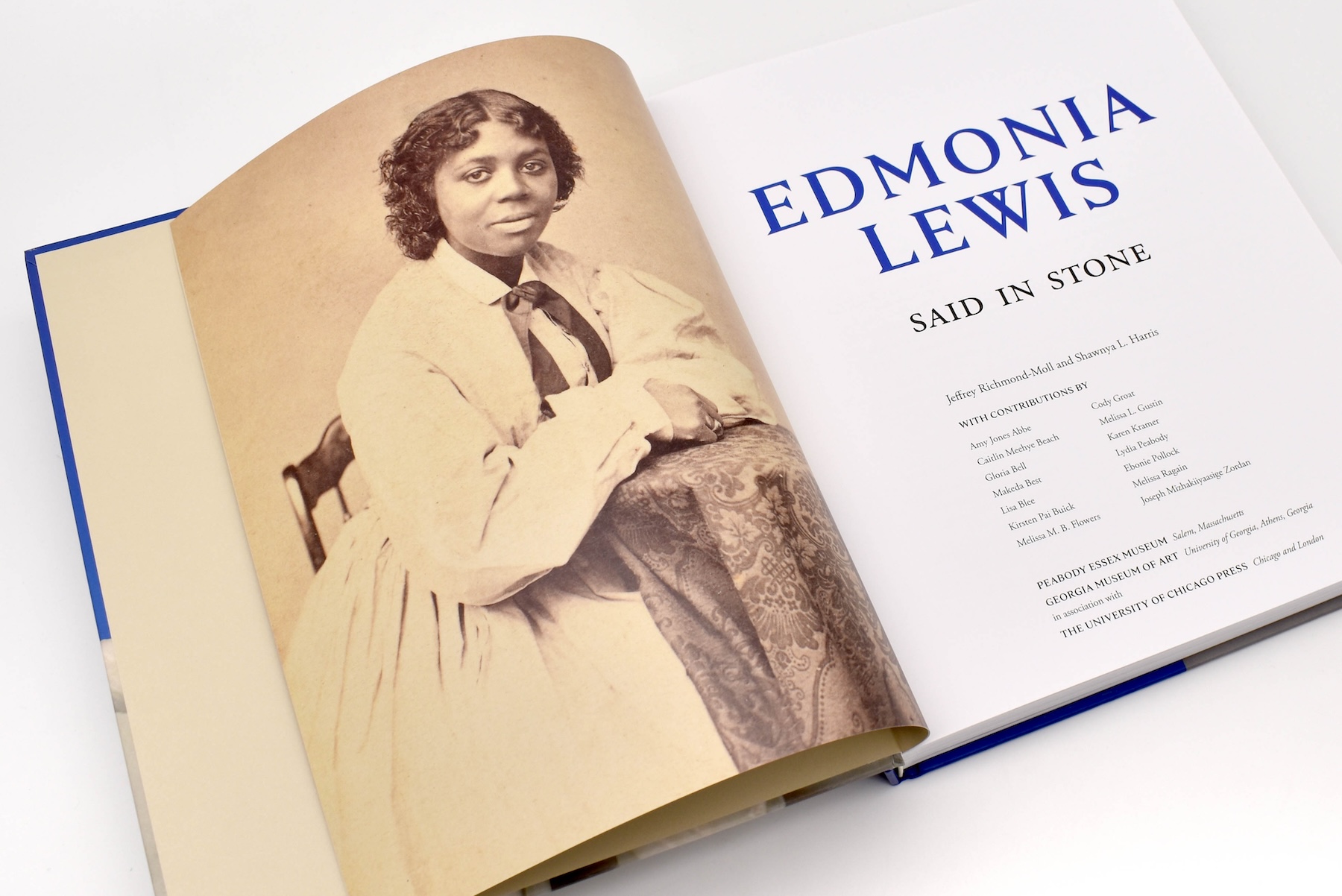
“Said in Stone” is accompanied by a catalogue with essays from 16 different scholars exploring Lewis’ life and work. An aid for understanding the nuances of her work and biography, this catalogue remedies “longstanding historical oversights” to assert Lewis’ rightful place in both art history and American history. The Georgia Museum and the Peabody Essex Museum collaborated on the book, which was published by the University of Chicago Press. Harris and Richmond-Moll edited the book, and their own scholarship is featured throughout.
“There are gaps, contradictions and long stretches of silence in the historical record. That means the work requires a combination of traditional art-historical research and investigative reconstruction,” said Harris. “In many ways, researching Lewis is an exercise in reading absence as carefully as presence.”
Lewis was born in Greenbush, New York, in 1844, to a father who was a free Afro-Caribbean man and a mother of African and Mississauga descent. Lewis received a formal art education at both New York Central College and Oberlin College but was greatly influenced by the Anishinaabe handicrafts she observed while growing up under the care of her aunts. Lewis moved to Boston in 1863, where she sold her works at antislavery meetings and established her reputation as an artist. She received commissions after building connections with abolitionist networks and used these to fund her travel to Europe, where she spent most of her career.
In Rome, she continued to hone her skills in neoclassical sculpture while providing the international art community with a perspective never before seen at such a scale. Her sculpture “Forever Free” celebrates emancipation with the formerly enslaved at the center of their freedom, while “The Old Indian Arrow Maker and His Daughter” celebrates the continuity of traditional Indigenous artistry between generations. Emblematic of Lewis’ historical obscurity is her masterpiece “The Death of Cleopatra.” Known for its dramatic, larger-than-life presence, “Cleopatra” was considered lost when Lewis died in 1907. Art historian Marilyn Richardson rediscovered it in the storage room of an Illinois strip mall in 1988. It is now in the collection of the Smithsonian American Art Museum but could not travel for the exhibition, which includes an interactive 3-D scan of the sculpture.
The “Said in Stone” catalogue seeks to re-establish Lewis in the canon of art scholarship and to challenge beliefs that she had been completely forgotten. An introductory chapter by co-curators Harris and Richmond-Moll sets the stage for readers by acquainting them with the complex identities that Lewis claimed.
“Lewis’s life and work touch so many different viewpoints,” said Harris. “During the planning period, we held two convenings with invited curators and scholars, where we discussed everything from previous scholarship on Lewis to emerging directions in Indigenous history, technical art history and transnational studies. The goal was to create a catalogue that mirrors the complexity of Lewis herself.”
Themes and more are explored in essays organized in seven distinct sections. “Indigenous Artistic Worlds” highlights how Lewis’ Indigenous background influenced her subject choice and style. “Relations” analyzes how professional, personal and familial relationships helped Lewis develop a sense of personal and artistic identity. “Diplomacies” discusses her time in Europe, especially the development of her Indigenous identity through her art. “Facts and Fiction” looks at her strategic use of networking, the printed press and visual media to control narratives of herself. “Religion and Myth” looks at the influence of the Catholic church and classical sculpture she experienced while in Rome. “Materialities” provides an in-depth technical study of the labor that went into her sculpture as well as the political obstacles of working in the medium. And “Legacies” explores how Lewis has been remembered, forgotten and rediscovered since her neoclassical style fell out of fashion in the late 1880s.
In addition to essays by Harris and Richmond-Moll, the publication includes contributions by Amy Jones Abbe, conservator; Caitlin Meehye Beach, The Graduate Center, City University of New York; Gloria Bell, McGill University; Makeda Best, Oakland Museum of California; Lisa Blee, Wake Forest University; Kristen Pai Buick, University of New Mexico; Melissa M. B. Flowers, American Conservation Experience Mellow Humanities Postdoctoral Fellow; Cody Groat, Western University, London, Ontario; Melissa L. Gustin, Walker Art Gallery, National Museums Liverpool, UK; Karen Kramer, Peabody Essex Museum; Lydia Peabody, Peabody Essex Museum; Ebonie Pollock, Harvard University; Melissa Ragain, Montana State University; and Joseph Mizhakiiyaasige Zordan, Harvard University.
The catalogue is extensively illustrated with images of sculptures, paintings, prints and photographs from Lewis and many other artists to contextualize her sculptures and show her lasting impact. A facsimile of a pamphlet titled “How Edmonia Lewis Became an Artist” is included in each copy as well as an in-depth chronology of Lewis’ life and work, including the rediscovery of sculptures like “The Death of Cleopatra,” “Awake” and “Asleep.”
The exhibition and the catalogue provide such a wealth of information on Lewis that it is not hard to see that they are the product of years of extensive research, complex paper trails and sifting through dead-end leads.
“Even now, details about her life continue to surface,” said Harris, “which means this catalogue is part of an ongoing process of recovering and honoring her legacy.”
Authored by:
Elizabeth Kim