Last month’s Family Day program was more than just the usual experience of helping children and caregivers explore and learn about art together. The April event also gave University of Georgia students a chance to get their feet wet in the field of art education. Students experienced what it’s like to see hands-on projects they’d developed light up faces with smiles and the awe that often accompanies learning about the creative arts.
Callan Steinmann, the museum’s head of education and curator of academic and public programs, often teaches Introduction to Museum Education (ARED 5500/7500) to undergraduate and graduate students each spring. The elective class is popular among students pursuing an undergraduate- or graduate-level certificate in museum studies.
Steinmann believes in the value of learning by doing. She likes to incorporate real, hands-on projects for her students as part of her curriculum. The April Family Day was Earth Day-themed, so students in the class developed three distinct Earth Day activities for attendees and then worked those stations during the event.
One group of students set up in the Letitia and Rowland Radford Gallery in the permanent collection. The Radford Gallery includes a lot of impressionist paintings, both American and European, and the students there developed an activity that let visitors “color” images of art with small round stickers, teaching them about pointillism while letting them look closely at paintings of nature.
Soudre Dadras, a doctoral student in art education, worked on a project about plastic waste and sea pollution. She set up her small group activity near Rebecca Rutstein’s light-up wall sculpture “Shimmer,” on the Patsy Dudley Pate Balcony. Rutstein’s work was inspired by her own deep-sea excursions with Samantha “Mandy” Joye, Athletic Association Professor in Arts and Sciences at UGA’s department of marine sciences. Joye is known for her study of plastics pollution in the ocean.
During the planning phase for the event, Dadras described the project that she would be hosting. “We will ask kids to create a sea monster using plastic shopping bags and will engage in a conversation with them on how to reduce plastic usage in our daily lives,” she said. “We cut and prepped shredded plastic strips. Each kid will receive a small wooden circle loom, googly eyes, and crayons to prepare the wooden loom, then tie the plastic bag strips to create an imaginary sea creature. We will ask them to give a name to their creatures and take them home at the end of the day.”
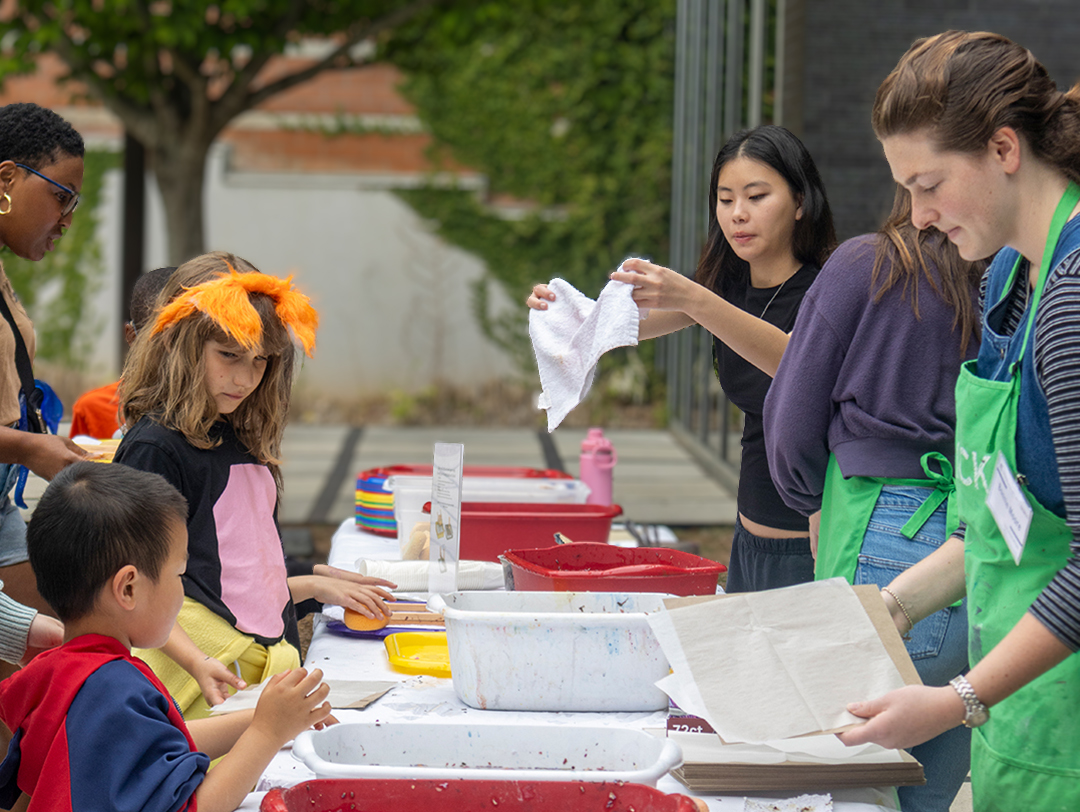
Finally, Saja Yim’s group worked with families in the Jane and Harry Willson Sculpture Garden to create plantable paper with wildflower seeds embedded in it. Yim said, “my groupmate Isaak Thurman came up with that idea, and we all agreed it would be a fun outdoor artmaking activity for kids of all ages.”
Papermaking can be complicated, so the students adapted the project to younger participants by having them make seed bombs. They used already shredded paper (which cannot be recycled through other means), native Georgia wildflower seeds, lavender and dried flowers to create paper pulp. Participants then scooped out the wet pulp and pressed it into frames (to make paper) or wadded it into balls (to make seed bombs), then let the results dry. Participants could then plant their finished project items anywhere to let wildflowers grow and spread.
Yim, who is a doctoral student in art education, said, “We’ve learned a lot about museum education practices in [the] class, like how to give gallery tours and develop programming for museum visitors of all ages.”
Prior to the project, Steinmann said, the class studied a range of topics including visitor experience, object-based learning, interpretation and engagement strategies for different museum audiences. “This project allows them to put theory into practice, applying what they’ve learned to a real museum program and getting to engage with our visitors,” she said. “This kind of project is key to our work at the museum, providing rich, experiential learning opportunities for university students while also serving our public audiences.”
Authored by:
Hillary Brown