


John Langley Howard created paintings that showed the mysteries of nature and the environment. Howard worked “with ever increasing knowledge to best express the life around him.” He was a prominent illustrator who worked for many magazines. Howard created “Private Little Jungle” the year he began working with Scientific American magazine. What do you notice about this painting?
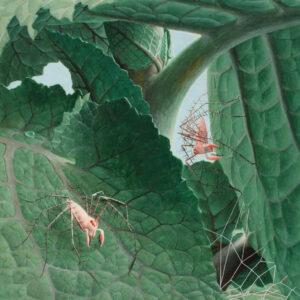
John Langley Howard (American, 1902 – 1999), “Private Little Jungle,” 1953. Lacquer on Masonite, 15 ½ x 15 ¼ inches. Collection of Michael T. Ricker.
“Private Little Jungle” makes a tiny place look like a vast habitat. An ordinary leaf, most likely a piece of kale, appears gigantic as it curls in all directions. A pair of spiders inhabit this green space. Can you find their web? Do you think this small world is painted from the artist’s imagination? Or do you think Howard happened upon these creatures in his kitchen?
In this activity, you’ll make a viewfinder and explore by looking closely — framing what you see and taking photos of the tiny worlds around you.
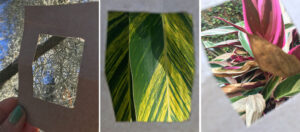
For this activity you will need:
- Recycled cardboard or thick paper
- Scissors
- A phone or other camera
To make your little-world photo:
- Make a viewfinder. Fold a piece of cardboard in half and cut a rectangle out of the folded edge.
- Unfold the cardboard and look through your viewfinder! It should look like a tiny window. What do you notice?
- Use the viewfinder to look closely at the world around you. Try looking at plants or tree bark outside or fruits and vegetables in your kitchen! Get really close. Hold the viewfinder at different angles to change the dimensions of the picture. How does the world look similar or different through your viewfinder?
- Use a phone or camera to snap pictures of the little worlds you spy through the viewfinder window.