

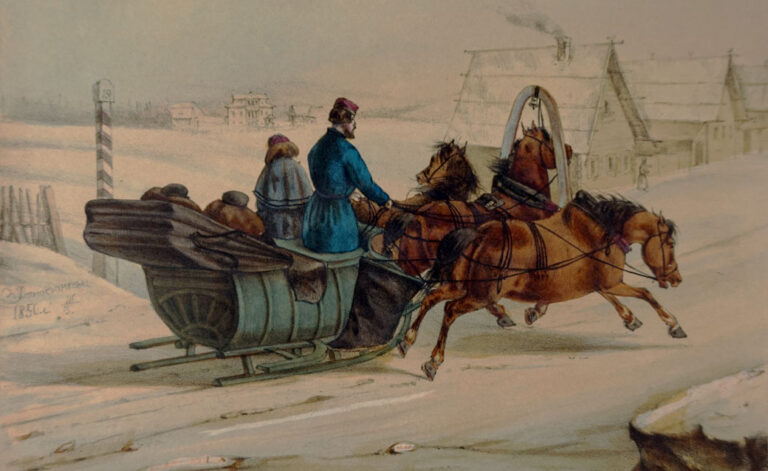
About This Exhibition
Family Day To-Go this month focuses on the exhibition “In Dialogue: Views of Empire: Grand and Humble.” This exhibition features Russian prints, sculptures and small metal boxes. These works of art show buildings, landscapes and people in Russia during the late 1800s.
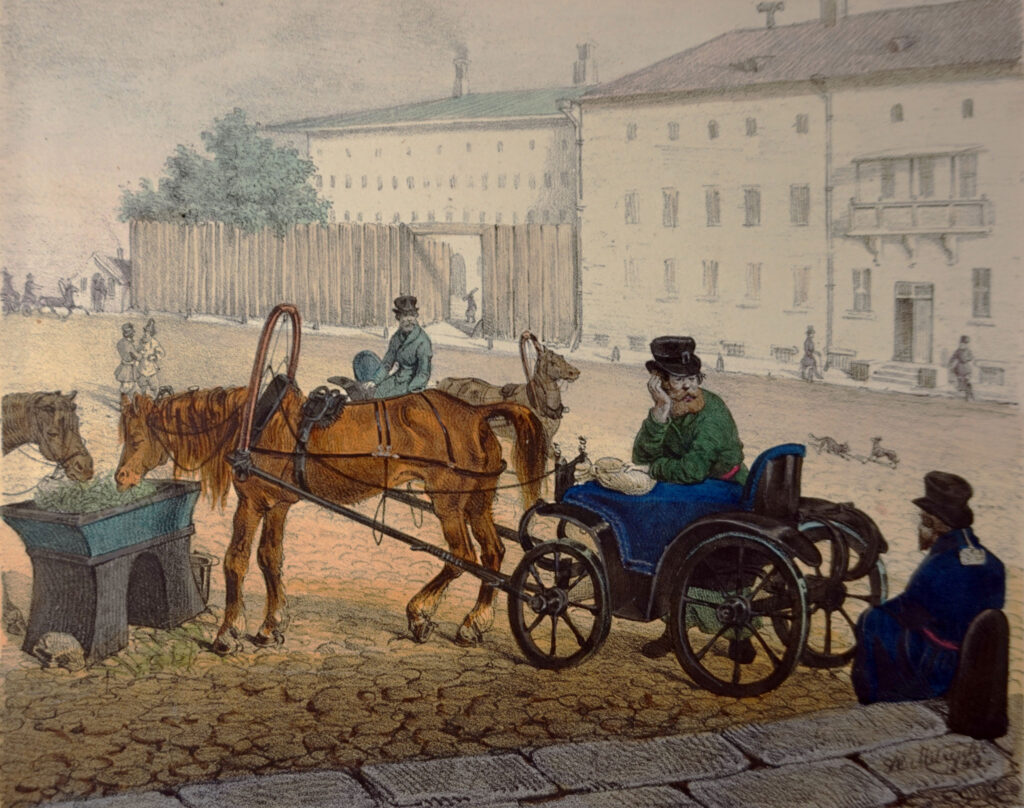 Print of figures with horse and carriage, 1840 – 50. Hand-colored lithograph on paper. Georgia Museum of Art, University of Georgia; Promised gift of Marina Belosselsky-Belozersky Kasarda.
St. Petersburg was and is an important city in Russia. Images of its buildings and streets appear in this exhibition. So do images of working people. If you see the exhibition in person, can you find coachmen, water carriers, innkeepers, firefighters and street peddlers?
“Views of Empire” is on view through August 21.
Close Looking: Russian Architecture
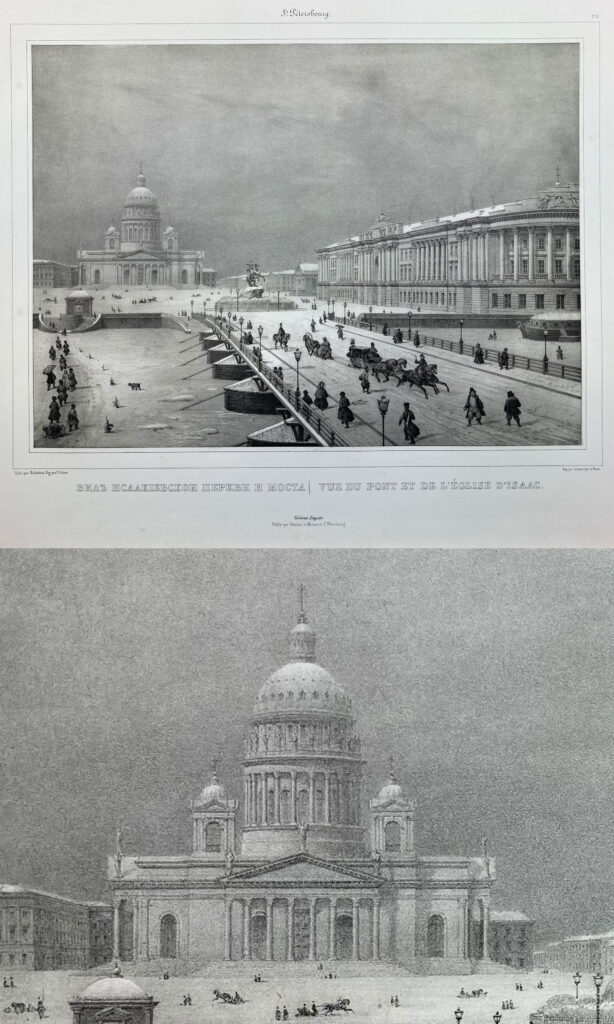 Jean Victor Adam (French, 1801 – 1866), drawing; Louis Pierre Alphonse Bichebois (French, 1801 – 1850), lithographer, “The Senate Square in Winter/View of Saint Isaac’s Cathedral and Bridge,” ca. 1858, Lithograph. Georgia Museum of Art, University of Georgia; Promised gift from the Parker Collection. GMOA 2018.208.3E.
Take a closer look at the buildings in this print. Find as many details as you can. The decoration on the buildings is called ornamentation. What ornamentation would you add to your dream building?
Find the Differences

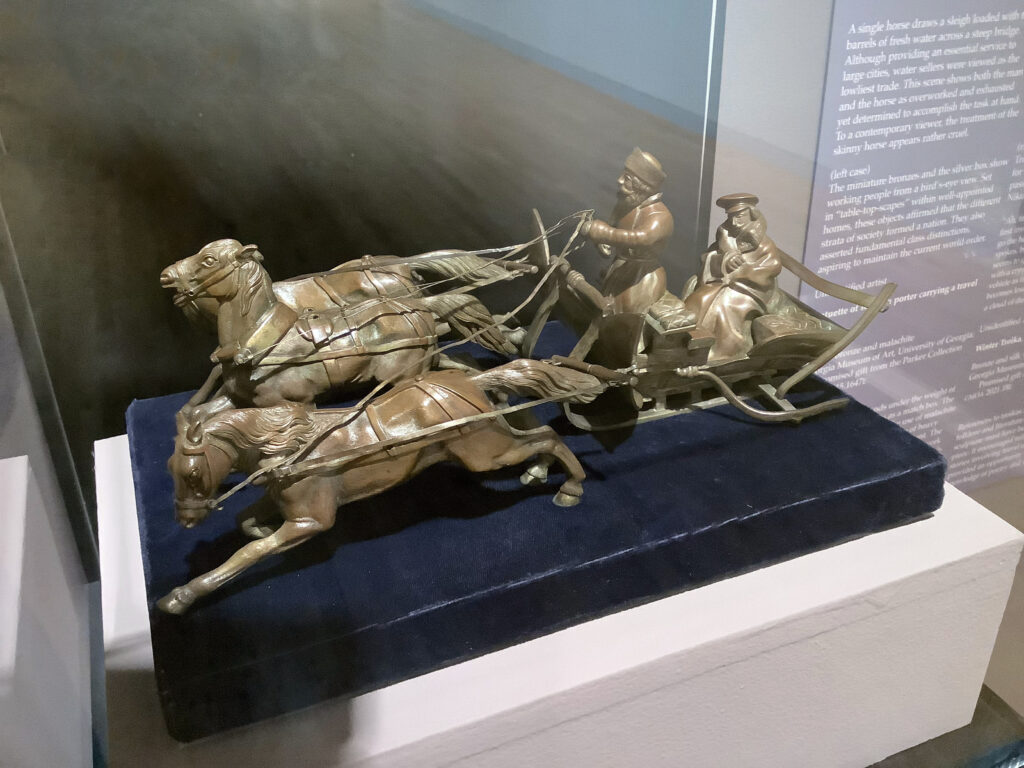 (top) P. Fernlund/Petr Petrovich Ferlund (active mid-19th century), “Winter Troika,” ca. 1840. Watercolor on lithograph. Georgia Museum of Art, University of Georgia; Promised gift of Marina Belosselsky-Belozersky Kasarda. Acquisition in progress. (bottom) Unidentified artist, “Winter Troika,” ca. 1840. Bronze and silk velvet. Georgia Museum of Art, University of Georgia; Promised gift from the Parker Collection. GMOA 2021.18E.
This print and sculpture show troikas. A troika is a high-speed sleigh drawn by three horses. This kind of sleigh is a popular symbol of Russia. It could travel fast over the thick snow that covered roads.
Troikas used a special breed of horses called Orlov Trotters. They were known for their impressive speed and stamina. Horses and drivers had to train for a long time to master the skills to operate a troika.
Compare these two works of art. Write down three differences you see and three similarities.
Keepsake Box
This box was made to hold something special. Look closely at the details on the box, including the image on the outside. Now it is your turn to decorate a box however you choose.
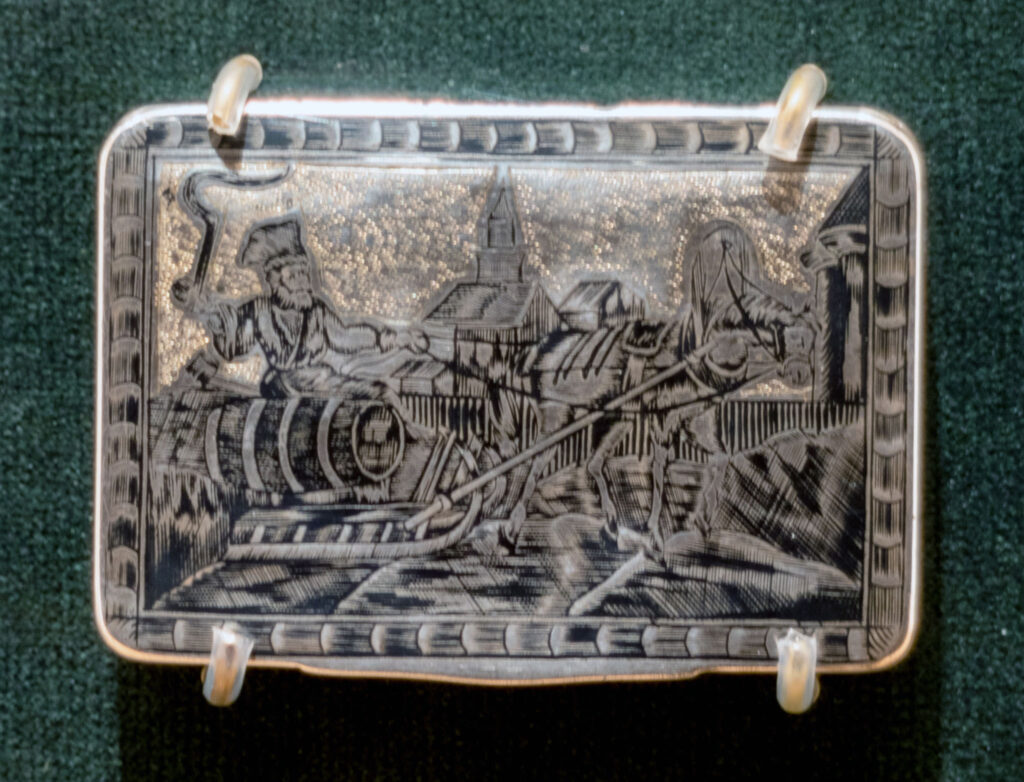 Osip Balanov and Nikita Dens’ev (Moscow), snuffbox, 1838. Silver, silver gilt and niello. Georgia Museum of Art, University of Georgia; Gift of Marina Belosselsky-Belozersky Kasarda. GMOA 2018.260.
You’ll need the following supplies:
- wooden box
- tissue paper
- Mod Podge glue
- paint brush
- silver marker
- scissors
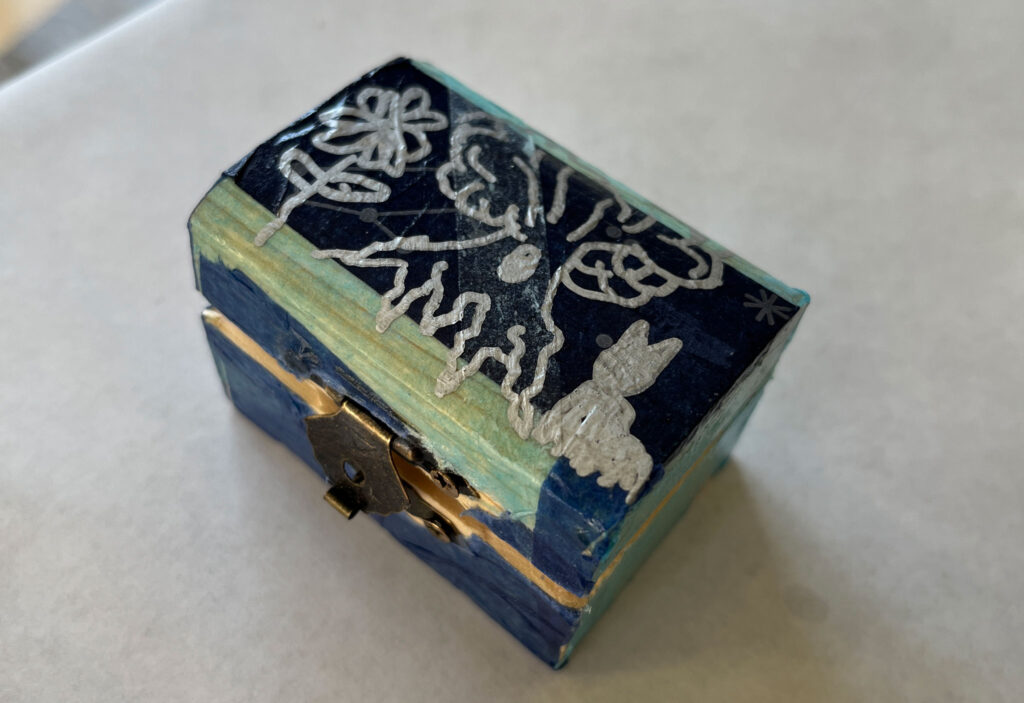
- Use your brush to cover one side of the box with glue. Place a layer of tissue paper over the glue.
- Repeat step 1 until all sides of your box are covered with tissue paper.
- Completely cover all of the tissue paper with a top coat of glue to seal it.
- Let the glue dry. The glue is dry when it is clear and glossy.
- Decorate your box using the marker. Draw your favorite person, thing, shapes or patterns.
- Step back and admire your special box. What will you keep inside of it?
TIP: Layer shapes of tissue paper and glue to create designs with the paper.
We’d love your feedback! Please take a few minutes to complete a survey about this program.
Family Day art kits are sponsored by Lucy and Buddy Allen and the Friends of the Georgia Museum of Art.