

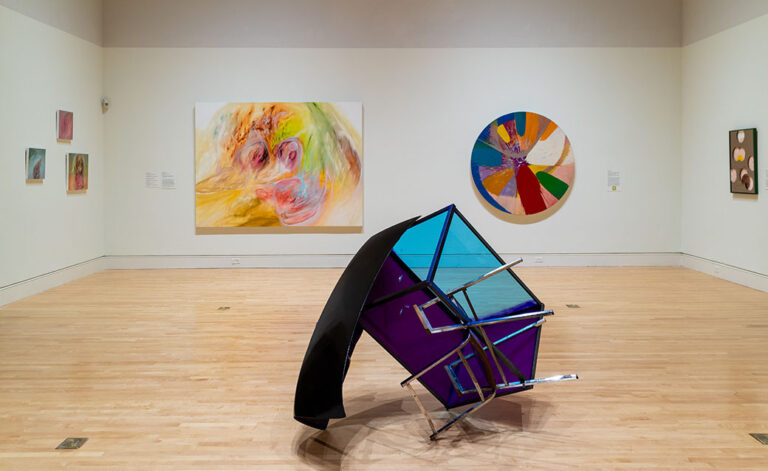
At the end of 2019, art collectors John and Sara Shlesinger gave 110 works of art to the Georgia Museum of Art. Most of this art is contemporary, meaning artists made it in the recent past. The artists come from all over the world.
Abstract art does not try to show things that are recognizable like people, objects or landscapes. Instead artists use shapes, colors, forms and marks to make something no one has ever seen before. Modern artists created innovative abstract art through the 1960s. Now contemporary artists are exploring abstraction again. This exhibition showcases a range of abstract art made by contemporary artists in the last 25 years.
This guide takes a closer look at two works of art from this exhibition. See “Neo-Abstraction: Celebrating a Gift of Contemporary Art from John and Sara Shlesinger” in person through December 5.
Close Looking: “Beautiful ….painting”
Take a moment to look at this work of art. What do you see?
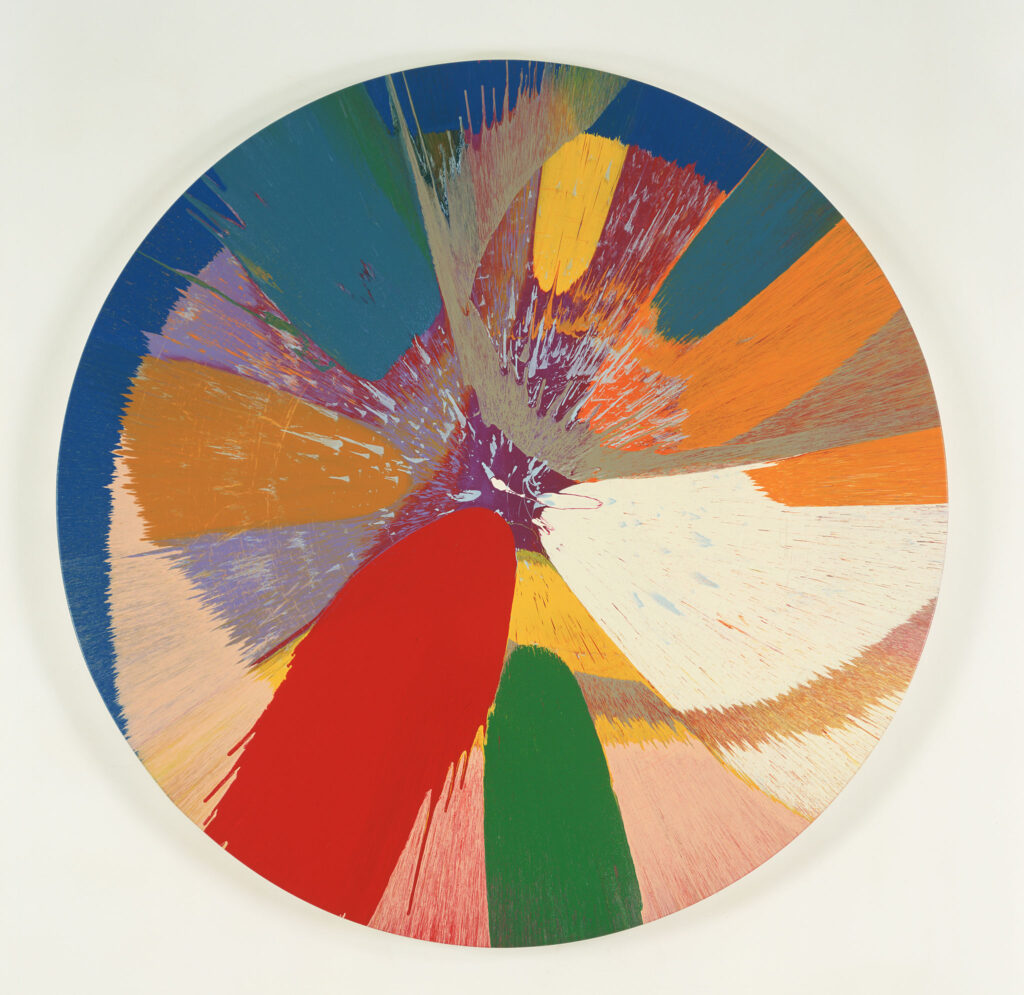 Damien Hirst (British, b. 1965), “Beautiful primary, childish, pale blue, sneezing pepper painting,” 1998. Gloss household paint on canvas. Georgia Museum of Art, University of Georgia; The John and Sara Shlesinger Collection. GMOA 2019.416.
Damien Hirst discovered spin art when he was 9 years old. He loved the way the spin art machines splashed paint across a flat, spinning surface.
As a grown-up, he made brightly colored spin paintings with long titles. The titles all begin with the word “beautiful” and end in “painting.” Take a look at the title of this spin painting and the one pictured on page four. What do you think of these titles? Do they do a good job describing the paintings?
Hirst worked with Snapchat on a filter that lets users create their own spin paintings. Open the app and scan this code to create your own.
Close Looking: “Coexist”
Look closely at this sculpture. What do you notice first?
The artist, Sarah Braman, uses everyday objects in her art. She combines junkyard scraps of metal with translucent color. Do the colors remind you of stained glass?
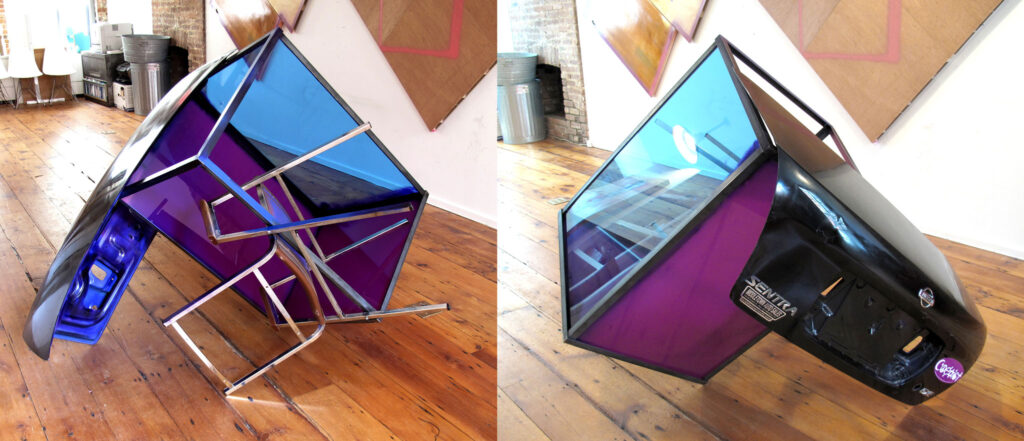 Sarah Braman (American, b. 1970), “Coexist,” 2010. Found car parts, plexiglass, paint and found chair. Georgia Museum of Art, University of Georgia; The John and Sara Shlesinger Collection. GMOA 2019.365.
In this sculpture a chair and car parts are connected together to create a new object. The work’s title, “Coexist,” comes from the bumper sticker on the car. This term is a call for unity among people. Does this sculpture show unity? Why or why not? What do you think coexisting means? Is it important?
Spin Art
Spin art is the result of centrifugal force, which moves wet paint away from the center point. When the canvas or paper is spinning, paint spreads outward. The results are unpredictable. Now it is your turn to make something unexpected and exciting.
 Damien Hirst, “Beautiful ray of sunshine on a rainy day painting,” 1992. Photographed by Prudence Cuming Associates © Damien Hirst and Science Ltd.
You’ll need the following supplies:
- round pieces of cardboard
- different paint colors (nontoxic and water based)
- pipettes or eyedroppers
- clothes that can get messy
- open outdoor space
To make your spin art:
- Put on clothes that can get paint on them. Find an open outdoor space like a backyard or a park.
- Open your paint. Place your pipettes or eyedroppers within reach.
- Using a different pipette for each color, drop paint onto a cardboard round. Make different shapes like lines or dots. Vary the amount of paint you use.
- When you are ready, throw the cardboard round like a frisbee. Make sure to throw it away from yourself and others. Be prepared for flying paint and the unexpected! What do you think of your first experiment with spin art?
- Make some more.
- Lay flat to dry. Make up titles for them using Hirst’s formula of starting with the word “beautiful” and ending with the word “painting.”
TIP: You can also use a salad spinner to make spin art. Place your cardboard round inside the spinner. Drop paint on the cardboard. Cover and spin using the salad spinner top.
We’d love your feedback! Please take a few minutes to complete a survey about this program.
Family Day art kits are sponsored by Lucy and Buddy Allen and the Friends of the Georgia Museum of Art.