


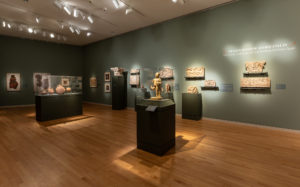
The exhibition “Modernism Foretold: The Nadler Collection of Late Antique Art from Egypt” is on view until September 26. It includes 56 objects from the 2nd to the 10th century CE. That means some objects in the exhibition are almost 2,000 years old.
The people who made and used them had jobs and families. These objects help us understand more about those people who were alive a long time ago.
What are some of your objects that people might like to study 2,000 years from now? What would those objects say about you? Or the society you are a part of?
Close Looking
Take a moment to look at this work of art. What do you see?
 Hunter and prey, ca. 4th – 6th century CE (?). Limestone relief fragment; architectural element, perhaps from Oxyrhynchus. The Nadler Collection.
This carving, or relief, shows a hunting scene. If you look closely you can see a person holding a bow and arrow. What other details can you find?
What is the hunter shooting at? It might be a wolf. The animal rears up. Its head twists back and it opens its mouth. Scenes like this one that show humans or other animals attacking animals make us think about triumphing over challenges.
Nature scenes with plants and animals were also common during this time. Nature was a popular topic because land is a form of wealth.
Everyday Objects
Half of this exhibition includes works of art made for funerals and Christian churches. The other half includes objects that people had in their homes and used for everyday life. These two objects would have been in people’s homes.
 Bust of a woman, ca. 7th – 10th century CE. Tapestry weave in polychrome wool on linen. The Nadler Collection.
The weaving, or tapestry, shows a woman. The part that you can see here is from a larger work of art that would have hung on a wall. Tapestries were expensive and people displayed them to show off their wealth?
 Round vessel, 5th – 7th century CE. Red clay with polychrome slip. The Nadler Collection.
The round vase is an example of pottery. Pottery is made by shaping wet, flexible clay into a container. When the clay dries it is fired, or heated in fire to harden it.
Animal Relief Carving
People all around the world have used relief carving to make sculptures for thousands of years. Artists start with a flat base, usually wood or stone, and carve away material until a final design stands out against the background. This piece of sculpture once decorated the exterior of a building. It is from the top, or capital, of a pilaster. A pilaster is a rectangular building support that looks like a flattened column.
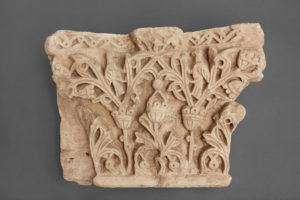 Pilaster capital with two birds, ca. 6th century CE. Limestone, 16 1/4 × 23 × 8 inches. The Nadler Collection.
You will need the following supplies included in the art kit (or found at home).
- soap (a soft soap like Ivory works well)
- paper
- pencil
- scissors
- carving tools (a butter knife, a paper clip, a toothpick)
- newspaper or kraft paper
Directions:
- Spread out newspaper or kraft paper for easy cleanup.
- Using pencil and paper, trace around the bar of soap to make a rectangle on the paper.
- Decide what kind of animal you want to carve out of the soap. Draw it inside the rectangle on the paper so you know it will fit on the soap.
- Cut out the drawing of your animal. Place the animal shape on top of your soap. Trace around the shape with a carving tool.
- To make a relief, scrape away a layer of soap around the animal. To make a sculpture, cut off all the soap around the animal. (The curved end of a paper clip works well to scrape soap off.)
- Add details using pointed tools. Smooth the surface using flat tools. When you are finished, brush off your sculpture and clean up all the scraps.