


About This Exhibition
This exhibition focuses on prints by Indigenous artists. Indigenous means the original or earliest known inhabitants of an area. The exhibition particularly highlights the work of Cherokee, Muscogee (Creek) and Yuchi artists. These tribes were the original stewards of the land and water of northeast Georgia and surrounding areas.
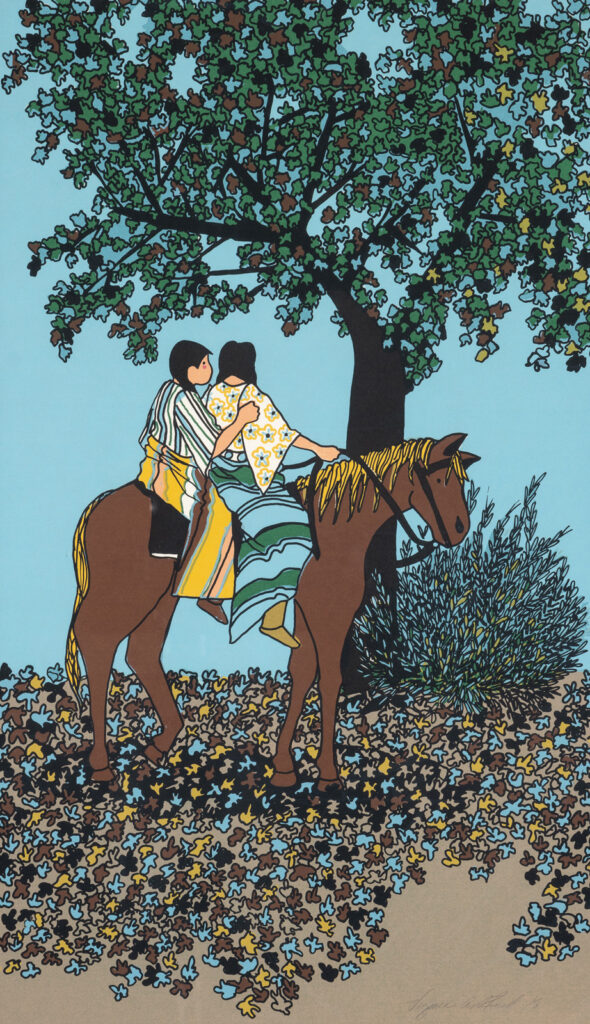
Virginia A. Stroud (Cherokee/Muscogee (Creek), b. 1951), “Children on Horseback,” n.d. Serigraph. Fred Jones Jr. Museum of Art, The University of Oklahoma Norman; The James T. Bialac Native American Art Collection, 2010, 2010.023.1932
Look for different kinds of prints as you explore “Collective Impressions: Modern Native American Printmakers.” Monoprints, lithographs and linocuts are examples of prints. They are all made by transferring an image from one surface to another.
Virginia A. Stroud said, “I paint for my people. Art is a way for our culture to survive . . . perhaps the only way. More than anything, I want to become an orator, to share with others the oldest Indian traditions.” Traditions are customs or beliefs passed from one generation to the next. When you look at the art in this exhibition, what can you discover about traditions and expressing oneself?
Sound Print
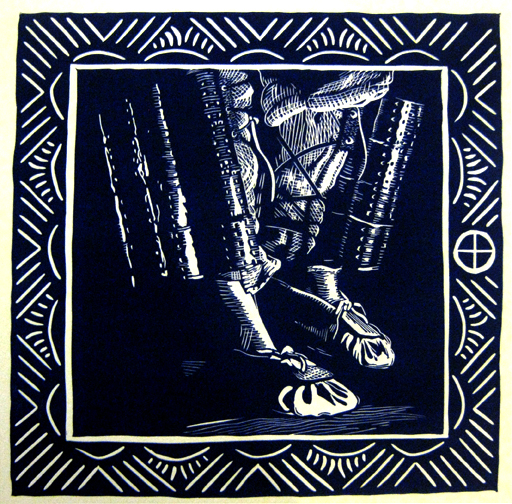 America Meredith (Cherokee Nation, b. 1972), “Stomp Dance,” 2010. Oil-based ink linoleum block print on paper, 13 × 12 1/2 inches. Collection of the artist.
America Meredith honors her Cherokee heritage by showing a pair of feet participating in a stomp dance. At stomp dances, men sing and women produce rhythm and percussion with their leg shackles. In this activity, you will listen to the sounds of a stomp dance and design a print inspired by what you hear.
You will need the following supplies:
- styrofoam plates
- ballpoint pen
- paper
- foam paintbrush
- paint
- newspaper or kraft paper
- music available here
Directions:
- Lay out newspaper or kraft paper on your work surface for easy clean-up.
- Listen closely to the music of a stomp dance. What sounds do you hear? Are the sounds smooth and flowing or short and choppy?
- Draw lines, shapes and patterns on a styrofoam plate to capture what you hear.
- Carefully go over the lines of your design once you are finished to make them deep enough.
- Use the foam paintbrush to apply a light layer of paint across your plate.
- Flip your plate over and press it paint-side down onto your paper.
- Rub the back of the plate firmly to transfer the paint onto the paper.
- Peel the plate off your paper. Now you have a print!
TIP: If the print is not as clear as you want, try using more or less paint, or wash off your plate and go over the lines again with the pen to make them deeper.