


Family Day this month focuses on the exhibition “Graphic Eloquence: American Modernism on Paper from the Collection of Michael T. Ricker.” This exhibition highlights many different kinds of works of art on paper.
Modernism was a movement that happened around the world after World War I. Modern artists experimented with new materials and techniques. They wanted to create art that reflected the realities and hopes of modern societies.
Modern Marvel

Hananiah Harari (American, 1912 – 2000), untitled, ca. 1935 – 40. Gouache on artist’s board. Georgia Museum of Art, University of Georgia; Promised gift of Michael T. Ricker.
Hananiah Harari made this painting of the Brooklyn Bridge while living in New York City.
The Brooklyn Bridge was designed by John Roebling. Roebling was a civil engineer from Germany who designed and built many of the biggest and most beautiful bridges of the time. An engineering marvel, the Brooklyn Bridge was both the longest bridge and the tallest structure in North America when it was built. The bridge officially opened in 1883, spanning over 1,500 feet to connect Manhattan with Brooklyn across the East River.
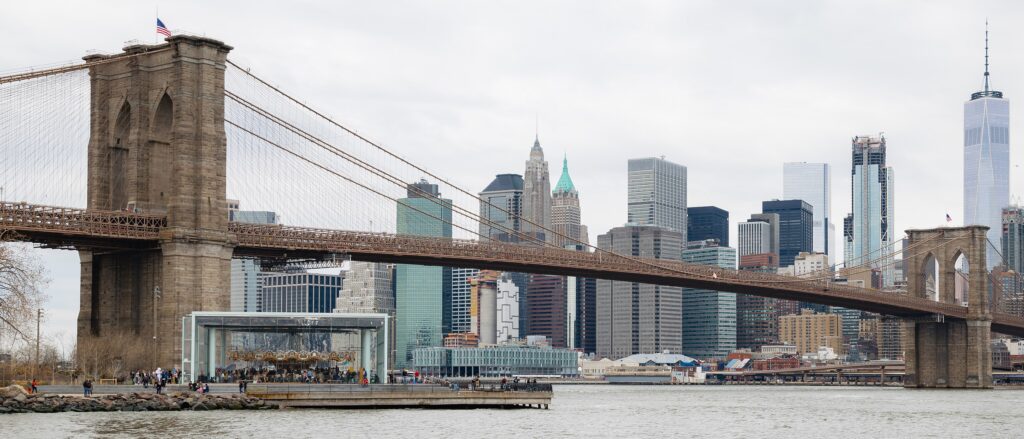
Credit: Kai Pilger
Imagine you have been hired to design a bridge to connect two cities on either side of a river. Download and print this sketch and draw your design in the space.

Modern Watercolors

Lloyd Raymond Ney (American, 1893 – 1964), “Composition,” 1939. Watercolor, ink, and graphite. Georgia Museum of Art, University of Georgia; Promised gift of Michael T. Ricker.
This work of art captures an exciting array of shapes and colors. Notice the shapes of different sizes and shapes within shapes. How many colors can you find? Now it is your turn to cover your paper with shapes and color!

You’ll need the following supplies:
- watercolor paper
- smudge-proof ink pen
- watercolor paint
- paintbrush
- water
Directions:
- Use the ink pen to draw or trace different sizes of shapes on your paper.
- Continue to add shapes until the paper is covered.
- Wet your brush and the watercolor paints. Fill in the shapes with your favorite colors.
- Look at Ney’s painting for ideas on how to color your shapes within shapes.
- Notice the space around the shapes. Color that in as well.
- When the first painting is finished, make another one!
TIP: Use more water to make the watercolor more translucent. Use less water to make the watercolor more opaque.
We’d love your feedback! Please take a few minutes to complete a survey about this program.
Family Day art kits are sponsored by Lucy and Buddy Allen and the Friends of the Georgia Museum of Art.